What’s actually slowing this PC down?
Pick the symptom - the matching free tool is one click away.
Customer loyalty matters because repeat customer relationships can support retention, customer lifetime value, stronger brand relationships and growth. Loyalty programs are one common way companies try to encourage those outcomes, but a program existing does not prove that loyalty has been created, and it does not prove that the program is profitable. The sections below cover the business case, what customers say they value, the evidence on spending, and how to measure whether loyalty is actually working.
What loyalty means in business terms
Loyalty is a pattern of repeat choice: a customer keeps coming back to the same company instead of treating each purchase as a fresh comparison. It is broader than a points balance or a discount code. A loyalty program is one mechanism a business can use to build that pattern, and it can work only if the value it offers is relevant to customers. Poor value, complicated rules or frustrating redemption can erode the relationship a program was meant to strengthen.
As an Amazon Associate I earn from qualifying purchases.
The surveys cited in this article were published during 2024, so they describe customer and corporate attitudes at that time rather than current benchmarks.
Why retention and relationships sit at the centre of the business case
When companies explain why they run loyalty programs, retention and relationship-building come first. In the 2024 EY Loyalty Market Study, corporate respondents gave the following reasons for offering a program:
#1 Best Overall
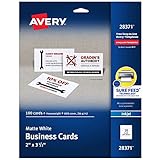
- Quality Cardstock: Crafted from white cardstock paper for printer, these custom business cards offer professional quality, making your business cards easily customizable and personal
- Sure Feed Technology: Get a reliable output for your blank business cards, Sure Feed Technology technology that reduces tmisalignments and jams so every detail is correctly printed on your custom cards
- Smooth, Clean Edges: With multiple precise cuts, these white cardstock business cards provide clean, smooth edges for easy separation, so your custom business cards maintain a professional appearance
- Customization: Use Avery business cards templates to design and print business cards that can be customized at home using card paper with an inkjet printer
- Crisp, Smudge-Free Printing: Compatible with inkjet printers, the white cardstock paper delivers crisp, smudge-free prints for business cards, allowing you to customize your designs on both sides
| Stated reason for offering a loyalty program | Share of corporate respondents | Source |
|---|---|---|
| Improving brand relationships with target customers or customer groups | 46% | EY, 2024 |
| Increasing customer retention | 44% | EY, 2024 |
| Acquiring new customers | 36% | EY, 2024 |
| Increasing customer margin or customer lifetime value | 35% | EY, 2024 |
The logic behind these answers is straightforward. A customer who keeps buying spreads the cost of winning them over many transactions, and a stable relationship makes future spending more predictable. These figures, however, describe the reasons companies give for running programs. They are not measurements of outcomes that programs have produced.
What customers say they want from a program
Consumer surveys point to value and convenience as the main priorities. Deloitte’s 2024 consumer research, published as “Consumer Loyalty Program Trends,” reported the following:
- 86% rated financial rewards and simplicity or ease of use as important or very important.
- About four in five valued flexibility in how they earn and redeem rewards.
- 60% were satisfied with the customized and targeted experiences currently offered to them.
The last figure matters. Personalization is a common program goal, yet the survey suggests a sizeable share of customers are not yet satisfied with what they receive. That gap is a design opportunity, not a reason to abandon personalization.
The Tool Desk
Outbyte Driver Updater FREEScan for outdated or missing drivers - takes under a minuteDriver Scan →Outbyte PC Repair FREERepair Windows errors before they cause bigger problemsFix Now →Rank #2

- Printable cardstock lets you design and print your own personalized business cards
- Our most premium business cards feature Clean Edge(R) technology so that cards snap apart easily and leave behind the smoothest cleanest edges of any printable business card available
- Optimized for inkjet printers for jam & smudge-free performance guaranteed. Add crisp text and vibrant images to both sides of the professional business cards.
- Personalize your white business card with your own design or choose from thousands of free templates and designs on the Avery site
- Ideal for professional-quality printable business cards gift cards gift tags coupons or customer loyalty cards; use the back for photos maps and notes
Restaurant and food-service evidence
The National Restaurant Association’s April 9, 2024 report, “Get with the program: Building loyalty grows business,” surveyed loyalty program customers in the restaurant sector. Among them, 96% said programs were a good way to get more “bang for their buck,” and 52% said they participate in restaurant, coffee shop, snack-place or deli loyalty programs. These figures describe restaurant-sector customers only and should not be read as an estimate for consumers in general.
Does loyalty increase spending? Two survey signals
Two 2024 surveys asked consumers whether their loyalty program memberships changed how much they spend. Their results are measured differently and should be read separately:
- Coresight Research (US retail, March 2024 survey; report dated April 16, 2024): a net 39.5% of surveyed US consumers said they had spent more with a brand or retailer since joining its loyalty program.
- EY (2024 Loyalty Market Study, reported December 20, 2024): 58% of consumer respondents said loyalty programs had increased their spending to a moderate or great extent.
Both results are self-reported. Customers who say they spend more are describing their own perception, and neither survey isolates what those same customers would have spent without the program. They are useful evidence that many members believe their membership changes their behaviour. They are not evidence of a causal lift that a business can expect to repeat.
Rank #3

- Suited to your single printing needs
- Get rid of sub-contractors deadlines; Print on demand based on your requirements and immediately replace any lost or stolen card
- Your badges are printed in high resolution on a quality plastic card; Moreover, the online template library offers professional-looking designs to choose from
- Brand Name - Badgy
Why loyalty is hard to prove: measurement
Showing that loyalty is valuable is harder than believing it is. In the EY study, 41% of corporate loyalty leader respondents reported challenges quantifying the overall impact of their program. Gartner analyst Brad Jashinsky, Director Analyst, described a common problem in a June 5, 2024 interview, “The Profitable Loyalty Program Equation: Balancing Rewards and Revenue”:
“Teams often make mistakes in their measurement by grabbing onto simple statistics, ignoring costs or focusing on the wrong metrics altogether – these can overvalue the contribution of the loyalty program and limit its long-term success.”
Several measurement errors tend to flatter a program’s apparent value:
Rank #4
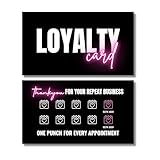
- PREMIUM DESIGN: Modern profesional cards that are full color, high gloss front and back printed on 14 point thick cardstock.
- REWARD SYSTEM: Simple punch card system where each visit earns one punch, with rewards given after collecting 5 punches
- FLEXIBILITY: You can decide what reward you want to offer, giving you flexibility to support your business goals and to maintain high profits.
- WHAT YOU GET: 55 business card sized loyalty cards. Size is 3.5 inches x 2 inches
- SMALL BUSINESS: Thank you for support a female owned small business
- Counting purchases that would have happened anyway. A member who buys at the usual rate and receives a discount has cost the business money without changing behaviour.
- Ignoring reward expense and operating cost. Points, discounts, platform fees and staff time all reduce what the program actually contributes.
- Ignoring fraud risk. Abuse of earning or redemption rules is a cost that headline metrics usually do not show.
- Relying on membership or redemption counts. Large member numbers or heavy redemption can coexist with weak or negative profitability.
Design trade-offs to weigh
Loyalty programs involve choices along four axes. The cited research supports discussing these trade-offs, but it does not identify one best program format, and it does not establish a single return figure that applies across industries.
| Axis | One design direction | Another design direction | What to watch |
|---|---|---|---|
| Customer value | Financial rewards and savings | Relevant services, access, recognition or experiences | Whether the reward is relevant enough to change behaviour, and what it costs |
| Convenience | Easy enrollment, clear rules and flexible earning and redemption | Complex restrictions and narrow redemption options | Flexibility can raise cost and make liability harder to predict |
| Business economics | Retention, spending and customer lifetime value | Reward expense, operating cost, discounts on purchases that would have happened anyway and fraud | Whether gains exceed the full cost of the program |
| Measurement | Incremental outcomes and profitability | Participation and redemption counts | Counts can show activity but not causal impact |
How to check whether your loyalty effort is working
A practical check does not require a formal study, but it does require comparing members with a reasonable baseline. The steps below follow the measurement concerns raised in the sources above:
Do these 3 things before closing this tab:
1Repair Windows errors before they cause bigger problems2Fix the driver behind crashes, sound loss and screen glitches3Clear out junk files and repair common Windows errors- Define the outcome first. Choose measures such as retention rate, repeat purchase rate, spend per customer and margin per customer, rather than enrollment alone.
- Build a comparison group. Compare members with similar non-members, or hold back a randomly chosen group from a new offer where that is practical, so you can separate the program’s effect from customers who would have stayed or bought anyway.
- Subtract every cost. Net out reward expense, discounts, platform and staffing costs, and fraud losses before calling a result a gain.
- Test relevance with customers. Ask whether rewards feel worth the effort and whether earning and redemption are easy, since the surveys above show these are the attributes customers weigh most.
- Re-measure after each rule change. A change to reward values, earning rates or redemption limits can shift both spending and costs, so compare results before and after the change.
When a program produces strong participation but flat retention or weak margin, the problem is usually in the design or the measurement, not in the idea of loyalty itself.
The Bottom Line
Customer loyalty is important because repeat relationships can support retention, lifetime value and growth. A loyalty program is one tool for building that relationship, and it earns its place only when the value it delivers to customers exceeds its full cost, as measured against a fair comparison.
Quick Recap
Product prices and availability are accurate as of the date/time indicated and are subject to change. Any price and availability information displayed on Amazon at the time of purchase will apply.




