Humanoid robots make practical sense when a job happens in places already built for people: aisles, stairs, workstations and tools that a human worker can navigate. Their human-like form may let them move between tasks without rebuilding a facility around a specialized machine. That is a potential advantage, not proof that humanoids are cheaper or better. Today’s pilots focus on structured, repeatable work—not the all-purpose autonomy Hollywood portrays.
Why build a robot in a human shape?
The strongest case is compatibility with human-designed environments. Factories, warehouses and service sites already have doors, stairs, aisles, work surfaces and controls laid out for people. A robot with a human-scale body and the ability to move and manipulate objects could work in some of those spaces with fewer infrastructure changes than a fixed machine would require.
As an Amazon Associate I earn from qualifying purchases.
International Federation of Robotics (IFR) President Takayuki Ito described the rationale in August 2025: “Since our environment is optimized for the human body the demand for a quick, universal helper to maintain manufacturing and services is evident.” He also cautioned that the timing of mass adoption remains uncertain and that humanoids are expected to complement, not replace, existing robot types. IFR’s statement on its ‘Vision and Reality’ paper frames the form as a possible addition to automation, not a universal upgrade.
This advantage depends on the work and the location. Human-compatible access is useful only if the robot can perform the task safely and reliably; a wheeled platform, cobot or purpose-built machine may be simpler and more capable for a stable, repetitive job.
#1 Best Overall

- 【Humanoid Robot with ESP32】 Powered by ESP32 and 17 intelligent servos, Tonybot smart humanoid robot delivers smooth, dynamic performance. Use the app to easily control it for walking, dancing, kicking, and more. Tonybot can stand up automatically, which is great for playing football and performing gymnastics.
- 【Multimodal Large AI Models】Powered by an AI model module that combines language, voice, and vision models, Tonybot Ultimate Kit unlocks advanced embodied AI functions such as natural conversation and scene understanding. (Ultimate Kit Only)
- 【AI Vision & Voice Interaction】Equipped with an ESP32-S3 vision module and voice interaction module, Tonybot AI robot enables offline face recognition, target tracking, visual line following, voice control, and more. Customize commands and train it to be your AI assistant.
- 【Expandable AI Development with Sensors】 Tonybot robot kit comes with an ultrasonic sensor, IMU sensor, buzzer, and supports modules like dot matrix display, fan, temp/humidity sensors, and WiFi for endless AI-driven development.
- 【3 Programming Options & Comprehensive Tutorials】Tonybot smart AI robot supports Arduino, Python, and Scratch programming, with open-source low-level code and step-by-step tutorials covering everything from beginner learning to advanced humanoid robot development.
What humanoid robots are doing now
Early commercial activity is concentrated in structured settings and bounded tasks, rather than open-ended work. McKinsey’s October 2025 review describes pilots involving component movement inside BMW factories with Figure AI, production-line material transport with Mercedes-Benz and Apptronik’s Apollo, and tote movement by Agility Robotics’ Digit in semisegregated Amazon warehouse zones. It also describes inspection and monitoring in hazardous industrial environments. These examples show potential in known routes, basic handling and situations where human infrastructure or exposure to hazards matters; a pilot does not demonstrate broad commercial viability. McKinsey’s review says the gap between demonstrations and reliable, economically justifiable performance at scale remains wide.
Gartner’s January 2026 outlook projects that fewer than 100 companies will move humanoid proof-of-concept projects beyond experimentation through 2028, and fewer than 20 will reach production for manufacturing and supply-chain use cases. Gartner expects most deployments in that period to remain tightly controlled. These are forecasts, not counts of completed deployments. Gartner’s forecast puts current interest in perspective: the technology is being explored, but large-scale production use remains limited.
What Hollywood gets wrong
Screen depictions often suggest a machine that can fluidly understand and perform almost any human task. Current deployments instead center on known work in controlled or structured settings. General-purpose capability across unpredictable environments is not established, and safety, cost, integration and performance remain substantial challenges. IFR says mass adoption as universal household helpers may not happen in the near or medium term.
Free tools Windows power users keep installed
One-click scans. No signup required.
Rank #2
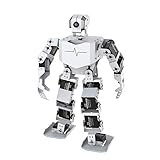
- Al-Driven & Raspberry Pi Powered. TonyPi is a high-performance AI vision robot designed for AI education applications. It is powered by the Raspberry Pi 5, integrated with an OpenCV image processing library and robotic inverse kinematics algorithms. Offering open-source access, TonyPi provides a flexible development environment that supports advanced AI robotics development.
- AI Large Model ChatGPT Integration for Enhanced User-Machine Interaction. TonyPi incorporates a multimodal model, with ChatGPT at the core of its interaction system. With AI vision and voice integration, TonyPi excels in perception, reasoning, and action, enabling advanced embodied AI applications and delivering a seamless, intuitive human-machine interaction experience!
- AI Voice Command & Recognition. Equipped with Large Language Models, TonyPi accurately understands voice commands, analyzes visual scenes in its field of view, and carries out appropriate actions—enabling smooth and responsive voice interaction.
- AI Vision Recognition and Tracking. TonyPi's 2DOF head is fitted with an HD camera that provides a wide field of view. It supports a range of AI vision capabilities, including color recognition, target tracking, ball kicking, line following, and MediaPipe-based motion control for interactive AI applications.
- Comprehensive Learning Resources. TonyPi offers abundant educational content, including resources on robotic motion control, OpenCV, deep learning, MediaPipe, AI large models, voice interaction, and sensor applications. We provide extensive learning materials and tutorials to guide you from foundational concepts to advanced practices, helping you develop your AI humanoid robot.
A human-like body is not automatically the best design just because a facility was built for people. Gartner notes that wheeled polyfunctional robots can be more efficient for supply-chain operations, and advises organizations not to postpone investment in available smart robots for predictable, high-volume tasks while waiting for humanoids. The useful question is whether a humanoid’s form solves a real site-specific constraint better than a less complex alternative.
How to compare a humanoid with other automation
Evaluate the robot against a fixed industrial robot, autonomous mobile robot, collaborative robot (cobot) or wheeled polyfunctional machine for the same job. Compare the whole application rather than the appearance or a single demonstration.
| Evaluation area | What to establish |
|---|---|
| Task fit and adaptability | Does the job involve varied objects or switching among activities, or is it stable and repetitive? Complexity and variety may favor flexibility; predictable volume often favors task-specific automation. |
| Environment fit | Are stairs, narrow passages, human-sized controls or existing workstations genuine barriers for other robot types? Count the infrastructure changes each option needs. |
| Throughput and uptime | Can the system meet the required work rate and operate for the intended shifts? Gartner says current humanoids can lag task-specific robots on warehouse throughput and uptime. |
| Safety | Can it work near people with dependable sensing, collision mitigation and predictable behavior? Some pilots use semisegregated zones rather than unrestricted shared spaces. |
| Energy and charging | Measure runtime in the actual work pattern, including standing, walking and carrying loads—not just an idle or stationary condition. |
| Total cost and integration | Include purchase, maintenance, charging, software, safety measures, workflow integration and site changes. Compare them with measurable benefits; upfront and maintenance costs are high and returns uncertain, according to Gartner. |
For a concrete assessment, Fraunhofer IPA’s benchmark approach examines basic technologies and capabilities, complex tasks, cleanroom suitability, functional safety, cybersecurity and energy efficiency. That kind of application-specific evaluation helps distinguish a convincing demonstration from readiness for a particular site. Fraunhofer IPA’s humanoid-robot analyses also illustrate why appearance alone says little about deployment readiness.
Rank #3
- 【Humanoid Robot with ESP32】 Powered by ESP32 and 17 intelligent servos, Tonybot smart humanoid robot delivers smooth, dynamic performance. Use the app to easily control it for walking, dancing, kicking, and more. Tonybot can stand up automatically, which is great for playing football and performing gymnastics.
- 【Multimodal Large AI Models】Powered by an AI model module that combines language, voice, and vision models, Tonybot Ultimate Kit unlocks advanced embodied AI functions such as natural conversation and scene understanding. (Ultimate Kit Only)
- 【AI Vision & Voice Interaction】Equipped with an ESP32-S3 vision module and voice interaction module, Tonybot AI robot enables offline face recognition, target tracking, visual line following, voice control, and more. Customize commands and train it to be your AI assistant.
- 【Expandable AI Development with Sensors】 Tonybot robot kit comes with an ultrasonic sensor, IMU sensor, buzzer, and supports modules like dot matrix display, fan, temp/humidity sensors, and WiFi for endless AI-driven development.
- 【3 Programming Options & Comprehensive Tutorials】Tonybot smart AI robot supports Arduino, Python, and Scratch programming, with open-source low-level code and step-by-step tutorials covering everything from beginner learning to advanced humanoid robot development.
What current tests reveal about practical limits
Performance and safety findings should be read as configuration-specific, not generalized to every humanoid. In Fraunhofer IPA testing of a Unitree G1 EDU-4 equipped with Dex3-1 three-finger hands, delivered in May 2025 with firmware 1.04, collision force exceeded 500 newtons. The same report measured maximum operating times of 2 hours and 49 minutes while standing still and 1 hour and 49 minutes in a typical standing-and-walking scenario. Fraunhofer notes that the Bluetooth vulnerability it identified was resolved after testing. These results concern that tested configuration only; they are not a general runtime or safety rating for humanoid robots. Fraunhofer IPA’s report provides the test context.
Quick wins for a faster PC:
Fix the driver behind crashes, sound loss and screen glitchesFind Drivers →Repair Windows errors before they cause bigger problemsFix Now →Scan for outdated or missing drivers - takes under a minuteDriver Scan →The figures make clear why a deployment decision requires more than a mobility demonstration. A buyer or operator needs evidence for the intended payload, route, shifts, people nearby, charging plan and failure response. A system that can complete a task once may still fall short on sustained throughput, safe operation or total cost.
Why the humanoid form is a complement, not a replacement
Automation is not a choice between humanoids and every other robot. Fixed industrial robots can excel at repeatable work; mobile robots can move loads through suitable routes; cobots can support defined tasks alongside workers. Humanoids may add value where mobility and manipulation need to coexist in human-oriented spaces, especially when changing the site would be costly or impractical.
That niche remains conditional. If a specialized or wheeled system meets the need with better uptime, throughput, safety or economics, the humanoid’s additional complexity is difficult to justify. The practical case is therefore not that every workplace should adopt a human-shaped robot, but that some work may be easier to automate when the robot can use the environment as it already exists.
Quick Recap
Product prices and availability are accurate as of the date/time indicated and are subject to change. Any price and availability information displayed on Amazon at the time of purchase will apply.
What’s actually slowing this PC down?
Pick the symptom - the matching free tool is one click away.




