CRTs draw pictures with a moving electron beam that scans the screen line by line. That makes the image behave differently from a modern display that holds a complete digital frame: the raster can show horizontal structure, its light output changes as it refreshes, and the display’s own delay is only one part of the time between an input and a visible result.
Why CRTs have scanlines
A CRT forms a raster by sweeping an electron beam horizontally across the screen. The video signal controls brightness as the beam moves. At the end of each line, the beam returns to the left and begins the next; after reaching the bottom, it returns to the top for another frame. Horizontal sync coordinates the start of each line, while vertical sync marks the frame transition. Analog Devices explains the timing and structure of analog video.
As an Amazon Associate I earn from qualifying purchases.
Because the picture is drawn in lines rather than displayed as a uniformly illuminated grid, adjacent rows can look distinct. How visible that structure is depends on the signal mode, image content, and display; it is not equally apparent on every CRT or with every picture.
What’s actually slowing this PC down?
Pick the symptom - the matching free tool is one click away.
Interlaced and progressive signals are different
With progressive scanning, the display draws all lines in a frame in one pass. Interlaced video instead divides a frame into two fields, each drawn in a separate pass. The fields contain alternating lines, so the timing and appearance of the image differ from progressive video. Analog Devices describes interlaced analog video and its fields.
#1 Best Overall

- Bright, clear picture: Bring entertainment to life on our 24" flat screen TV with bright 720p HD—perfect for bedrooms, kitchens, and beyond. Roku Smart Picture cleans up incoming TV signals, optimizes them, and chooses the right picture mode.
- Seamless streaming: With fast Wi-Fi and apps that launch in a snap, Roku Select Series TVs get you to your entertainment quickly. You get excellent picture quality, clear sound, automatic updates, and more. It’s simple to use. Hard to outgrow.
- TV, simplified: With setup that only takes minutes, a simple-to-navigate Home Screen, and an uncluttered remote control that does all you need—Roku makes it easier to watch the TV you love.
- A world of free entertainment: Enjoy a huge selection of free live TV, news, sports, movies, shows, and much more—all just a click away.
- More streaming, less searching: With personalized picks right on your Home Screen, quick access to the sports and entertainment you watch most, and fast and easy search in one place—the days of endless scrolling are over.
That distinction matters when judging line structure or flicker. A description of one mode should not be assumed to apply unchanged to the other.
Why a CRT flickers
The beam illuminates the phosphor as it scans, and the screen’s light output varies as the raster refreshes. A CRT does not keep every point of the image lit at a constant level between scans. Whether that variation is visible depends on the refresh conditions and on viewing circumstances, including display size and the viewer’s sensitivity.
Rank #2
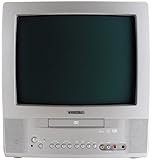
- 13-inch combo TV/DVD player; measures 14.25 x 15 x 14.4 inches (W x H x D)
- Compatibility with DVD movie, CD audio,CD-R/CD-RW, DVD-R, and VCD discs
- JPEG Viewer enables you to create slideshows with digital photos stored on disc
- Digital coaxial audio output connects to your multi-channel audio/video receiver for surround sound content
- Glow-key remote control, icon-based on-screen displays, V-chip, and an auto-clock
The FAA defines display flicker as “the rapid temporal variation in the luminance of a symbol or a group of symbols” in guidance for flight-deck displays. That context is specialized, but the description helps explain why refresh rate alone cannot guarantee that every viewer will perceive a screen as flicker-free. The FAA also notes that flicker may be more noticeable as illumination increases. Read the FAA’s refresh-rate guidance.
Windows Errors? Fix Them Before They Spread
Repair common Windows errors and clear accumulated junk for a smoother, more stable PC - no reinstall needed.Free scan · no reinstallOutdated Drivers Are Slowing You Down
One free scan finds every outdated or missing driver and matches the right update for your exact hardware.Free scan · exact hardware matchA 1987 study by Olov Östberg, Houshang Shahnavaz, and Rikard Stenberg reported that 70 Hz may not be enough to ensure freedom from flicker on large displays. That is a finding about the conditions considered by those researchers, not a universal minimum for CRTs. The study is published in Displays.
Rank #3

- 1:10.1"TV screen is full HD
- 2:Small TV built-in, ATSC tuner to receive your favourite local free-to-air TV programmes
- 3:Main formats compatible with the TV's USB port: AVI, MOV, MPEG 1, MPEG 2, MPEG 3, MPEG4, XVID, AVC, MP4, H.264, HEVC(H.265), FLV, MKV, MP3, JPEG, WMV, RMVB, AVI, MKY, 3GP
- 4:HDMI and AV inputs:This portable TV offers enhanced compatibility with a wide range of devices.Sync up to HD 1080P video from your to this TV via HDMI/AV cable (not included). You can also connect many other devices to this small TV, such as DVD player, TV sticks, Xbox, game consoles,kindle fire, computer, camera,and more
- 5:Package accessories: 10.1inchportable TV, AC adapter, manual, remote control, antenna, car 12v cable
Do CRTs have input lag?
A CRT can have low display latency because the incoming raster controls the beam directly, without the frame buffering that can occur in digitally processing displays. But “zero input lag” is too broad: the picture is scanned rather than appearing everywhere at once, and the time from an input to visible change also depends on the source device, its rendering and synchronization, and any conversion or processing in the signal path.
The scan itself takes time, so changes at different vertical positions do not appear simultaneously. A computer or other digital source may also need digital-to-analog conversion to drive a CRT; that conversion can add delay. Adapters, scaling, and buffering can matter too. As a result, the CRT’s display latency and a complete system’s input-to-screen latency are not interchangeable measurements.
Rank #4

- RCA to HDMI Converter: Converts analog RCA composite (Yellow, White, Red) input to HDMI 720P/1080P output on HDTVs/Monitors. Only support RCA to HDMI. NOT Support HDMI to RCA!
- Plug to Play: AV to HDMI converter doesn't need extra drivers, just plug and play, easy to use. Please hook up the USB power cable (included) to 5V power adapter when using this RCA to HDMI adapter.
- Wide Compatibility: This av hdmi converter supports for all standard TV formats such as PAL, NTSC3.58, NTSC4.43, SECAM, PAL/M, PAL/N. Provide advanced signal processing and make videos come to life.
- Extensive Use: Composite to HDMI converter widely applied to PS2, PS3, Xbox, N64, WII, STB, VHS, VCR, DVD Players and other devices with standard composite AV input.
- Attention & Package: Please ensure to connect this rca to hdmi converter to power source to make it work. Package include: 1x RCA to HDMI Converter, 1* Micro USB cable (adapter not included), 1*User Manual. Please free feel to contact us if you have any product problems.
A 2014 gaze-contingent display study reported a best measured system latency of 12 ms for its fast CRT configuration. That is the result for the researchers’ test setup, not a general specification for CRT monitors or gaming systems. Read the study’s latency measurements and discussion of conversion delay.
The Tool Desk
Outbyte PC Repair FREERepair Windows errors before they cause bigger problemsFix Now →Outbyte Driver Updater FREEFix the driver behind crashes, sound loss and screen glitchesFind Drivers →What to check when comparing CRT setups
Resolution, refresh rate, and scanning limits are related. A CRT monitor has a range of scanning frequencies it can support; a model’s separately stated maximum resolution and maximum refresh rate may not be achievable at the same time. iFixit’s CRT overview explains monitor scanning-frequency constraints.
For a meaningful comparison, check the whole configuration rather than relying on a single specification:
Quick Recap
- Signal mode: establish whether the signal is interlaced or progressive.
- Resolution and refresh together: confirm that the monitor supports the intended combination, not just each maximum listed separately.
- Monitor scanning range: check the display’s scanning-frequency limits for the signal being used.
- Signal chain: identify any scaling, buffering, adapters, or digital-to-analog conversion that could affect latency.
Product prices and availability are accurate as of the date/time indicated and are subject to change. Any price and availability information displayed on Amazon at the time of purchase will apply.




