The Adriatic Sea, Baltic Sea and western Mediterranean Sea are the European waters identified as highest risk for harmful artificial light at night (ALAN) in a new regional assessment. It finds a broad pattern: more enclosed seas tend to face greater exposure risk, while open waters such as Macaronesia, the Barents Sea and the Iceland Sea are among the lowest-risk areas.
How the assessment compares European waters
The framework was developed to help assess Good Environmental Status in relation to artificial light at night in marine waters. It combines light emitted by coastal towns and cities with local water clarity and the depth to which light can penetrate. The assessment scores risk separately for the water column and the seabed, then groups areas into nil, low, medium and high risk categories.
As an Amazon Associate I earn from qualifying purchases.
The University of Plymouth’s 7 October 2026 release says the team used existing information, including a global atlas of nighttime light pollution. The release does not give the full paper’s equations, thresholds, data versions or detailed regional percentages, so the rankings are best read as a regional screening rather than a precise measurement of exposure at every site. (University of Plymouth, 7 October 2026)
Free tools Windows power users keep installed
One-click scans. No signup required.
Which regions are at higher and lower risk?
Highest-risk seas
The assessment names the Adriatic Sea, Baltic Sea and western Mediterranean Sea as Europe’s highest-risk regions. It describes the general tendency for enclosed waters—those bordered by land on several sides—to be more exposed to coastal lighting. This is a regional pattern, not a claim that every location within those seas has the same risk.
#1 Best Overall

- Measures luminosity from 0 to 200,000 Lux and ambient temperature
- High accuracy of ±3% rdg ± 8 dgts (10,000 Lux)
- 4 digital color LCD screen, MIN/Max readings, data hold, auto power off, and low battery indication
- Wide range of application, use lux light meter for set design, factory, office or home use
- lightweight and compact, 2 years long period warranty
Lower-risk examples and UK waters
Macaronesia, the Barents Sea and the Iceland Sea are among the lower-risk examples. Macaronesia includes the Canary Islands, Azores, Madeira and Cape Verde. The UK’s surrounding waters, the Greater North Sea and the Celtic Seas are described as mostly medium to low risk. The release notes an important qualification for the North Sea: oil and gas fields and related infrastructure add light pollution to an otherwise more open-water setting.
The release provides broad regional findings, not exact shares of each sea assigned to each risk category. A detailed comparison of water-column and seabed scores, regional percentages or uncertainty would require the full paper.
Rank #2
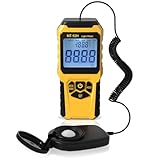
- High-Precision Light Measurement: Delivers accurate readings from 0-200,000 Lux with ±3% accuracy and resolution down to 0.1 Lux. With instant 0.5-second refresh rates, you’ll capture even subtle light changes
- Innovative Split-Sensor Design: Advanced split light sensor technology enables simultaneous measurement and monitoring. The separate probe maintains measurement integrity while allowing flexible positioning
- Dual Measurement Units for Versatile Applications: Seamlessly toggle between Lux/Fc for precise illuminance measurement and ℃/℉ for environmental monitoring - catering to diverse professional needs and international measurement standards with a single button press
- High-Visibility Backlit Display: Features an ultra-bright, with switchable backlight, glare-resistant screen that remains clearly readable in total darkness or direct sunlight
- Compact & Durable Design: Weighing just 188g with a space-saving profile (125×56×30mm), Standard 3xAAA batteries ensure reliable operation in various professional environments
What underwater light exposure can mean
Artificial light reaching the sea can matter below the surface as well as along the coast. A 2020 peer-reviewed study measured light at the surface over Plymouth Sound and the Tamar Estuary, then modeled its movement through the water using local optical properties, bathymetry, tide and cloud conditions. Under cloudy conditions at low-water spring tide, green light crossed the study’s biologically important threshold across 76% of the surveyed three-dimensional seafloor area. That figure applies only to the surveyed area and the authors’ chosen threshold; it is not a Europe-wide estimate. (Davies et al., 2020)
Recommended Free Tools
The study defined its threshold using minimum blue, green and red irradiances that elicit diel vertical migration in Calanus copepods. The authors cautioned that biological sensitivity varies by taxon and that a threshold based on species with measured sensitivities cannot represent every marine organism. A regional risk category therefore should not be treated as proof that a particular ecosystem has crossed a universal biological harm threshold.
Rank #3
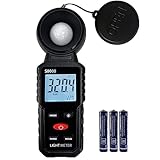
- 【Widely used】S8608 is a digital illuminometer, used for measuring visible brightness, large screen display, wide measuring range, up to 200000LUX, automatic conversion range. Can be widely used in such as schools, hospitals, factories, airports, families and other occasions of brightness measurement.
- Measurement visible brightness, measurement range is wide
- lluminance unit switch,Unit of illuminance:LUX、FC
- Measurement time: S
- MAX/ MIN,Data HOLD,Backlight function
What lighting changes are proposed?
The University of Plymouth release says authorities in heavily affected tourist areas could explore measures intended to limit light entering the sea:
- Shielding: direct light toward the area that needs illumination and away from the water.
- Dimming: reduce brightness where full output is unnecessary.
- Part-night lighting: switch lights off during hours when they are not needed.
- Wavelength choices: consider light spectra that reduce exposure relevant to marine environments.
- Dark spaces: designate dark areas on and around islands as an alternative visitor experience.
These are options suggested in the release, not interventions whose effectiveness was experimentally measured by the regional assessment.
Rank #4

- ✅【High Accuracy】DANOPLUS Light Lux Meter is equipped with high-tech sensor, the accuracy of lux reading is +/-4% +/-10dgts; 400~700nm spectral range
- ✅【Auto Range Setting】This light meter is designed with 4 lux ranges setting, 200/2,000/20,000/200,000, and 0 to 20,000 foot candles(FC) unit Switchable
- ✅【360 Degree Rotating Sensor】DANOPLUS Light Meter is equipped with 360 degree rotating sensor, which separate with the light meter, can adjust suitable position to ensure the accurate measurement
- ✅【Multi-Fuctional】MIN/MAX readings, Data Hold, Auto Power Off&Disable Auto Power Off, Auto Range Selection and Low Battery Indication
- ✅【Wide Application】This compact Light Meter is used for measuring the brightness of visible light (400~700nm spectral range), it's suitable for factories, hospitals, schools, home, office, etc.
What the findings do—and do not—establish
The assessment provides a way to identify European marine regions for closer attention by combining coastal emissions with water conditions and light penetration. It does not, in the public summary, supply the numerical regional shares, category thresholds, input-data versions or uncertainty analysis needed to reproduce detailed comparisons. Its risk categories are screening indicators, not direct measurements of harm to every species.
Policy context also needs a date attached. A 2022 Eionet review reported that there was then no common EU policy regulating light pollution, although some national and regional approaches existed. That historical summary does not establish the current legal position. (Eionet, 2022)
Quick Recap
Best Value

- High Precision & Fast Response: This high-precision illuminance meter delivers lightning-fast readings 2 times per second, ensuring you get accurate light intensity data—perfect for creating the ideal growing environment for your plants.
- FC/LUX Conversion: FC or LUX? The Power is in Your Hands! Effortlessly toggle between FC and LUX to measure light intensity in the unit that suits your gardening needs—precision made simple.
- PEAK Data Recording: Instantly lock in and display the highest light pulse value with a single press of the PEAK button—perfect for measuring lightning, laser beams, and other brief high-intensity sources.
- Low Battery Alert: Stay powered, stay prepared! A handy + - symbol appears when the battery runs low, so you’ll always know when it’s time to swap out the 9V battery and keep your light measurements going strong.
- Versatile Usage: Ready for any setting! Whether indoors or outdoors, this meter is perfect for homes, offices, factories, or measuring sunlight intensity to create the perfect environment for your plants to thrive.
Product prices and availability are accurate as of the date/time indicated and are subject to change. Any price and availability information displayed on Amazon at the time of purchase will apply.




