The most important feature is not a headline specification: it is choosing the right camera category for how you shoot. An action-camera replacement must survive movement and deliver an ultra-wide view, while a handheld gimbal camera is designed for controlled, stabilized footage. After that decision, compare sensor and light performance, lens perspective, required resolution and frame rates, stabilization limits, and storage compatibility.
DJI’s current Osmo Action comparison covers Action 6, Action 5 Pro, and Action 4. The Osmo Pocket line is a different type of camera, with a mechanical three-axis gimbal. Treating those products as interchangeable can lead to a camera that has impressive specifications but the wrong handling or shooting behavior.
As an Amazon Associate I earn from qualifying purchases.
First define what “DJI replacement” means
People use the phrase “DJI replacement” to describe several very different purchases. You might be replacing a rugged action camera, a handheld gimbal camera, or an older camera whose shape and controls you already like. Those categories solve different problems, so start with the way the camera will be held and moved.
Recommended Free Tools
Action-camera replacement
An action camera is built around wide-angle activity capture. It is the natural category for cycling, skiing, motorcycling, hiking, water activities, mounting on equipment, or recording while you move through a scene. Its value comes from a compact body, a broad field of view, and electronic stabilization that can correct movement in recorded footage.
#1 Best Overall

- Pro-Grade Night & Dynamic Imaging - Discover breathtaking imaging quality with Osmo Action 5 Pro action camera 4K and its all-new 1/1.3" sensor. Advanced tech with 2.4 µm large pixels and 13.5-stop dynamic range delivers unmatched low-light performance and clarity.
- Always Centered, Always Focused - Achieve pinpoint accuracy with our advanced 4nm chip. DJI Osmo Action 5 Pro vlogging camera keeps fast-moving subjects perfectly centered in 16:9 or 9:16—ideal for vlogging, cycling, or capturing friends and pets in action.[7]
- 360° HorizonSteady [17], Rock-Solid Footage - Industry-leading stabilization eliminates 360° roll-axis shakes, keeping your horizon level and motion smooth. This action camera captures first-person action or scenic landscapes with pro-quality stability.
- All-Weather, All-Day Power - Osmo Action 5 Pro underwater camera features a high-capacity 1950mAh battery, providing up to 4 hours [1] of recording, and 3.6 hours at -20° C(-4° F) [9]. IP68 rated for 20m underwater use [8], it delivers clear footage in any environment.
- Dual OLED Touchscreens, Maximum Control - Front and rear ultra-bright OLED touchscreens make framing, playback, and parameter adjustment easy—ideal for motorcycle camera use. Enjoy crystal-clear visuals without removing the action camera.
Handheld gimbal-camera replacement
A handheld gimbal camera is operated more like a small stabilized camera than a wearable action device. DJI describes the Osmo Pocket as a handheld camera with a three-axis mechanical gimbal. That physical gimbal changes the look and handling of moving shots: the camera can maintain a level, deliberate perspective while you walk, pan, or follow a subject. It is not simply an action camera with a different screen.
Why the distinction matters
Before comparing sensors or frame rates, answer these questions:
- Will the camera be mounted to equipment or held in your hand?
- Do you need an ultra-wide view to keep fast-moving subjects in frame?
- Can you protect a small gimbal mechanism, or does your use require a rugged action-camera body?
- Do you want mechanical movement control, or is electronic stabilization in an action camera sufficient?
If your answers point to a handheld gimbal, compare Pocket-style cameras with other gimbal cameras. If they point to rugged, wide-angle capture, stay within the action-camera category before comparing individual models.
Sensor size, aperture, and the light you actually shoot in
Sensor information is useful because it describes the amount of imaging area available, but it is not a guarantee of better real-world image quality. Lens design, processing, exposure choices, stabilization, and the scene itself also affect the result. Use sensor size as one comparison point rather than treating it as a laboratory ranking.
What the current Action models list
| Model | Listed sensor | What that tells you |
|---|---|---|
| Osmo Action 6 | 1/1.1-inch CMOS | A larger listed sensor than the other Action models in DJI’s current comparison; still evaluate the complete imaging system. |
| Osmo Action 5 Pro | 1/1.3-inch CMOS | Compare its lens, processing, stabilization modes, and workflow alongside the sensor specification. |
| Osmo Action 4 | 1/1.3-inch CMOS | The same listed sensor size as Action 5 Pro does not mean identical footage or features. |
| Osmo Pocket 3 | One-inch CMOS | A different, handheld-gimbal form factor; do not compare the number in isolation with an action camera. |
These sensor descriptions come from DJI’s current comparison and specification pages accessed in 2026. They identify physical format categories, not independently measured dynamic range, noise, or sharpness.
Match the sensor to lighting
List your most difficult lighting before deciding that a sensor difference matters. Indoor scenes, forests, evening streets, and dawn or dusk sports place more demands on exposure than a sunny beach. Check the manufacturer’s stated aperture and ISO modes for the exact model, then consider whether you can add light or accept motion blur. A camera that records a high resolution in bright daylight may still be a poor fit for dim scenes if your chosen frame rate forces short exposures.
Rank #2

- Bundle Includes - 1 x DJI Osmo Action 5 Pro Standard Combo | 2 x Extra Batteries | 1 x 64GB microSDXC Card | 1 x 58-in-1 Accessory Kit
- Pro-Grade Night & Dynamic Imaging - Discover breathtaking imaging quality with Osmo Action 5 Pro action camera 4K and its all-new 1/1.3" sensor. Advanced tech with 2.4 µm large pixels and 13.5-stop dynamic range delivers unmatched low-light performance and clarity.
- Always Centered, Always Focused - Achieve pinpoint accuracy with our advanced 4nm chip. DJI Osmo Action 5 Pro vlogging camera keeps fast-moving subjects perfectly centered in 16:9 or 9:16—ideal for vlogging, cycling, or capturing friends and pets in action.[7]
- 360° HorizonSteady [17], Rock-Solid Footage - Industry-leading stabilization eliminates 360° roll-axis shakes, keeping your horizon level and motion smooth. This action camera captures first-person action or scenic landscapes with pro-quality stability.
- All-Weather, All-Day Power - Osmo Action 5 Pro underwater camera features a high-capacity 1950mAh battery, providing up to 4 hours [1] of recording, and 3.6 hours at -20° C(-4° F) [9]. IP68 rated for 20m underwater use [8], it delivers clear footage in any environment.
For a fair comparison, keep the intended resolution, frame rate, lens setting, and stabilization mode the same. Otherwise, you may attribute a processing or exposure difference to sensor size alone.
Lens and field of view determine the look
Field of view changes both composition and how much distance appears between the camera and subject. DJI’s current comparison lists a 155-degree field of view for the compared Osmo Action models. That ultra-wide perspective is useful when the camera is mounted close to a rider, vehicle, helmet, or hand-held activity. It also makes nearby objects look larger and can exaggerate perspective at the edges.
Osmo Pocket 3 lists a 20 mm-equivalent lens. That is a different perspective from an ultra-wide action-camera view. It can suit talking shots, walk-and-talk footage, and subjects framed at a more natural distance, but it may not include as much of a fast-moving scene when the camera is mounted close to the action.
Choose by subject distance
- Very close mounting: an ultra-wide action view helps keep the rider, equipment, and surroundings visible.
- Arm’s-length presentation: check whether the camera’s perspective gives enough room for your face and background without excessive edge distortion.
- Follow or tracking shots: a mechanical gimbal can provide a different movement character from electronic correction, especially when the camera is operated by hand.
- Editing flexibility: a wider source can provide room to reframe, but cropping reduces the angle of view and effective detail.
Do not assume that a wider number is automatically better. If you routinely place the camera far from the subject, an ultra-wide image may make the subject too small. If you mount it close to fast action, a narrower lens can lose the subject outside the frame.
Resolution, frame rate, and aspect ratio must fit the final video
Start with the delivery format: a phone clip, a 16:9 video, a vertical short, a slowed sports sequence, or an edited project that will be cropped later. Resolution tells you how many pixels are recorded; frame rate determines motion sampling and slow-motion options; aspect ratio determines the shape of the image and how much of the sensor area is used.
The Tool Desk
Outbyte PC Repair FREEClear out junk files and repair common Windows errorsFree Scan →Outbyte Driver Updater FREEFix the driver behind crashes, sound loss and screen glitchesFind Drivers →Relevant figures in the current lineup
| Requirement | Documented model detail | Decision implication |
|---|---|---|
| Very high-resolution capture | DJI’s current Action comparison lists 8K recording for Osmo Action 6. | Useful only if your storage, computer, editor, and delivery workflow can handle the files. Confirm the exact mode, frame rate, and aspect ratio before buying. |
| 4K slow motion | Osmo Action 4 specifications list 4K recording up to 120 fps. | Check whether your chosen lens and stabilization options remain available at 4K/120. |
| Vertical or cropped delivery | Availability depends on the model and recording mode. | Verify aspect-ratio choices and whether reframing is done in-camera or in editing. |
Higher resolution is not automatically the best choice. If your finished video is 4K, a reliable 4K mode with the required frame rate may be more useful than a high-resolution mode that limits stabilization, creates unmanageable files, or requires a computer upgrade. Conversely, extra pixels can be valuable when you know you will crop a wide action shot.
Rank #3

- Pro-Grade Night & Dynamic Imaging - Discover breathtaking imaging quality with Osmo Action 5 Pro action camera 4K and its all-new 1/1.3" sensor. Advanced tech with 2.4 µm large pixels and 13.5-stop dynamic range delivers unmatched low-light performance and clarity.
- Always Centered, Always Focused - Achieve pinpoint accuracy with our advanced 4nm chip. DJI Osmo Action 5 Pro vlogging camera keeps fast-moving subjects perfectly centered in 16:9 or 9:16—ideal for vlogging, cycling, or capturing friends and pets in action.[7]
- 360° HorizonSteady [17], Rock-Solid Footage - Industry-leading stabilization eliminates 360° roll-axis shakes, keeping your horizon level and motion smooth. This action camera captures first-person action or scenic landscapes with pro-quality stability.
- All-Weather, All-Day Power - Osmo Action 5 Pro underwater camera features a high-capacity 1950mAh battery, providing up to 4 hours [1] of recording, and 3.6 hours at -20° C(-4° F) [9]. IP68 rated for 20m underwater use [8], it delivers clear footage in any environment.
- Dual OLED Touchscreens, Maximum Control - Front and rear ultra-bright OLED touchscreens make framing, playback, and parameter adjustment easy—ideal for motorcycle camera use. Enjoy crystal-clear visuals without removing the action camera.
Check the complete mode combination
Write down the exact combination you intend to use: resolution, frame rate, aspect ratio, lens setting, stabilization, and color or exposure options. Then verify that the camera supports that combination simultaneously. Manufacturers often list each feature separately, while a practical workflow depends on their intersection.
Stabilization is a mode-specific feature
Stabilization should be evaluated at the settings you will actually record, not as a single label on the box. Electronic image stabilization (EIS) can be unavailable in particular frame rates, resolutions, or recording modes. A camera that is excellent in a standard 4K mode may behave differently in slow motion or time-lapse.
Documented Action 4 limitations
DJI states that Action 4’s HorizonSteady is available only when the video resolution is 1080p (16:9) or 2.7K (16:9), with a frame rate of 60 fps or below. DJI also states that EIS is not supported in slow motion or time-lapse on Action 4.
Do these 3 things before closing this tab:
1Scan for outdated or missing drivers - takes under a minute2Repair Windows errors before they cause bigger problems3Fix the driver behind crashes, sound loss and screen glitchesThose are model-specific restrictions; do not assume they apply identically to Action 5 Pro, Action 6, or another camera. Read the exact specification page for the replacement you are considering and confirm stabilization behavior at your intended settings.
Mechanical versus electronic correction
A three-axis gimbal physically rotates the camera to counter movement. Electronic stabilization analyzes frames and typically needs image margin for correction, which can reduce the effective field of view or affect available modes. Neither approach is universally superior. Choose a gimbal when handheld, controlled movement is central to your footage; choose an action camera when compact mounting, rugged activity capture, and wide coverage matter more.
Handling, display, and control can outweigh a specification
Two cameras with similar image numbers can feel completely different in use. Consider how quickly you can start recording, change frame rate, check exposure, and stop recording while wearing gloves or moving. A camera that stays mounted may need simple physical controls and a clear status display. A handheld camera may benefit more from a screen and controls that support framing while walking.
Rank #4
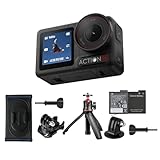
- Bundle Includes - 1 x DJI Osmo Action 5 Pro Standard Combo | 1 x Extra Battery | 1 x Osmo Action Mini Extension Rod | 1 x Osmo Backpack Strap Mount
- Pro-Grade Night & Dynamic Imaging - Discover breathtaking imaging quality with Osmo Action 5 Pro action camera 4K and its all-new 1/1.3" sensor. Advanced tech with 2.4 µm large pixels and 13.5-stop dynamic range delivers unmatched low-light performance and clarity.
- Always Centered, Always Focused - Achieve pinpoint accuracy with our advanced 4nm chip. DJI Osmo Action 5 Pro vlogging camera keeps fast-moving subjects perfectly centered in 16:9 or 9:16—ideal for vlogging, cycling, or capturing friends and pets in action.[7]
- 360° HorizonSteady [17], Rock-Solid Footage - Industry-leading stabilization eliminates 360° roll-axis shakes, keeping your horizon level and motion smooth. This action camera captures first-person action or scenic landscapes with pro-quality stability.
- All-Weather, All-Day Power - Osmo Action 5 Pro underwater camera features a high-capacity 1950mAh battery, providing up to 4 hours [1] of recording, and 3.6 hours at -20° C(-4° F) [9]. IP68 rated for 20m underwater use [8], it delivers clear footage in any environment.
Evaluate these practical questions in a shop or returnable trial period:
- Can you see the framing in bright sun and in the orientation you use?
- Can you change the recording mode without navigating several menus?
- Does the body fit your mount, handle, or protective case?
- Will a gimbal head be exposed to knocks or restricted by the way you store the camera?
- Can you transfer clips without disrupting the way you shoot?
These are selection criteria, not cosmetic extras. A technically capable camera that is awkward to operate may produce fewer usable clips than a simpler camera you can control confidently.
Storage and editing compatibility are part of the camera choice
High-resolution and high-frame-rate footage consumes storage quickly. Verify the exact model’s supported microSD capacity and speed before purchasing a card. DJI publishes approved card examples for Action 4; those recommendations should not be assumed to apply to another model.
Use a workflow check before buying
- Identify the recording modes you need. Write down the resolution, frame rate, and aspect ratio rather than relying on a general “4K” or “8K” label.
- Check the camera’s card specification. Confirm supported capacity, speed class, and approved or tested card models for the exact replacement.
- Estimate transfer and backup time. Decide where the files will be copied after a shoot and whether your phone, tablet, or computer has enough free space.
- Verify software support. If a high-resolution workflow depends on a particular app, operating system, codec, or editor, check current compatibility before committing.
- Test a complete clip. Record, transfer, edit, export, and play one representative file. This catches workflow limits that a specification sheet cannot show.
Do not buy a memory card based only on a capacity number. A card that is too slow for the selected mode can cause recording errors, while a card that works in one model may not be approved for another.
Compare candidates with one decision table
When several cameras appear suitable, score them against the same requirements. The following framework keeps a larger sensor, higher resolution, or wider lens from dominating a decision where another feature is more important.
Outdated Drivers Are Slowing You Down
One free scan finds every outdated or missing driver and matches the right update for your exact hardware.Free scan · exact hardware matchPC Slower Than It Used to Be?
A free scan shows the junk files, broken settings and background clutter dragging Windows down - then fixes them in one click.Free scan · Windows 10 & 11| Comparison axis | Questions to answer | Evidence to record |
|---|---|---|
| Form factor | Action camera or handheld gimbal? | Mounting method, protection needs, and how the camera is moved. |
| Sensor and light | What scenes are hardest to expose? | Listed sensor, aperture, ISO modes, and any independent tests you trust. |
| Lens and perspective | How close will the camera be to the subject? | Field of view, equivalent focal length, and available crop options. |
| Recording modes | What must be captured and delivered? | Resolution, frame rate, aspect ratio, and mode combinations. |
| Stabilization | Does correction work in the exact mode? | Supported resolutions, frame rates, and exclusions such as slow motion or time-lapse. |
| Handling | Can you operate and frame it under real conditions? | Controls, display visibility, mounting, and protection. |
| Storage and workflow | Can your card, device, and editor handle the files? | Model-specific card requirements, app support, transfer, and backup plan. |
Match features to common shooting situations
Mounted sports and outdoor activity
Prioritize the action-camera form factor, a wide field of view, secure mounting, and stabilization that remains available at your chosen resolution and frame rate. If you want slow motion, verify whether electronic stabilization is supported in that slow-motion mode; Action 4, for example, does not support EIS in slow motion.
Best Value

- Pro-Grade Night & Dynamic Imaging - Discover breathtaking imaging quality with Osmo Action 5 Pro action camera 4K and its all-new 1/1.3" sensor. Advanced tech with 2.4 µm large pixels and 13.5-stop dynamic range delivers unmatched low-light performance and clarity.
- Always Centered, Always Focused - Achieve pinpoint accuracy with our advanced 4nm chip. DJI Osmo Action 5 Pro vlogging camera keeps fast-moving subjects perfectly centered in 16:9 or 9:16—ideal for vlogging, cycling, or capturing friends and pets in action.[7]
- 360° HorizonSteady [17], Rock-Solid Footage - Industry-leading stabilization eliminates 360° roll-axis shakes, keeping your horizon level and motion smooth. This action camera captures first-person action or scenic landscapes with pro-quality stability.
- All-Weather, All-Day Power - Osmo Action 5 Pro underwater camera features a high-capacity 1950mAh battery, providing up to 4 hours [1] of recording, and 3.6 hours at -20° C(-4° F) [9]. IP68 rated for 20m underwater use [8], it delivers clear footage in any environment.
- Dual OLED Touchscreens, Maximum Control - Front and rear ultra-bright OLED touchscreens make framing, playback, and parameter adjustment easy—ideal for motorcycle camera use. Enjoy crystal-clear visuals without removing the action camera.
Walking presentations and travel pieces
Decide whether a handheld three-axis gimbal better matches your movement than an ultra-wide action view. A 20 mm-equivalent lens on Pocket 3 offers a different framing choice from the 155-degree view listed for the Action models. Consider how far you can hold the camera from yourself and whether you need to include a broad environment.
Low-light scenes
Compare the listed sensor, aperture, and ISO behavior, then test the exact frame rate you will use. Avoid inferring night performance from sensor size alone. A stable shot, added light, or a lower frame rate may affect the result as much as the sensor specification.
Projects that will be heavily cropped
Higher-resolution capture can provide more room for reframing, but it also increases storage and processing demands. Confirm that your computer and editor can handle the files and that the camera’s stabilization and aspect-ratio options remain acceptable in the high-resolution mode.
What’s actually slowing this PC down?
Pick the symptom - the matching free tool is one click away.
A step-by-step replacement checklist
- Describe the old camera’s job. Record where it was mounted or held, the typical subject distance, and the final platform for your videos.
- Choose the category. Select an action camera or a handheld gimbal camera before comparing model numbers.
- Set non-negotiable recording modes. Specify the minimum resolution, frame rate, and aspect ratio; include slow motion if it is essential.
- Check perspective. Compare the required field of view with the distance between camera and subject.
- Check stabilization limits. Confirm that stabilization works in the selected mode, including any HorizonSteady or EIS restrictions.
- Check light requirements. Compare sensor, aperture, and ISO information for your hardest scenes without treating any one number as a quality verdict.
- Validate storage and editing. Confirm card compatibility, file sizes, transfer method, and software support.
- Check current availability. Prices, stock, firmware, model lineups, and app support can change, so verify them immediately before purchase.
- Score the candidates. Eliminate any camera that fails a non-negotiable requirement, then choose among the remaining models by handling and workflow.
Pitfalls that lead to the wrong replacement
- Buying by sensor size alone: a listed sensor format does not establish real-world image quality without matching lens, processing, exposure, and stabilization conditions.
- Buying the highest resolution: 8K or another headline mode may be unnecessary for your delivery format and may increase editing and storage demands.
- Assuming stabilization is universal: stabilization can disappear or change at particular resolutions, frame rates, slow-motion modes, and time-lapse settings.
- Using the wrong perspective: a 155-degree action view and a 20 mm-equivalent handheld lens frame subjects differently; choose for shooting distance, not the larger number.
- Reusing an old memory card without checking: card approval and speed requirements are model-specific.
- Comparing unlike cameras: a rugged action camera and a three-axis gimbal camera may both record video, but their handling, movement, and mounting assumptions differ.
- Relying on old listings: confirm the current model lineup, specifications, firmware, retailer stock, and software requirements at the time of purchase.
How to make the final choice
There is no single best replacement without knowing the original camera, shooting conditions, budget, region, and final output. For an action-camera replacement, begin with the current Action models and reject any option that cannot deliver your required resolution, frame rate, stabilization mode, field of view, or card workflow. For a handheld replacement, compare cameras built around a mechanical gimbal and judge their lens perspective and controls against the way you walk, frame, and edit.
Use the specifications as a filter, then make the decision on the complete shooting chain: camera category, light, perspective, recording mode, stabilization availability, handling, storage, and editing. That process produces a replacement that fits your footage rather than one chosen from a single impressive number.
Quick Recap
Product prices and availability are accurate as of the date/time indicated and are subject to change. Any price and availability information displayed on Amazon at the time of purchase will apply.




