PC Slower Than It Used to Be?
A free scan shows the junk files, broken settings and background clutter dragging Windows down - then fixes them in one click.Free scan · Windows 10 & 11Crashes, No Sound, or Screen Glitches?
Random freezes, missing sound and display glitches usually trace back to one bad driver. Find and replace yours safely.Free scan · under a minuteCar safety systems are vehicle features and equipment designed to help prevent crashes, reduce their severity, protect people in a collision, or support a response afterward. The term covers several different jobs—not one fixed checklist—and a warning system is not the same as one that intervenes automatically.
Three jobs car safety systems can do
A useful way to understand a vehicle’s safety equipment is to group it by the problem it addresses. The categories below describe function; labels such as “active” and “passive” are common shorthand, but they are not used consistently for every feature.
As an Amazon Associate I earn from qualifying purchases.
Help avoid or lessen a crash
Driver-assistance and crash-avoidance systems warn the driver or help the vehicle respond to a hazard. Examples include forward-collision warning, automatic emergency braking (AEB), pedestrian AEB, lane-departure warning, lane-keeping assistance, blind-spot warning, rear cross-traffic warning, adaptive cruise control, and electronic stability control (ESC). Some systems only alert; others can brake or provide steering support. NHTSA explains these differences in its driver-assistance technology guidance.
Protect people when a crash happens
Seat belts, airbags, vehicle structure, head restraints, and child restraints help limit injury during a collision. Seat belts and airbags are complementary: NHTSA says, “Air bags are supplemental protection and are designed to work best in combination with seat belts.”
#1 Best Overall
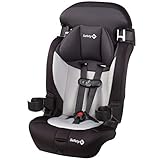
- 2 IN 1 BOOSTER FUNCTIONALITY: Safety 1st Grand 2-in-1 Booster Car Seat adapts as your child grows, from a forward-facing harness booster car seat (40–65 lbs., 43.4"–49") to a belt-positioning booster car seat with back for (40–100 lbs., 43.4"–52").
- SLIM CAR SEAT DESIGN FITS 3 ACROSS: Great for large families or carpools, this 2-in-1 booster seat for forward-facing with harness and belt-positioning booster with high back is designed to fit three across in the back seat of most vehicles.
- LIGHTWEIGHT & PORTABLE BOOSTER: Easily move this booster car seat from car to car, thanks to its lightweight design, making it ideal for busy, on-the-go families needing versatile booster seats for children 40–100 lbs.
- CUSTOMIZABLE SUPPORT: The adjustable headrest allows for tailored support as your child grows, providing comfort during every ride in this 2-in-1 booster car seat with a 5-point harness that converts to a belt-positioning high back booster seat.
- EASY TO CLEAN: 2-in-1 booster car seat for forward-facing with harness and belt-positioning highback booster has a seat pad that is machine-washable and dryer-safe. The two removable cup holders are dishwasher-safe.
Support safety or response after an event
Seat-belt reminders can prompt safer use before a trip, while systems such as automatic crash notification and eCall can help summon assistance after a crash. The European Commission includes both reminders and post-crash systems in its overview of vehicle safety systems.
How common systems work
Seat belts and airbags
A seat belt restrains occupants so they are less likely to strike the vehicle interior or be thrown from the vehicle. Airbag sensors detect crash conditions and can trigger inflation in a fraction of a second, cushioning occupants from contact with interior surfaces. An airbag does not replace a seat belt. NHTSA’s airbag guidance also covers child passengers and airbag precautions.
Rank #2

- MADE TO BE WITH YOU FOR YEARS The Safety 1st Ellaris Convertible Car Seat is a 3 in 1 car seat that adapts to your growing little one with 3 modes of use, making Ellaris car seats a key piece of your family for years to come
- 3 WAYS TO USE The Safety 1st Ellaris Convertible Car Seat offers extended use as a rear facing car seat with Rear-Facing Infant (5–30 lbs.) and Rear-Facing Toddler (30–40 lbs.), and as a forward facing car seat (30–65 lbs.)
- COMFORT AND FLEXIBILITY This convertible slim car seat has a slim design for more space, and its easily adjustable 5-position headrest and harness provide a comfortable ride as your little one grows
- FEDERAL SAFETY AND SIDE IMPACT STANDARDS This convertible car seat was engineered and tested to meet or exceed federal safety standards. It also meets the federal Side Impact standard
- ADDITIONAL FEATURES YOU’LL LOVE Baby car seat with machine-washable and dryer-safe seat pad; 2 removable, dishwasher-safe cup holders; Hook-style LATCH for easy installation; Airplane ready, compact design for travel from the airport to the flight
ABS and ESC
Anti-lock braking systems (ABS) help prevent wheels from locking during hard braking, supporting steering control. ESC can help prevent skids: Euro NCAP says it may brake individual wheels or reduce engine power when it detects a loss of control. These systems can help a driver maintain control, but they do not override road conditions or guarantee that a crash can be avoided. See the European Commission’s system overview and Euro NCAP’s explanation of how cars are tested for safety.
Free tools Windows power users keep installed
One-click scans. No signup required.
Collision warnings and automatic emergency braking
Forward-collision warning alerts the driver to a possible impact. AEB can apply the brakes when a forward collision is imminent. NHTSA distinguishes warnings from interventions and identifies dynamic brake support and crash imminent braking as types that meet its performance specifications. Availability and the hazards a system detects depend on the vehicle.
Rank #3

- 2 IN 1 BOOSTER FUNCTIONALITY: Safety 1st Grand 2-in-1 Booster Car Seat adapts as your child grows, from a forward-facing harness booster car seat (40–65 lbs., 43.4"–49") to a belt-positioning booster car seat with back for (40–100 lbs., 43.4"–52").
- SLIM CAR SEAT DESIGN FITS 3 ACROSS: Great for large families or carpools, this 2-in-1 booster seat for forward-facing with harness and belt-positioning booster with high back is designed to fit three across in the back seat of most vehicles.
- LIGHTWEIGHT & PORTABLE BOOSTER: Easily move this booster car seat from car to car, thanks to its lightweight design, making it ideal for busy, on-the-go families needing versatile booster seats for children 40–100 lbs.
- CUSTOMIZABLE SUPPORT: The adjustable headrest allows for tailored support as your child grows, providing comfort during every ride in this 2-in-1 booster car seat with a 5-point harness that converts to a belt-positioning high back booster seat.
- EASY TO CLEAN: 2-in-1 booster car seat for forward-facing with harness and belt-positioning highback booster has a seat pad that is machine-washable and dryer-safe. The two removable cup holders are dishwasher-safe.
Lane and blind-spot support
Lane-departure warning alerts the driver when the vehicle approaches or crosses lane markings. Lane-support features may steer or brake in some circumstances. Blind-spot warning provides information about traffic outside the driver’s direct view; it does not make a lane change safe by itself. Manufacturers can use different names for similar functions, so check the vehicle manual rather than relying only on a feature label.
Independent reader supportYour contribution helps us test, update, and keep practical guides available for everyone.Driver assistance is not the same as self-driving
Driver-assistance features can help with particular driving tasks, but they do not remove the driver’s responsibility to monitor the road. NHTSA’s descriptions of Levels 0–2 say the driver must remain engaged and attentive. At Level 2, a system can assist with steering and acceleration or braking together while the driver continues to monitor the driving environment. NHTSA puts the responsibility plainly: “You, as the driver, are responsible for driving the vehicle.” Read its automated vehicle safety guidance for the context and level descriptions.
Rank #4

- This Graco booster seat helps safely transport your big kid from ages 4 -10, from 40 - 100 pounds and up to 57 inches tall
- Backless booster is top-rated by leading consumer magazines and publications
- Graco ProtectPlus Engineered: a combination of the most rigorous crash tests that helps to protect your child in frontal, rear, and rollover crashes; additional testing based on the New Car Assessment Program and for extreme car interior temperatures
- The boost your child will love
- Height-adjustable armrests for your child's comfort
What to check on a specific vehicle
A safety-feature name alone does not establish what a vehicle can do. Equipment, operation, and availability can differ by manufacturer, trim, model year, and market. Before buying or relying on a feature:
Quick wins for a faster PC:
Scan for outdated or missing drivers - takes under a minuteDriver Scan →Clear out junk files and repair common Windows errorsFree Scan →Fix the driver behind crashes, sound loss and screen glitchesFind Drivers →- Confirm what it does. Determine whether it warns, assists, or intervenes automatically, and which hazards it is designed to detect.
- Check availability and limits. Use the exact vehicle’s equipment list and owner’s manual to verify whether a feature is standard or optional and the conditions in which it operates.
- Review ratings and recalls. NHTSA’s Car Safety Ratings portal provides rating, comparison, and recall information. A rating is additional evidence, not proof that every trim has identical equipment.
- Fit child restraints to the child and vehicle. Follow age- and size-appropriate restraint guidance as well as the vehicle’s instructions on child seats and airbags. NHTSA’s airbag guidance provides relevant precautions.
- Use qualified repair after airbag deployment. IIHS advises replacing a deployed airbag at a repair shop with OEM replacement parts; counterfeit or substandard inflators can be dangerous. See IIHS airbag information.
Safety systems and legal requirements vary by region
Vehicle equipment and legal requirements depend on jurisdiction, vehicle class, and model year. The European Commission’s overview discusses EU Regulation 2019/2144, while NHTSA’s pages describe U.S. consumer guidance and ratings. Neither source establishes one universal list of systems required on every vehicle worldwide. Check the rules and equipment information applicable to the vehicle’s market.
What the available figures mean
Safety-system statistics need their original scope and attribution. NHTSA reports that 39,254 people died in U.S. motor vehicle crashes in 2024; that figure does not show how many deaths any particular feature could have prevented. The agency also says frontal airbags have saved more than 50,000 lives over a 30-year period, a cumulative figure rather than an annual rate. Separately, a European Commission page cites an eImpact 2020 high-scenario estimate that ESC could prevent about 3,000 fatalities and 50,000 injuries per year. That is a scenario estimate, not a guaranteed outcome or a direct count.
Quick Recap
Product prices and availability are accurate as of the date/time indicated and are subject to change. Any price and availability information displayed on Amazon at the time of purchase will apply.




