Free tools Windows power users keep installed
One-click scans. No signup required.
An arcade game becomes memorable not through one magic ingredient, but when its play is easy to enter and rewarding to learn. A first-time player should quickly grasp what to do; a returning player should find room to improve. Clear feedback, well-tuned challenge, distinctive presentation, and the cabinet itself can make that experience recognizable. These are useful design lessons, not a universal formula for classic status.
What separates an inviting game from a lasting one?
Coin-op design guidance published by Jeff Brown and James Plamondon in the October 1996 issue of Game Developer argues that players should be able to approach a machine and begin without studying instructions. Controls, goals, choices, and reasons for losing should be understandable on the first play. The article is historical practitioner guidance, not a controlled study, but it offers a practical test: can a new player make sense of the game while playing it?


As an Amazon Associate I earn from qualifying purchases.
Clarity does not mean a game must be shallow. A smooth learning curve lets a player improve gradually, while more precise control or deeper strategy emerges through practice. The player should also be able to understand why a run ended and see how a different decision might change the next one. Difficulty that feels arbitrary can obscure the path to improvement; difficulty that communicates risk and consequence can invite another attempt.
How Pac-Man turned a simple premise into strategic play
Pac-Man makes its basic action legible: steer through a maze, eat dots, avoid ghosts, and advance through levels. Power pellets temporarily reverse the threat, giving the player a chance to pursue ghosts instead of fleeing them. The maze and its changing risks create route choices on top of the simple joystick control. That strategic tension is a reading of the mechanics, not a measured claim about player response.
#1 Best Overall

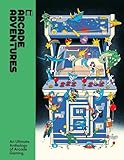
- Page Count: 272 pages
- Binding: Softcover
- Images: 408 illustrations
- Release Date: October 10, 2019
- Dimensions: 23.0 x 17.0 cm
The Museum of Modern Art describes Pac-Man as an early interactive flat landscape and places it against the popularity of shooter games. Its collection interpretation says creator Toru Iwatani wanted a nonviolent game that could appeal to teenage couples and groups as well as boys. In a Bandai Namco interview, Iwatani describes aiming for controls and gameplay that were easy to understand and enjoyable regardless of a person’s video-game skill. He said: “Essentially, we had all of these concepts and ideas, and worked to refine the gameplay, the design, and the controls to be as simple as possible.”
The neon-like maze, colorful characters, and presentation influenced by pinball and pop art helped give the game a recognizable identity alongside its rules. Pac-Man illustrates how a distinctive premise can broaden an invitation to play without removing challenge.
Why Q*Bert shows that difficulty needs tuning
Q*Bert designer and project leader Warren Davis describes simplicity as both a practical and stylistic choice. He recounts hearing that the game was too difficult, making it easier, then revising again after observing players who could spend a long time on one quarter. His account shows difficulty being adjusted in response to observed play, rather than treated as something to maximize.
Davis attributed repeat play to mechanics that were simple to learn but difficult to master, alongside surreal characters, unusual visuals, and the cabinet’s feedback when Q*Bert falls. That is the creator’s retrospective explanation, not an independent causal study. As Davis put it, “The game mechanics were simple to learn, but could be difficult to master.”
Rank #3
How the cabinet contributes to the game
An arcade game is not only software on a screen. The Strong National Museum of Play describes the coin-op machine as a physical object comprising cabinet materials, monitor, overlays, controls, speakers, and electronic components. The joystick, buttons, screen, artwork, and sound shape how a player encounters the rules and receives feedback.
The Strong’s Pac-Man conservation example discusses replacing failed speakers or controls with compatible modern parts while retaining wear that records how people used the machine. That approach reflects a useful distinction: preserving a cabinet’s ability to communicate and function does not necessarily mean removing every trace of its history. When assessing a game’s identity, consider what the cabinet makes visible, how its controls invite action, and how it signals success or failure.
Rank #4

- Used Book in Good Condition
What arcade history can—and cannot—tell us
The Strong calls the late 1970s through the middle of the 1980s the so-called golden age of arcade games. It is a useful historical periodization, not a fixed definition of “classic.” The games of that era differed in genre, controls, hardware, and business model, so they are better compared by the experience they create than ranked against one universal checklist.
What’s actually slowing this PC down?
Pick the symptom - the matching free tool is one click away.
Atari’s Triple Hunt, recorded by the American Classic Arcade Museum as released in 1977, offers a reminder that design could involve more than on-screen action: it was a target-shooting game with three selectable modes and sampled sound playback from an 8-track tape player. Mode selection, physical controls, and hardware presentation all formed part of what players encountered.
Coin-op economics also shaped design choices. The 1996 design article discusses tuning challenge and reward in the context of arcade business conditions, including desired play duration. That historical incentive should not be mistaken for a timeless recommendation to make players lose quickly. Modern games operate in different contexts, and there is no single ideal session length established here.
A practical way to recognize enduring design
When looking at an old arcade game—or designing a new one—ask questions that focus on what a player can actually experience:
- First move: Can a newcomer infer the controls and immediate goal quickly?
- Growth: Does practice reveal meaningful new skill or strategy?
- Feedback: Can players tell why an action succeeded or a run ended?
- Challenge: Does difficulty give players a legible reason to improve, rather than merely punish them?
- Presentation: Do sound, visuals, controls, and cabinet design make the experience easier to recognize and engage with?
These questions describe qualities that can help explain why a game remains memorable; they do not prove that any one quality causes classic status. The available creator accounts, museum interpretations, and practitioner advice illuminate particular games and design ideas, but do not establish a statistical formula or universal difficulty curve.
Quick Recap
Product prices and availability are accurate as of the date/time indicated and are subject to change. Any price and availability information displayed on Amazon at the time of purchase will apply.




