A convincing AI-tutor demo shows that a system can produce a useful response. It does not show that learners will remember the material, work independently, or be safe and supported in ordinary use. Building a tutor for real learning means designing and testing instructional behavior, learner-history use, human oversight, privacy, and outcomes after AI help is removed.
What should an AI tutor be built to do?
Start with the job the system is meant to perform. A tool that helps a tutor prepare a hint is not the same product as one that teaches a student directly, and neither is automatically a replacement for high-impact tutoring. The National Student Support Accelerator’s August 20, 2026 brief, “AI Tutoring is Not a Monolith: What We Actually Know,” states that “High-impact tutoring remains defined by live human-led instruction.” Its account supports a more cautious distinction: current evidence is clearer for AI enhancing tutor effectiveness and educator capacity than for AI replacing human-led tutoring.
As an Amazon Associate I earn from qualifying purchases.
That distinction should shape both the product and the evidence used to justify it. Decide whether the system is intended to coach a learner, assist an educator, or provide real-time suggestions to a tutor. Specify who remains responsible for instruction, when a human needs to intervene, and what the system should do when it cannot confidently help. A demo can hide these operational questions; a deployed tutor cannot.
What’s actually slowing this PC down?
Pick the symptom - the matching free tool is one click away.
How can the tutor help without doing the learner’s work?
A correct answer is not necessarily a good teaching move. The system needs to decide whether to explain, ask a question, offer a hint, or wait for the learner to try. If it gives away the solution too early, a student may finish the exercise without acquiring the skill needed to solve a similar problem alone.
#1 Best Overall
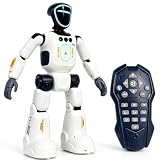
- Smart AI-Inspired Robot Toy for Kids: Bring futuristic fun to playtime with this smart interactive robot toy. Designed with AI-inspired features, glowing LED face effects, music, movement, and responsive controls, it keeps kids engaged through hands-on play and imagination
- Gesture Sensing & Remote Control Play: Kids can control the robot with simple hand gestures or use the included remote control for forward, backward, left turn, right turn, dancing, music, and demo functions. Easy operation makes it fun for beginners and exciting for daily play
- DIY Programming for Creative Fun: Create custom action sequences with the programmable function. Kids can set movements, add music, and play back their own routines, helping encourage creativity, logical thinking, and hands-on STEM learning through interactive play
- Voice Recording & Playback: Record fun messages and let the robot play back. The voice recording feature makes parent-child interaction more exciting and gives kids a fun way to hear their own voice while playing with the robot
- Singing, Dancing & Educational Companion: This robot toy combines built-in songs, dance moves, auto demo, science knowledge, and interactive play in one entertaining design. A birthday, holiday, or Christmas gift for boys and girls who love robots, technology, and smart toys
Use the high-school math findings as a warning, not a universal forecast
A 2025 PNAS field experiment involving nearly 1,000 high-school mathematics students compared a standard GPT-4 chat interface, a teacher-informed GPT Tutor interface, and no generative-AI resource. In that study’s reported setup, practice grades improved by 48% in the GPT Base arm and 127% in the GPT Tutor arm. But after access was removed, the GPT Base group scored 17% lower than students who had not received AI access. The negative effect was largely mitigated in the tutor condition, which emphasized teacher-designed hints rather than giving away answers.
These are findings from that study and population, not forecasts for every product, subject, or classroom. They do establish why practice performance with the system available is not enough to claim learning. The tutor’s instructional policy should be evaluated for whether it scaffolds a learner’s thinking, rather than simply how quickly it produces an answer.
Make “when to help” a deliberate behavior
Define observable behaviors for the instructional moments that matter: whether the system diagnoses the learner’s attempt before responding, gives a hint that preserves useful work, adjusts the hint if the learner remains stuck, and avoids escalating straight to a full solution. These are design targets, not a validated universal rubric. They should be tested on actual learning tasks and reviewed by educators familiar with the subject and students.
The Allen Institute for AI’s TutorMoments project page describes a preview set of 462 de-identified text transcripts, more than 1,500 teacher-annotated key moments, and annotations from 27 U.S.-based teacher annotators. The project compares a plain prompt with an evaluation-aware prompt that makes trade-offs among scaffolding, over-scaffolding, and rigor explicit. This is a contribution to dataset and evaluation work, not evidence that a system improved learning outcomes.
Rank #2

- 🤖【AI Learning Companion for Kids】Designed to grow with your child, the AI Robot combines learning and entertainment in one interactive companion. Kids can practice drawing, learn letters, listen to stories, sing songs, chat with AI, watch educational videos, and play fun games—all through a friendly touch-screen robot that keeps children engaged while encouraging creativity and curiosity.
- 🎨 【Interactive Drawing & Educational Content】Children can trace pictures directly on the 7-inch HD touchscreen, learn step by step how to draw, color their artwork, recognize letters, and explore educational activities designed to improve creativity, hand-eye coordination, and early cognitive development.
- 📱【 Powerful Android System with Endless Apps】Built-in Google Play Store lets you download your favorite educational apps, learning software, streaming services, and games. Equipped with 1GB RAM, 16GB internal storage, expandable TF card support, Wi-Fi (2.4GHz), Bluetooth connectivity, and OTA online updates to keep your robot up to date.
- 💬【Smart AI Conversations & Fun Moving Companion】More than just a learning device, Voltix features intelligent AI voice interaction that can answer questions, chat with kids, tell stories, and sing songs. Smooth wheels allow the robot to move around, dance, and interact naturally, creating a more engaging companion experience.
- 🔋【Long Battery Life & Family-Friendly Design】Powered by a built-in 4000mAh rechargeable battery, the robot provides approximately 4–6 hours of continuous use on a single charge. The bright 7-inch HD display (1024 × 600 resolution) delivers vivid visuals while the compact design makes it perfect for bedrooms, playrooms, travel, and family activities.
How should the system use a learner’s history?
Personalization over time involves more than recalling a student’s name or the last question they asked. A tutor must find relevant evidence in prior interactions, infer what the learner currently understands, and choose an appropriate next teaching action. These are separate capabilities; a system may retrieve a past mistake correctly but still misdiagnose the learner or respond with an unsuitable lesson.
Test the full chain, not memory alone
LongTutor, a 2026 benchmark described in “LongTutor: Benchmarking Large Language Models for Long-term Personalized Tutoring,” evaluates historical-evidence acquisition, knowledge-state diagnosis, and adaptive teaching action using expert-annotated real-world learning logs. Its authors report that models can do well at finding evidence yet struggle to turn long-term history into accurate diagnoses and adaptive teaching. For a deployed tutor, evaluate each step separately:
- Evidence: Does it retrieve the relevant prior work and distinguish it from unrelated history?
- Diagnosis: Does it infer what the learner understands from evidence, rather than treating one error as proof of a persistent gap?
- Action: Does it choose a next step that follows from the diagnosis, such as a targeted hint or a different example?
- Freshness: Does it avoid treating old or context-specific information as a reliable description of the learner now?
This breakdown is an implementation and evaluation implication of LongTutor’s task design, not a source-validated checklist or guarantee of personalization quality.
Quick wins for a faster PC:
Scan for outdated or missing drivers - takes under a minuteDriver Scan →Clear out junk files and repair common Windows errorsFree Scan →Fix the driver behind crashes, sound loss and screen glitchesFind Drivers →When should AI support a tutor or teacher instead?
For some settings, the more defensible design is to put AI in the hands of a tutor or teacher rather than making it the sole instructor. A human can interpret context, choose whether to use a suggestion, and take responsibility for what happens next. That arrangement still needs evaluation: a recommendation can be distracting, unsuitable, or wrong, and human oversight only helps when the person has time and authority to act on it.
Rank #3

- 🌟V28 update 🚀 new features are now available! In response to Loona's charging problem, we've upgraded the automatic recharge 2.0.The upgrade is to help Loona remember and match the charging routes of different scenarios to improve the auto-recharge success rate.Mobile hotspots connect to loona, breaking Wi-Fi restrictions and allowing you to interact with loona anytime, anywhere. Our team is committed to continuous improvement, ensuring that Loona continues to evolve to meet your expectations.
- 🤖 Smart and Interactive Robot Pet🧠Loona is like no other pet you've seen. With a high-definition RGB camera, Loona sees and understands your world. Loona recognizes faces, understands your gestures, and follows you like a real puppy! Please take Loona to a well-lit environment and ensure the surfaces of the camera and ToF depth sensor are clean.
- 🗣️ Voice Command Enabled AI robot 🎤Loona is not just a good listener; also a great conversationalist! Powered by Amazon Lex & ChatGPT, Loona recognizes your voice commands and responds in real-time. Plus, Loona keeps your information secure, so you can chat with peace of mind. Pro tip: Clear pronunciation in quiet spaces ensures smoother responses.
- 🚀Auto-Charging Smart Robot🌟 Use different rooms as a starting point to preset multiple recharge routes for Loona. When the battery runs low, loona can charge it home by itself, no need for you to take care of it. it takes about 2.5 hours to complete the charging. Place the dock in an open area with no obstructions on either side or in front.
- 🕹️ Endless Playtime robot toys for kids 🎮Loona is always up for playtime! Loona can chase laser pens, fetch balls, and even interact with objects in your home. But it doesn't end there—Loona's app offers a world of games and quizzes to keep the fun going.
The 2025 Tutor CoPilot study record describes a randomized controlled trial with 900 tutors and 1,800 K–12 students from historically underserved communities. Students whose tutors had access to Tutor CoPilot were four percentage points more likely to master lesson topics; the record reports a nine-percentage-point increase for students of lower-rated tutors. These are study-specific results in that tutoring context, not a guarantee that another tool or deployment will have the same effect.
The finding makes tutor-facing assistance a promising design direction to investigate, not a conclusion that AI can replace tutors. If a system is intended to support educators, assess whether it improves the relevant tutor practice and student outcomes in the setting where it will be used.
Independent reader supportYour contribution helps us test, update, and keep practical guides available for everyone.What safety, privacy, and supervision belong in deployment?
A tutor’s obligations do not end with the quality of its explanation. Direct student interaction raises questions about data safeguards, boundaries on interaction, and what happens when no adult is monitoring the session. The National Student Support Accelerator and Stanford SCALE briefs dated August 20, 2026 call for careful attention to privacy safeguards, safety guardrails, and the depth of unmonitored interaction.
The Stanford SCALE brief describes formal data-protection arrangements, training on personally identifiable information, and staged human-review decisions before, during, and after sessions. These are institutional implementation recommendations, not jurisdiction-specific legal advice. Schools and providers need to determine applicable obligations for their setting rather than treating a general checklist as legal compliance.
Rank #4

- [Lovi AI Companion Robot | Lively Conversations]: More than an AI talking toy, this is a true interactive companion. With a vibrant LCD screen that displays over 20 emotions and the ability to switch between 8 unique character modes and 6 fun voices, every chat is a new adventure. It responds to your child’s mood, keeping them engaged and sparking joy with every interaction.
- [A Growth Partner & Bedtime Storyteller]: This isn't just a emo robot pet; it's your child's trusted confidant. It listens, comforts, and even turns daily chats into a precious digital growth journal, capturing sweet childhood memories. At night, this AI companion toy becomes a magical storyteller, crafting custom bedtime tales that gently lull your little one into a cozy sleep, night after night.
- [Smart Reminders & All-Day Play]: Help your child build healthy routines with fun daily reminders for tasks and activities. With a long-lasting 4-5 hours of continuous talk time and up to 20 hours on standby, this AI interactive pet is ready for all-day adventures, from car rides to playdates, without the constant need for recharging.
- [Safe, Snuggle-Soft & Simple Setup]: Crafted from premium, ultra-soft, hypoallergenic fabric, this AI plush toy for kids is completely, safe and gentle on your child's skin, and easy to wipe clean. Getting started is a breeze: just download the app, power on, sync your device and say "Hi Lovi" to begin an amazing AI journey. No complicated setup needed!
- [The Perfect Gift That Grows With Them]: Lightweight and portable with a handy carry strap, this AI electronic cute pet robot is the ideal travel buddy for trips and outings. Perfect for boys and girls ages 3-12, it’s more than a seasonal gift—it's a lasting companion that fosters creativity, empathy, and learning, making it an unforgettable present for any occasion.
The brief also describes possible support functions such as adapting examples for cultural relevance and language accessibility, helping educators communicate with multilingual families, and analyzing session transcripts to give teachers or tutors feedback. When these functions involve student records or direct interaction, they require appropriate privacy protections and human review. Establish who can see records, how they are used, and when review or escalation is required before enabling such features.
How can you evaluate whether the tutor works outside a demo?
Evaluation should follow the claim. A system claiming to teach needs evidence about learning and transfer, including what happens when assistance is removed. A system claiming to support tutors needs evidence about tutor practice and student outcomes in the relevant tutoring context. One score cannot stand in for these different claims: the cited sources examine different designs and do not establish a universal product-readiness threshold or ranking.
| Claim being tested | What to measure | Evidence or limitation |
|---|---|---|
| “Students learn the material” | Practice performance and later independent performance without AI assistance. | The 2025 PNAS study demonstrates why both conditions matter; its results apply to its study design and population. |
| “The tutor gives useful guidance” | Whether it scaffolds, gives away answers, and knows when to hold back. | TutorMoments provides annotated moments and a prompt-evaluation perspective, not proof of improved learning. |
| “The tutor personalizes instruction over time” | Relevant-history retrieval, knowledge-state diagnosis, and adaptive teaching action as distinct steps. | LongTutor reports challenges translating long-term history into accurate diagnosis and teaching actions. |
| “The tool improves human tutoring” | Tutor practice and student outcomes in the intended tutoring context. | Tutor CoPilot offers randomized-trial evidence in its studied context; effects are not guaranteed elsewhere. |
| “The system is ready for student use” | Privacy safeguards, interaction boundaries, oversight, and review arrangements. | The Stanford SCALE and National Student Support Accelerator briefs offer implementation considerations, not a universal certification threshold. |
Keep the evaluation conditions close to the results: who participated, what interface or support they used, and whether AI was available during the assessed task. A result while AI is present answers a different question from independent performance afterward. Likewise, a benchmark, a prompt comparison, and a field trial are different kinds of evidence; none should be presented as if it proves all aspects of a tutor’s readiness.
Free tools Windows power users keep installed
One-click scans. No signup required.
What does a credible AI-tutor project need before launch?
Before deploying beyond a controlled demonstration, define the intended instructional role and test the system against it. A practical readiness review should cover:
- Instruction: Are the tutor’s hinting and answer-giving behaviors deliberate and tested on realistic learner attempts?
- Learning: Is the outcome measured both with AI assistance and after it is removed when the product claims to teach?
- Personalization: Are history retrieval, learner diagnosis, and instructional action checked separately?
- Human roles: Is it clear what tutors or teachers review, what they can override, and when they are expected to intervene?
- Data and safety: Are privacy arrangements, student-interaction boundaries, staff training, and review points established for the actual deployment?
A polished response is an interface milestone. A tutor that can support learning in ordinary use needs evidence across instructional behavior, independent outcomes, human integration, and responsible operation.
Quick Recap
Product prices and availability are accurate as of the date/time indicated and are subject to change. Any price and availability information displayed on Amazon at the time of purchase will apply.




