Recommended Free Tools
Constant bitrate (CBR) is an encoding or transmission mode that aims to keep the data rate steady over time. It is useful when a channel or workflow needs predictable bandwidth, but it does not mean every frame or packet carries the same amount of information. The exact behavior depends on the codec and system.
What constant bitrate means
With CBR, an encoder tries to hold output near a chosen bitrate or within a narrow rate constraint. That predictability can help when a communication channel has limited capacity or a workflow needs a stable data rate. AWS Elemental describes CBR as an encoder rate-control mode that outputs a constant bitrate over time; Extron’s SME 211 guide similarly describes its value where a channel benefits from output staying within a tight tolerance.
As an Amazon Associate I earn from qualifying purchases.
CBR is a rate-control goal, not a promise that every frame, packet, or moment contains an identical number of bits. Encoders and delivery systems may use buffers, padding, targets, or constraints, and the precise meaning varies with the codec and transport. For example, RFC 6716 explains that a constrained variable-bitrate behavior can simulate a bit reservoir and resemble what MP3 and AAC call CBR without being true CBR.
CBR vs. VBR: what changes?
| Factor | CBR | VBR |
|---|---|---|
| Rate behavior | Aims to keep the bitrate steady or within a narrow constraint. | Allows the bitrate to vary with content and time. |
| Predictability | More suitable when a channel or workflow needs a predictable rate. | Less fixed moment to moment; can adapt resource use to the content. |
| Quality efficiency | May allocate bits less flexibly when content complexity changes. | For Opus audio, RFC 7587 says VBR can deliver higher quality than CBR at the same average bitrate. |
| Examples in official guidance | ETSI/3GPP identifies constant-rate links with strict end-to-end delay constraints as a CBR video use case. Google recommends CBR for VP9 live streaming. | Google recommends VBR for high-motion VP9 video-on-demand. VBR is the default mode for Opus. |
These are not universal rankings. The better choice depends on the codec and implementation, how predictable the rate must be, available channel capacity, delay constraints, and whether the priority is consistent bandwidth or adapting to content.
#1 Best Overall

- Encode Analog Audio to MP3 up to 192/320kbps. VBR and CBR support.
- Encode to G.711, uLaw, aLaw, 16-bit PCM @ 8, 16, 22.05, 24, 32, 44.1, 48 kHz
- RJ45, 10/100Mbps auto, Link & Activity LEDs
- Includes 100-240VAC power adaptor to 5VDC micro USB - max. 1A
- Encode Analog Audio from RCA line inputs and stream over IP Networks
When CBR is useful
Links with strict rate or delay limits
ETSI/3GPP identifies encoding for constant-rate links, such as ISDN, under strict end-to-end delay constraints as a main application for CBR video rate control. A steady output rate can make it easier to fit within a link’s capacity and timing requirements.
VP9 live streaming
Google recommends CBR for live streaming with VP9, explaining that this helps prevent the encoder from producing data faster than the network can carry. This is guidance for VP9 live streaming, not a rule for every codec, platform, or live workflow.
Rank #2

- ⭐【Innovative Product with Leading Technology】- Equipped with an advanced H.265/H.264 dual encoding chip, supports 1920x1080 resolution input and output, achieving 60fps high-definition presentation with realistic and delicate color reproduction and lossless detail. It also supports HDCP 1.4 decryption, easily decoding various HDMI high-definition video sources, delivering a cinematic visual experience for both professional live streaming and high-definition content transmission.
- ⭐【Multi-protocol and Multi-platform Compatibility】- Fully compatible with streaming protocols such as HTTP, RTSP, RTMP(S), SRT, HLS(M3U8), MP4, Multicast(UDP, RTP, PTL), ONVIF, FLV, it can simultaneously output 4 video streams with different protocols and push them to live streaming platforms such as YouTube, Facebook, Twitch, and Vimeo with one click. Simultaneous live streaming across multiple platforms can be achieved without additional equipment.
- ⭐【Highly Customizable Settings to Meet Individual Needs】- It supports adding static text, scrolling captions, brand logos, and timestamps. Users can freely adjust core parameters such as video resolution, frame rate, and bitrate, and also perform personalized editing functions such as video cropping, rotation, flipping, and mirroring. It supports dual input of HDMI embedded audio and line-in audio, with adjustable sound quality, making your live stream content more distinctive and allowing you to create a unique brand live stream style.
- ⭐【Stable and Efficient Transmission, Easy Operation】- Employing HDMI to Ethernet core connection technology, it ensures stable and reliable network transmission with low latency and no lag, adapting to various network environments. Equipped with an intuitive user interface and detailed instruction manual, no professional technical background is required; setup can be completed quickly after connecting the device. It is also compatible with multiple terminals such as computers and mobile phones for management, and the video stream status can be viewed in real time via a URL.
- ⭐【Lifetime Free Warranty and Technical Supports】- All URayCoder video codecs come with a lifetime free warranty and technical supports, supporting secondary development and feature customization to meet enterprise-level personalized needs. Meanwhile, we providing many kinds of customization services such as shell pattern printing, logo addition, hardware and function development, ensuring reliable quality and worry-free after-sales service.
Audio transports that require fixed-size frames
RFC 6716 gives cases where CBR may be required for Opus: a transport may support only a fixed size for each compressed frame, or an encrypted audio stream may be highly constrained or sensitive. RFC 7587 also identifies a possible information-leak concern when encrypting compressed audio as a reason to consider CBR. CBR alone is not a general security guarantee.
Do these 3 things before closing this tab:
1Repair Windows errors before they cause bigger problems2Fix the driver behind crashes, sound loss and screen glitches3Clear out junk files and repair common Windows errorsWhen VBR may be a better fit
Variable bitrate can adapt the rate to the material instead of holding it near a steady target. Google recommends VBR for high-motion VP9 video-on-demand. For Opus, RFC 6716 describes VBR as more efficient and says it is the default; RFC 7587 says VBR can achieve higher audio quality than CBR at the same average bitrate. Those claims apply to the documented codecs and use cases, not automatically to every encoder or format.
Rank #3

- Avoid storing the products in a place at high temperature, high humidity and in Corrosive gases.
- Do not touch the product with water, as this may cause abnormal output waveforms.
- Material: Plastic, Metal; Main Color: Blue, Silver Tone.
- Rated Voltage: DC 5V; Shaft Movement Direction: Action Type: Momentary.
- Package Content: 10 x EC11 Rotary Encoder with Switch (20MM).
How to choose a mode
- Choose for the channel: If the link has a strict rate tolerance or delay constraint, CBR may be more appropriate.
- Choose for the workflow: Google’s VP9 guidance favors CBR for live streaming and VBR for high-motion video-on-demand.
- Check the codec’s behavior: Audio modes and rate-control terminology differ; Opus, for example, defaults to VBR and also defines constrained behavior.
- Balance rate and quality: Scene complexity and motion affect video bitrate needs. Resolution, frame rate, codec, and encoding parameters matter too, so a CBR setting by itself does not determine quality.
For streaming video, RFC 9317 identifies resolution, frame rate, codec, encoding parameters, scene complexity, and motion as relevant bitrate-selection factors. Confirm the requirements of the specific platform and encoder before choosing settings.
Quick Recap
Best Value
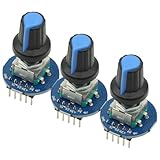
- 3Pcs Round Audio Rotating Potentiometer Knob Cap EC11 With Switch Rotary Encoder Module
- Operating Voltage: 5V
- Pulse Number for One Circle: 20
Rank #4
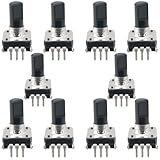
- Type: EC12 rotary encoder without switch; Adjustment method: 360 degrees; Number of pulses: 24
- Shaft type: Type D; Maximum operating current (resistive load): 10mA max; Rated voltage: 5 volts 500 characters can also be written
- Shaft Diameter: 6mm/0.24inch; Shaft Height: 15mm/0.59inch; Dimensions: 14 x 13.2mm/0.55 x 0.52inch
- Features: In forward rotation, line A phase leads to line B phase; when reversed, line B phase leads to line A phase. Simple digital logic circuits (exclusive or gate and d flip-flop) can be used to recognize the phase relationship of AB and the number of rotations.
- Uses/applications: industrial controls, robotics, camera lenses, computer input devices. Circuit board design dimming and sound 3D printers LCD displays, etc. (CD players, for volume and ON/OFF control or data selection via LED or LCD displays.)
Sources
- RFC 6716: Definition of the Opus Audio Codec
- RFC 7587: RTP Payload Format for the Opus Speech and Audio Codec
- Google for Developers: VP9 bitrate modes
- ETSI TR 126 937 / 3GPP TR 26.937, version 12.0.0
- RFC 9317: Operational Considerations for Streaming Media
Product prices and availability are accurate as of the date/time indicated and are subject to change. Any price and availability information displayed on Amazon at the time of purchase will apply.




