Quick wins for a faster PC:
Fix the driver behind crashes, sound loss and screen glitchesFind Drivers →Clear out junk files and repair common Windows errorsFree Scan →Scan for outdated or missing drivers - takes under a minuteDriver Scan →Cgroups can account for and constrain a game server’s CPU time, memory, task count and, when configured, device I/O. They cannot guarantee smooth tick times, reserve an exclusive CPU core, control every kind of network contention or provide a complete security boundary. Their effect depends on which Linux controllers the host exposes and how its resource hierarchy is configured.
What cgroups do on a shared game server
Linux control groups, or cgroups, organize processes in a hierarchy. Enabled controllers can measure resource use and influence how resources are distributed among groups. A host’s cgroup version, controller availability and hierarchy determine which controls are actually usable; a controller that is absent, disabled or attached to a different hierarchy cannot be assumed to work. See the Linux kernel’s cgroup v2 documentation.
As an Amazon Associate I earn from qualifying purchases.
This is resource management, not a guarantee that one server’s players will never feel another workload. A control can limit or prioritize certain resource use, but user-visible latency also depends on host scheduling, the storage device, the workload and other bottlenecks.
CPU: relative share is not a dedicated core
In cgroup v2, cpu.weight sets a relative CPU allocation for supported scheduler classes when groups compete for CPU. It is a proportioning control, not a promise that a server will always receive a particular amount of processing time. By contrast, cpu.max sets a bandwidth ceiling for eligible fair-class processes (or supported BPF schedulers). Neither setting pins a process to a CPU or reserves exclusive hardware; CPU placement is a separate concern.
#1 Best Overall

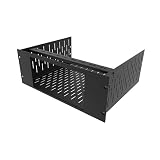
- 4U Rack Space Design: Designed to occupy 4U of space in standard 19-inch server racks, AV racks, and network cabinets, helping optimize rack organization and equipment layout
- Universal VESA Compatibility: Supports most LCD and LED monitors with 75x75mm and 100x100mm VESA mounting patterns for broad compatibility with commonly used displays
- Adjustable Depth Installation: Adjustable mounting depth allows flexible monitor positioning inside rack cabinets, helping improve equipment clearance and allowing cabinet doors to close properly in many setups
- Durable Cold Rolled Steel Construction: Constructed from solid cold rolled steel for reliable support and long-term durability in server rooms, data centers, security systems, home labs, and professional AV environments
- Clean & Space-Saving Rack Setup: Provides an efficient way to mount a monitor directly inside a rack cabinet while reducing desktop clutter. Suitable for monitoring stations, IT equipment racks, DVR systems, and workstation setups
A bandwidth cap can protect co-tenants from a server using too much CPU, but a group that reaches its quota can be throttled until its allowance is replenished. That may contribute to stalls, rather than eliminate them. To check whether the group is hitting its own limit, inspect its cpu.stat file: it reports usage such as usage_usec and, when the controller is enabled, throttling counters including nr_throttled and throttled_usec. Those counters are evidence of throttling, not proof that it is the sole cause of observed latency; host scheduling and other constraints still matter.
Memory: pressure first, or a hard limit
Memory controls have different failure behavior. memory.low is a best-effort protection boundary; memory.min provides hard protection up to its effective boundary. memory.high applies reclaim pressure and throttles a group that goes above the boundary, but does not itself invoke OOM. memory.max is the principal hard usage limit: if reclaim cannot bring usage down, the cgroup’s OOM killer can terminate a process in that group.
These controls can keep one game server from consuming memory needed by co-tenants or the host. The tradeoff is that the limited server may reclaim memory, stall or fail under pressure. A cap is therefore a boundary on resource use, not a promise of uninterrupted service.
Storage I/O: a device limit, not a latency guarantee
When the I/O controller is available and configured, cgroup v2’s io.max can cap maximum bytes per second (BPS), operations per second (IOPS), or both for a specified device. This controls device I/O through that controller. It does not guarantee storage latency, prevent every effect of device contention or shape network traffic. The documentation covered here does not establish cgroup network-bandwidth control or an end-to-end guarantee against storage contention.
Rank #3

- Durability: This rack mount rail is made from cold-rolled steel, 4-port fixed can support a weight of up to 120lbs (54kg); Electrostatic powder coat preventing rust and corrosion
- Flexible Depth: Server rack shelf rail with adjustable depth from 20.9 to 32",suitable for racks of different depths
- Widly Application: Compared to the 19 "cantilever shelf, this half bracket rail has no width limit,can be applied to server racks of 10 ", 19 "and so on
- Ventilation:Vented shelves increases ventilation efficiency and heat dissipation to protect equipments long-term use
- Installation:Equipped with a complete set of accessories,and it is easy to install,with instruction or video for reference
Tasks, networking and security boundaries
Cgroups can also account for and control task counts when the relevant controller is enabled. But resource grouping should not be mistaken for process or security isolation: cgroups alone do not provide a complete boundary for what processes can see or access. Hosts need appropriate complementary mechanisms, such as namespaces and access controls, for those boundaries. Nor should a cgroup CPU or I/O setting be treated as a general control over network contention.
How systemd affects configuration
On a systemd-managed host, systemd manages the cgroup tree and provides resource controls for service, slice and scope units. Its settings include controls such as CPUWeight= and TasksMax=; systemd enables relevant controllers as needed, subject to the hierarchy and available controllers. Check the installed systemd version and the actual unit configuration before relying on a setting.
Rank #4

- Spacious Chassis: This huge 4U server case comes with 7 internal 3.5" HDD bays. It only supports HDD drives with three screw holes on each side, allowing for a secure, 3-point connection on each side. IT DOES NOT Support HDD drives with two screw holes on each side
- Expandable & ATX/CEB Compatible: 7 PCI expansion slots and ATX and CEB motherboard compatibility give you growth options for all of your needs
- Quiet Cooling: 3 pre-installed cooling fans provide excellent airflow and heat protection at reduced noise. 1 front 120mm PWM fan and 2 rear 80mm PWM fans ensure your drives and chassis avoid overheating
- Front Panel Features: Front panel LED indicators for power and HDD monitoring allows quick, easy visual assessment. Additional utility with 2x USB 3.0 ports and a built-in front panel lock provides extra security for your server case
- Rackmount Design: Standard 4U rackmount form factor allows for easy installation in server racks and data center environments, providing professional mounting solutions for enterprise and home server applications
Services that need to create and manage child cgroups require delegation. The systemd project states: “Services must set Delegate=yes for the units they intend to manage subcgroups of.” Use systemd’s unit controls or a correctly delegated subtree rather than manipulating systemd-owned cgroups directly. See The New Control Group Interfaces and the systemd resource-control manual.
What to check when a server is struggling
- Confirm the control environment. Establish whether the host uses cgroup v2, which controllers are available and enabled, and which cgroup contains the game-server processes. A setting cannot govern a resource through a controller the hierarchy does not expose.
- Inspect the service manager’s configuration. On systemd hosts, review the unit and applicable slice settings, including resource controls and any delegation needed for child groups. Verify the installed systemd version rather than assuming a setting or behavior is universal.
- Look for matching resource evidence. For CPU, compare usage and throttling counters in
cpu.stat. For memory, examine usage, pressure and memory events alongside the configured boundaries. For I/O, confirm the device and limits actually configured. A limit’s presence alone does not show that it caused a particular symptom. - Measure the host and workload together. Tick-time or latency effects require workload-specific observation alongside host scheduling, memory and device conditions. Cgroup accounting can help identify constraints; it does not attribute every delay or prove a user-visible performance outcome by itself.
Choose controls for the failure behavior you can accept
| Control | What it does | Important tradeoff or boundary |
|---|---|---|
cpu.weight |
Sets relative CPU allocation under contention for supported scheduler classes. | Does not reserve a core or ensure a fixed share when the host is not contended. |
cpu.max |
Sets a CPU bandwidth ceiling for eligible processes. | Can throttle the capped group when it reaches its allowance; it is not CPU placement. |
memory.low / memory.min |
Provide best-effort / hard memory protection, respectively, up to the applicable boundary. | Protection depends on the effective hierarchy and does not create additional host memory. |
memory.high |
Applies reclaim pressure and throttling above the boundary. | Can slow the group; it does not invoke OOM by itself. |
memory.max |
Sets the principal hard memory usage limit. | If reclaim fails, the cgroup OOM killer can terminate a process in the group. |
io.max |
Caps BPS and/or IOPS for a configured device when the I/O controller is available. | Does not govern network bandwidth or guarantee storage latency. |
| Namespaces and access controls | Complement resource controls with process-visibility and security boundaries. | Cgroups alone do not provide a complete isolation boundary. |
There is no universally safe CPU or memory value for a game server: appropriate limits depend on host capacity, kernel and systemd configuration, the game workload and co-tenant behavior. A resource limit may protect the rest of the host while making the capped server less responsive or, for a hard memory cap, causing it to fail.
Quick Recap
Product prices and availability are accurate as of the date/time indicated and are subject to change. Any price and availability information displayed on Amazon at the time of purchase will apply.




