You cannot reliably tell from a video-call image alone whether the face belongs to a live, genuine person. A replay attack—showing a photo or recorded video to a camera—is one kind of biometric presentation attack, and tests can measure how well detection software catches it. But the strongest published replay figures come from an offline benchmark, not ordinary live calls; they do not certify a caller’s identity or cover every deepfake and software-injection attack.
What “real” means in a video call
There are two different questions: whether a face image came from a live person at the camera, and whether that person is who they claim to be. Presentation-attack detection (PAD) addresses the first question. NIST defines PAD as “automated determination of a presentation attack.” Liveness detection is a subset that examines anatomical characteristics or reactions to assess whether a living subject was present when the biometric sample was captured. NIST CSRC’s PAD glossary describes these terms.
As an Amazon Associate I earn from qualifying purchases.
A replay is a presentation attack: someone presents a photo or video of a face to a camera. NIST’s Face Analysis Technology Evaluation (FATE) PAD program describes replay attacks in those terms. Even successful PAD only indicates that a tested capture appears bona fide rather than an attack; it does not establish the person’s identity.
PC Slower Than It Used to Be?
A free scan shows the junk files, broken settings and background clutter dragging Windows down - then fixes them in one click.Free scan · Windows 10 & 11Crashes, No Sound, or Screen Glitches?
Random freezes, missing sound and display glitches usually trace back to one bad driver. Find and replace yours safely.Free scan · under a minuteWhat NIST measured in replay attacks
NISTIR 8491, published in September 2023, evaluated 82 prototype software algorithms from 45 developers. The evaluation used archived conventional 2D still and video imagery, including publicly described attack instruments. Its results are benchmark measurements, not a pass rate for video-call participants. NISTIR 8491 reports that PAD accuracy varies across algorithms, use cases, and attack types.
#1 Best Overall

- AI-Powered Smart Detection: Advanced AI technology accurately identifies people while filtering out vehicles and animals, so you only get the alerts that matter most
- Secure Cloud Storage: Protect your recordings with AES-128 encrypted cloud storage
- Pre-Capture Recording: Cloud subscribers benefit from pre-capture functionality, ensuring the camera starts recording right at the moment motion begins - never miss a thing
- Reliable 2.4GHz Wi-Fi Connection: Optimized for 2.4GHz networks to deliver stable, uninterrupted performance. (Not compatible with 5GHz Wi-Fi.)
- Exceptional Night Vision: Equipped with four powerful infrared LEDs and an advanced image sensor, providing sharp, detailed footage even in total darkness
The report gives results at selected operating points. APCER is the proportion of attack presentations incorrectly accepted as bona fide; BPCER is the proportion of bona fide presentations incorrectly flagged as attacks. Changing the decision threshold can reduce one error while increasing the other.
| Replay test category | Convenience-focused result | Security-focused result | What the number means |
|---|---|---|---|
| Still-image impersonation, photo print/replay (PA Type 8) | Top listed APCER: 0.0 at BPCER = 0.01 | Top listed BPCER: 0.0001 at APCER = 0.01 | Selected best results in the NIST benchmark at the stated operating points. |
| Zoomed replay | Best listed APCER: 0.005 at BPCER = 0.01 | Best listed BPCER: 0.006 at APCER = 0.01 | Selected best results in the NIST benchmark at the stated operating points. |
At BPCER = 0.01, the convenience-focused figure limits false flags on bona fide imagery to 1% and reports the share of attacks missed. At APCER = 0.01, the security-focused figure limits missed attacks to 1% and reports the share of bona fide imagery falsely flagged. The reported 0.0 for one benchmark result means no errors at that tested operating point; it is not proof that the algorithm can never miss a replay in another setting.
Rank #2

- Video Doorbell Camera for Complete Front Door and Entryway Protection: Monitor your front door with 2K video, person recognition, package detection, two-way audio, and IP65 weather resistance. Wired or wireless installation options.
- Arlo Secure Early Warning System Unlocks Advanced Features: Get 60-day video history, AI detection, and emergency response. A paid plan is required after trial. Live streaming and basic alerts work without a subscription.
- Smart Alerts That Keep You Informed: Get notifications for package and pet detection, along with person and vehicle recognition. Intelligent detection helps reduce false alerts and keeps you connected wherever you are.
- Only Get Alerts That Matter: Set custom activity zones to monitor areas like your front door and pathway, and use privacy zones to block sensitive spaces while reducing unnecessary motion alerts for more meaningful notifications.
- Flexible Power for Easy Installation: Choose a wire-free setup with a rechargeable doorbell or hardwire to existing wiring for trickle charging and uninterrupted security.
Why those figures do not answer whether a caller is genuine
The test was offline, not an ordinary call
NISTIR 8491 evaluated passive software-only PAD on archived imagery. It did not test real-time interaction or challenge-response, and excluded 3D, near-infrared, and hardware approaches. It therefore does not show how reliably a viewer—or a particular call platform—can identify a replay while a call is happening. The benchmark also does not establish that informal visual cues such as blinking or movement reliably distinguish genuine people from attacks.
The Tool Desk
Outbyte Driver Updater FREEScan for outdated or missing drivers - takes under a minuteDriver Scan →Outbyte PC Repair FREEClear out junk files and repair common Windows errorsFree Scan →Replay, synthetic video, and injection are different attack paths
- Replay: a photo or recorded face video is shown to the camera. This is the type of presentation attack described in the replay benchmark.
- Real-time synthetic video: a generated or altered face appears during a live interaction. Replay results alone do not measure this threat.
- Software injection: manipulated video enters the call after camera capture, for example by subverting software. NISTIR 8491 explicitly does not assess these non-presentation attacks.
A 2022 paper by Hui Guo, Xin Wang, and Siwei Lyu proposed an active-probing technique for video conferencing: briefly display a distinctive pattern and look for its reflection in the participant’s cornea. The authors found the pattern in reflections in their real-video experiments and not in the tested DeepFake outputs. Their approach depended on reliable face, eye/iris, and reflection detection, image resolution, and other practical factors; the reported implementation ran at one frame per four seconds. This is a research method, not a consumer-ready or foolproof check. Read the paper on arXiv.
Rank #3

- Capture it all with Retinal 2K video — From wide views to tighter focus, it’s easy to see your home or business in crisp clarity with Retinal 2K.
- Zoom in up to 6x — Catch details at a distance, inspect faces, and more with up to 6x Enhanced Zoom.
- Connect to who’s there — See, hear, and speak in real time with Live View and Two-Way Talk.
- Get real-time alerts — Receive real-time notifications on your phone when motion is detected.
- Easily recharge — Simply insert the included removal tool to detach your doorbell from the wall, then recharge the built-in battery via USB-C. (Cable not included.)
What to do when identity matters
For a routine conversation, a video image may be useful context, but it is not proof of identity. For a high-stakes request, verify the person through an independent, trusted route—such as a contact method already on file—rather than relying on the face or on a request made during the call.
NIST’s Digital Identity Guidelines make the distinction explicit for biometric authentication systems: facial-recognition systems are required to implement PAD, deployment testing should demonstrate an impostor attack presentation accept rate below 0.07, and biometrics must be used with a physical authenticator as part of multi-factor authentication. Those provisions concern biometric authentication systems; they do not mean every video call has PAD or that PAD alone authenticates a caller. See NIST SP 800-63-4, Authentication and Authenticator Management.
Rank #4
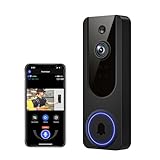
- AI Detection Precision: Advanced AI intelligently identifies humans while filtering out unnecessary motion alerts.
- Clear Night Vision: Equipped with four IR LEDs, the camera captures detailed footage even in darkness.
- Two-Way Audio Support: Communicate with anyone at your door from anywhere using your smartphone.
- Real-Time Alerts: Be notified instantly when motion is detected or someone rings the bell.
- Encrypted Cloud Storage: Safely store your recordings with AES-128 encryption. With a cloud subscription, you can live view, save, and replay recorded videos. Without a cloud subscription, core features such as two-way audio, human detection, and real-time notifications remain available.
How to judge a PAD result
When a system or vendor cites a liveness or replay-detection result, check whether the evaluation matches the threat and conditions you care about:
Quick Recap
- Attack type: Was the test for print, replay, zoomed replay, synthetic faces, or software injection? A result for one does not automatically cover the others.
- Operating point: What APCER and BPCER were reported, and at which threshold? A single error rate hides the trade-off.
- Capture conditions: Was it a still image or video, offline or live, and did the test reflect relevant resolution, compression, cameras, and lighting?
- Evaluation quality: Was the result independently evaluated, and do the dataset and attack instruments resemble the intended deployment?
- Identity assurance: Does the process separately verify the person’s claimed identity? PAD is not identity authentication by itself.
Product prices and availability are accurate as of the date/time indicated and are subject to change. Any price and availability information displayed on Amazon at the time of purchase will apply.




