These 17 free, open-source tools support different ways of using a computer: screen reading, Braille, speech input and output, alternative text entry, pointer access, and practice. They are not interchangeable, and a Linux-oriented list does not mean every tool works on every Linux desktop. Choose by the access task, the applications and desktop environment involved, and the devices the user relies on; check each project’s current documentation before installing.
How to choose among universal access tools
Start with the task the person needs to accomplish, not a general label such as “accessibility software.” A screen reader presents interface information through speech or Braille; a speech-recognition engine turns spoken commands into computer input; a virtual keyboard provides an alternate way to enter text. Those functions may complement one another, but they solve different problems.
As an Amazon Associate I earn from qualifying purchases.
- Task: Is the need to read screen content, enter text, control a pointer, use Braille, or practice an access method?
- System and desktop: Confirm operating-system, desktop-environment, and session compatibility for the specific tool.
- Applications and accessibility interfaces: Check whether the software a person needs to use exposes information through an interface the assistive tool can access.
- Input and output: Identify any required keyboard, pointing device, Braille display, microphone, or audio output.
- Project documentation: Verify current installation steps, supported configurations, and maintenance status directly with the project.
There is no user-independent ranking or single best choice established for this group. GNU’s accessibility guidance recommends compatible accessibility APIs, following W3C accessibility guidance, and seeking feedback from disabled users; these are useful principles, not evidence that every tool below meets a particular standard. GNU’s accessibility guidance offers further context.
Screen reading, Braille, and spoken feedback
Orca
Orca provides graphical desktop access through customizable combinations of speech and/or Braille. Its project says it works with applications and toolkits that support AT-SPI, the primary assistive-technology infrastructure for free and open desktops. That makes application and toolkit support a key compatibility check. See the Orca project overview.
#1 Best Overall
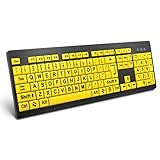
- ⌨【Large Print Keyboard】With letter characters larger than usual and command keys in a larger bolder font, these high-contrast keys can really help those who have trouble seeing keyboards. Perfect for elderly, the visually impaired, schools, special needs departments and libraries, as well as companies.
- ⌨【Spill resistant keyboard】It is designed to keep electronic components of keyboard safe. Water-Resistant function protection against accidental spills provides extra peace of mind. Be sure to air dry completely after spill before further use.
- ⌨【High Contrast】Large print keyboard offers increased visibility with easy to see yellow key caps and crisp large print black letters, Easily seen print, even in low light. With a life cycle of 5 million keystrokes, membrane key switches provide a faster response along with a quieter typing experience.
- ⌨【Ergonomics Design】Unfold the feet at back of the keyboard to reduce hand fatigue and enjoy long hours of playing. Full QWERTY English (US) 104 key keyboard layout with numeric keypad, Large Print keys provides superior comfort without forcing you to relearn how to type.
- ⌨【Wide Compatibility & Lifetime After-Sales Service】Compatible with Windows 10 / 8 / 7 / Vista / XP / 2000 / 98 | Also works with Mac OSX and macOS. Easy to install with plug and play technology | No additional software required.Except for Windows systems, other system hotkeys may not work and are only used for typing
Liblouis
Liblouis translates text to Braille and back, and can format Braille. It is a translation and formatting component, rather than a screen reader or a Braille display.
Speakup
Speakup is a kernel-based speech synthesizer driver suite. Its role differs from a graphical screen reader such as Orca; check the project’s documentation for the intended system configuration and supported hardware.
BRLTTY
BRLTTY gives Braille users access to text consoles. It addresses console access, a different setting from graphical desktop access.
Recommended Free Tools
Emacspeak
Emacspeak provides spoken output for Emacs. Its scope is the Emacs environment rather than general access to every application on a desktop.
Rank #2

- SEE WITH EASE, TYPE WITH CONFIDENCE – Featuring large, bold print, this large font key board makes every character easy to see. A great solution for seniors, students, and visually impaired users who want a more comfortable computer keyboard experience.
- SEE KEYS CLEARLY IN ANY LIGHT – Work day or night with a lighted keyboard for PC that includes 7 colors and 4 brightness levels. This backlit keyboard design ensures the keyboard light up keys stay visible in dim rooms, offices, or late-night study sessions.
- BOOST YOUR PRODUCTIVITY – The full-size 107-key layout includes a number pad and 12 shortcut keys, making this keyboard wired perfect for faster navigation, smoother workflow, and more efficient typing on any project.
- PLUG AND PLAY RELIABILITY – A simple USB keyboard connection delivers instant setup for PC, Chromebook, or as a keyboard for laptop. No software required, just connect this wired keyboard and start typing right away.
- DURABLE AND DEPENDABLE DESIGN – Built to handle daily use, this desktop keyboard is a long-lasting solution for home, office, or shared workspaces. A reliable keyboard designed for comfort and ease of use.
KMouth
KMouth speaks text entered by the user. This is a text-to-speech aid for producing spoken output, not speech recognition that transcribes what a person says.
Alternative text entry and speech input
Florence Virtual Keyboard
Florence is an extensible, scalable virtual keyboard. It can provide an on-screen text-entry option; confirm that its current version fits the target desktop and the user’s preferred access method.
Maliit
Maliit is a virtual keyboard plug-in for the Maliit Framework. Its framework relationship matters: check whether the intended environment uses a compatible framework rather than assuming it functions as a standalone desktop keyboard.
Do these 3 things before closing this tab:
1Repair Windows errors before they cause bigger problems2Scan for outdated or missing drivers - takes under a minute3Clear out junk files and repair common Windows errorsJulius
Julius is a large-vocabulary, continuous speech-recognition engine. It converts speech into recognized input; it is not a speech-output tool. Check project documentation for setup and application integration.
Rank #3

- All-day Comfort: The design of this standard keyboard creates a comfortable typing experience thanks to the deep-profile keys and full-size standard layout with F-keys and number pad
- Easy to Set-up and Use: Set-up couldn't be easier, you simply plug in this corded keyboard via USB on your desktop or laptop and start using right away without any software installation
- Compatibility: This full-size keyboard is compatible with Windows 7, 8, 10 or later, plus it's a reliable and durable partner for your desk at home, or at work
- Spill-proof: This durable keyboard features a spill-resistant design (1), anti-fade keys and sturdy tilt legs with adjustable height, meaning this keyboard is built to last
- Plastic parts in K120 include 51% certified post-consumer recycled plastic*
squeekboard
squeekboard is a keyboard-shaped input method for Wayland. Its Wayland context is central to deciding whether it fits a particular desktop session.
GOK (GNOME On-Screen Keyboard)
GOK is an on-screen keyboard associated with GNOME. Verify its current availability and compatibility in the GNOME environment you plan to use.
CoreKeyboard
CoreKeyboard is a virtual keyboard with word suggestions. Whether suggestions and the keyboard’s interaction model suit a user depends on their needs and the applications in use.
The Tool Desk
Outbyte PC Repair FREEClear out junk files and repair common Windows errorsFree Scan →Outbyte Driver Updater FREEScan for outdated or missing drivers - takes under a minuteDriver Scan →Dasher
Dasher uses graphical predictive text entry. It offers a different interaction model from a conventional on-screen keyboard, so personal testing is important before relying on it for regular work.
Rank #4
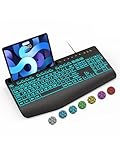
- Large Print Keyboard: SABLUTE Large Print Backlit Keyboard features an oversized font keys design. Alleviate your eyes, reduce typing errors, ideal for seniors, students, office workers, and those with visual impairments
- Wrist Fatigue Relief: The computer keyboard designed with a palm rest, bottom support. Ergonomic keyboard layout reduces wrist fatigue and discomfort during prolonged use
- Choose Your Backlight: The Backlit keyboard has 7 levels of brightness and 7 different colors. Backlit can choose to turn on/off and adjust brightness, making it more convenient to type in low-light environments(The lights do not have a memory function!)
- Phone and Tablet Holder: It can help you better watch videos, video conferencing, read materials etc. while using your computer. Please note that this holder doesn't have a charging function
- Plug and Play: The wired keyboard does not require batteries or charging, just connect it to a USB port and you can use it directly. The wired setting makes the connection more stable and typing without delay
Pointer control, remapping, and practice
keymapper
keymapper supports context-aware remapping, layers, shortcuts, and macros. Its purpose is to change how input is mapped, rather than provide screen reading or speech output.
Mouse actions
Mouse actions lets users issue commands from mouse events. Check which events and commands the current implementation supports and whether they fit the user’s pointing method.
KMouseTool
KMouseTool automatically clicks when the pointer pauses. This can help with a particular pointer-control workflow, but the pause-and-click behavior should be evaluated in the applications where it will be used.
borse
borse supports practice with Braille, Morse, and semaphore. It is a practice tool, not a general screen reader, text-entry keyboard, or accessibility interface for other software.
Best Value

- 【Large Print Keyboard】- 4X larger than standard keyboard fonts, clear and easy to find, and can really help those who have trouble seeing keyboards. Perfect for elderly, the visually impaired, schools, special needs departments and libraries, etc
- 【White LED Backlight】- Bright and evenly distributed backlit keys, easy typing in lower light environment. Ideal for studio work, office. Backlit can choose to turn on/off and adjust brightness.
- 【Full Size & Ergonomics Design】- Unfold the feet at back of the keyboard to reduce hand fatigue and enjoy long hours of playing. Full QWERTY English (US) 104 key keyboard layout with numeric keypad, Large Print keys provides superior comfort without forcing you to relearn how to type.
- 【Plug and Play & Wide Compatibility】 - This USB keyboard takes away the hassle of power charging or swapping out batteries and is easy to setup. No drivers required.Compatible with Windows 2000/XP/7/8/10, Vista,Raspberry Pi 3/4, Mac OS(Note: Multimedia keys may not fully compatible with Mac, OS System).Works with your PC, laptop.
- 【Spill-proof】- This durable keyboard features a spill-resistant design. So you don't have to worry about spilling coffee and water. Enjoy Keys life of more than 5000W times.
Accessibility testing and AAC are related, but separate
Assistive applications help people access or control computing; accessibility testing tools help evaluate websites and software. Section508.gov lists ANDI, browser developer tools, and a color contrast analyzer for different testing needs. It describes ANDI as a free, open-source bookmarklet developed by the Social Security Administration, and its Color Contrast Analyzer as a free, open-source tool useful where ANDI cannot programmatically identify contrast. Automated checks do not answer every accessibility question. See the Section508.gov ICT testing tools page, reviewed or updated in July 2026.
Augmentative and alternative communication (AAC) resources are another adjacent area, not an eighteenth entry in this tool list. OpenAAC describes its work as creating “free, open standards for the AAC community, and free, open-licensed materials and tools.” Its resources may be relevant to questions such as system choice, vocabulary portability, symbols, learning materials, integrations, and voice output. Explore OpenAAC’s resources for that context.
Scope and compatibility limits
The 17 tools were listed by LinuxLinks on August 22, 2026, in an article focused on free and open-source universal access software. Their functions span distinct tasks, and the list alone does not establish current release status, compatibility on every Linux distribution or desktop, accessibility outcomes, or comparative performance. Treat the names as options to investigate, not as a tested ranking; project documentation is the place to confirm current installation and configuration details.
What’s actually slowing this PC down?
Pick the symptom - the matching free tool is one click away.
Quick Recap
Product prices and availability are accurate as of the date/time indicated and are subject to change. Any price and availability information displayed on Amazon at the time of purchase will apply.




