I use my Steam Deck as a desktop for most of the week, and the only thing I needed to add was a dock. That describes my setup, not a guarantee that everyone can replace a desktop PC the same way. Valve provides the essentials: SteamOS includes the KDE Plasma desktop, and the Deck can send video to an external display over USB-C. A dock mainly makes connecting a monitor, keyboard, mouse, network cable, and power easier.
Can you use a Steam Deck as a desktop?
Yes. Valve lists SteamOS 3 and the KDE Plasma desktop environment in the Deck’s technical specifications, and describes the OLED model as usable as a PC. In desktop mode, the Deck gives you a conventional desktop interface for supported applications and general computer tasks. That establishes capability; it does not mean every desktop application or workload will suit the device.
As an Amazon Associate I earn from qualifying purchases.
To use a larger screen, you do not need a dock specifically: the Deck’s USB-C port supports DisplayPort 1.4 Alt Mode. Valve lists capability up to 8K at 60 Hz or 4K at 120 Hz for the Deck’s USB-C display connection. These are manufacturer specifications, not a promise that any particular monitor, cable, adapter, or configuration will reach those modes. See Valve’s Steam Deck technical specifications.
Do these 3 things before closing this tab:
1Clear out junk files and repair common Windows errors2Fix the driver behind crashes, sound loss and screen glitches3Repair Windows errors before they cause bigger problemsWhat the dock adds to a desk setup
A dock turns the Deck’s single USB-C connection into a more convenient set of desk connections. Valve’s Docking Station includes HDMI 2.0, DisplayPort 1.4, three USB-A 3.1 Gen 1 ports, Gigabit Ethernet, and USB-C power passthrough. Valve specifies support up to 4K at 60 Hz or 1440p at 120 Hz for the dock. Those figures describe the dock’s listed capability; actual output depends on the connected equipment and setup.
#1 Best Overall

- Upgraded 6-in-1 Docking Station: Features HDMI 2.1 4K@120Hz output for ultra-smooth, crystal-clear visuals, plus 100W PD charging, 3 fast USB A 3.0 ports, and a ultra-fast Gigabit Ethernet connection. Now supports ROG Ally X and Legion Go S, giving you more ways to enjoy a seamless big-screen gaming experience. NOTE: Not for ROG XBOX Ally / XBOX Ally X.
- 4K@120Hz HDMI Output (Upgraded): Experience double the refresh rate compared to the previous 4K@60Hz version. Whether you’re battling online or watching cinematic cut-scenes, enjoy buttery-smooth gameplay and reduced screen tearing on external monitors.
- Full-Speed 100W Charging: Supports up to 100W PD charging, easily powering your handheld in Turbo Mode. Keeps your gaming sessions uninterrupted — no need to worry about battery drain even during marathon play. Note: The ROG Ally's 30W Turbo Mode is fully supported, but a 100W charger is recommended.
- Gigabit Ethernet: Enhance your gaming with gigabit Ethernet for seamless online play, rapid updates, and quick file transfers. Enjoy lightning-fast downloads and uploads, eliminating lag and latency for uninterrupted sessions.
- Expanded Device Compatibility: Now works with Steam Deck LCD/OLED, ROG Ally / Ally X, Legion Go / Go S, and MSI Claw — making it your all-in-one solution across multiple handhelds. NOTE: Not for ROG XBOX Ally / XBOX Ally X.
The practical benefit is less plugging and unplugging. Connect the monitor, keyboard, mouse, wired network, and power to the dock, then connect the Deck. Valve describes using a keyboard and mouse on up to two external displays with its Docking Station. Its specifications also note that MST multi-monitor support currently requires both HDMI and DisplayPort connections; check Valve’s live product information if that configuration matters to you, since the page describes a software update as forthcoming.
Valve’s Docking Station page lists a price of $79 when accessed; the page does not state a publication date, and the displayed price may change. The product details are at Valve’s Steam Deck Docking Station page.
Rank #2
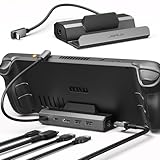
- Upgraded 5-in-1 Docking Station: Features HDMI 2.1 4K@120Hz output for ultra-smooth, crystal-clear visuals, plus 100W PD charging, dual USB A 2.0 ports, and a reliable Ethernet connection. Now supports ROG Ally X and Legion Go S, giving you more ways to enjoy a seamless big-screen gaming experience. NOTE: Not for ROG XBOX Ally / XBOX Ally X.
- 4K@120Hz HDMI Output (Upgraded): Experience double the refresh rate compared to the previous 4K@60Hz version. Whether you’re battling online or watching cinematic cut-scenes, enjoy buttery-smooth gameplay and reduced screen tearing on external monitors.
- Full-Speed 100W Charging: Supports up to 100W PD charging, easily powering your handheld in Turbo Mode. Keeps your gaming sessions uninterrupted — no need to worry about battery drain even during marathon play. Note: The ROG Ally's 30W Turbo Mode is fully supported, but a 100W charger is recommended.
- Reliable Wired Ethernet: Enjoy a stable and consistent network connection with the built-in RJ45 port, ensuring low-latency performance for smooth online gaming and streaming.
- Expanded Device Compatibility: Now works with Steam Deck LCD/OLED, ROG Ally / Ally X, Legion Go / Go S, and MSI Claw — making it your all-in-one solution across multiple handhelds. NOTE: Not for ROG XBOX Ally / XBOX Ally X.
Do you need the official Steam Deck dock?
No. Valve says its compatibility work extends to third-party hubs and docks, and its FAQ likens docking to connecting a USB-C hub to a PC. That is not a certification of every accessory or evidence that all models offer the same ports, power delivery, display modes, or multi-monitor behavior.
Choose by the connections your desk actually needs. Check the specific model for:
Rank #3

- 6-in-1 USB-C Hub: Connect, charge, and play without limits thanks to a 100W PD-IN port for fast charging, a 4K HDMI output, a 1Gbps Ethernet port, two USB-A ports at 5Gbps each, and one USB-C port at 5Gbps.
- See Every Detail: The 4K@60Hz HDMI port brings your games to life with stunning resolution and crystal-clear imagery.(Note: The USB-C data port does not support screen mirroring.)
- Ultra-Speed Ethernet: Dominate online play with lightning-fast 1,000 Mbps Ethernet, where every millisecond counts.
- Unlimited Connections: Maximize your gameplay with versatile USB ports, offering 5Gbps speed for mice, keyboards, game controllers, and more.
- What You Get: Anker USB-C Hub (6-in-1, For Handheld Game Console), 8.66-inch (220 mm) built-in USB C cable, welcome guide, 18-month warranty, and our friendly customer service.
- Video: HDMI or DisplayPort, and whether its stated resolution and refresh rate suit your monitor.
- USB: Enough ports for your keyboard, mouse, storage, or other devices.
- Power: Whether it supports USB-C power delivery and whether a suitable charger is included. Valve’s official dock provides power passthrough; check third-party product details for their own terms.
- Network: Gigabit Ethernet if you want a wired connection.
- Form factor: Size, cable arrangement, and whether the Deck can sit securely where you plan to use it.
- Compatibility: The exact Deck model and display arrangement, especially if you want multiple monitors.
If you only need video output and already have a suitable adapter, the Deck’s USB-C display support means a full dock may be unnecessary. If you want several desk peripherals connected at once, a hub or dock can reduce cable swapping. Valve’s general compatibility statement does not establish that a particular third-party model meets your requirements; verify the model’s specifications and compatibility independently.
Independent reader supportYour contribution helps us test, update, and keep practical guides available for everyone.What else belongs in a desktop setup?
A dock is not a screen or an input device. For a desktop-style workspace, you need an external display and keyboard and mouse unless you already own them or are content using the Deck’s built-in controls and screen. Valve specifically presents keyboard-and-mouse use with its dock and external displays, but these peripherals are optional additions, not requirements for docking.
Rank #4

- Adjustable Stand for Tailor-Made Comfort: The docking station has a stand composed of two foldable panels. Therefore, the back panel no longer blocks the heat dissipation outlet of the gaming consoles, greatly enhancing the heat dissipation effect.
- 10Gbps Fast Transmission: This USB C Dock has two USB 3.2 Gen 2 interfaces (1A1C) with a transmission rate of up to 10Gbps. It supports external mobile hard drives and USB flash drives and can transfer game files at high speed. There are also two USB-A 2.0 interfaces that support keyboard, mouse, gamepad receivers, etc., effectively reducing delays and interference.
- Ultra-clear Screen Projection: The Steam deck dock supports up to 4K (3840x2160) @60Hz, backward compatible with 4K@30Hz, 2K (2560x1440) @60Hz, 1080P (1920x1080) @120Hz.At the same time, it supports high brush resolutions such as 2K@144Hz, 2K@120Hz, 1080P@240Hz, and 1080P@144Hz.
- PD 100W Fast Charging: Supporting up to 100W power delivery, this docking station ensures your Type-C game device charges at maximum speed. Perfectly supports ROG Ally 30W Turbo mode to unleash surging performance.Note: Steam Deck max charging speed is 45W, while ROG Ally reaches 65W.
- Widely Compatible: This handheld gaming dock is widely compatible with gaming consoles such as Steam Deck, ROG Ally, ROG X, ROG Xbox Ally, LEGION Go and MSI Claw A1M. Also it is widely compatible with various USB-C devices to meet a variety of needs,like iPad Pro/Air, Surface Pro8 & Go 3. Not compatible with Swith 2
Before buying anything, list what you already have and the connections it uses. A monitor with HDMI, for example, may call for a different dock connection than a DisplayPort-only display. Also decide whether you need wired Ethernet, several USB devices, or one or more external screens; those needs determine whether a basic adapter, a hub, or a larger dock makes sense.
What’s actually slowing this PC down?
Pick the symptom - the matching free tool is one click away.
Does docking the Deck improve performance?
No. Valve says docking is more like plugging a USB-C hub into a PC and that the Deck runs at full performance in portable mode. A dock changes connectivity and workspace convenience; it does not boost the Deck’s computing performance. Valve’s answer is in its Steam Deck FAQ.
Quick Recap
Product prices and availability are accurate as of the date/time indicated and are subject to change. Any price and availability information displayed on Amazon at the time of purchase will apply.




