Speech Synthesis Markup Language (SSML) lets you give a text-to-speech engine structured hints about how to speak text. It can help clarify pronunciation, numbers, pauses, sentence structure, and delivery—but it does not guarantee identical results across services or voices. The practical goal is more controlled output that suits your use case, not an automatic increase in naturalness.
What is SSML?
SSML is XML-based markup that supplies information to a speech synthesis processor. The processor parses the document, interprets its structure, converts written text into a spoken form, and generates speech. That conversion matters because a written amount, fraction, date, or abbreviation can have more than one plausible reading.
As an Amazon Associate I earn from qualifying purchases.
Markup can make your intended reading clearer, but it is guidance rather than a recording of the exact sound to produce. The W3C standard says, “The processor has the ultimate authority to ensure that what it produces is pronounceable (and ideally intelligible).” The processor’s behavior depends on the element and implementation. See the W3C Speech Synthesis Markup Language (SSML) Version 1.1.
How can SSML make text-to-speech sound better?
Use SSML to address a specific problem in the spoken output. Depending on the provider and target voice, controls may include breaks, pronunciation or interpretation hints, language and voice selection, rate, pitch, volume, emphasis, and inserted audio. These are not universally available or consistently rendered.
#1 Best Overall

- BUILT FOR DICTATION & VIBE CODING – Talk to your AI assistant, dictate code, or draft documents by voice. The Movo WebMic's clear, close-up capture means fewer transcription errors so your words land right the first time.
- CARDIOID PICKUP FOR CLEAN VOICE-TO-TEXT – The directional cardioid capsule focuses on your voice and rejects noise from behind, giving speech-to-text engines and AI prompts the clean input they need to stay accurate.
- HANDS-ON CONTROLS, ONE-TOUCH MUTE – Built-in knobs adjust mic gain and headphone monitoring level, a 3.5mm headphone jack lets you hear yourself live, and one-touch mute keeps you in control during calls and long coding sessions.
- PLUG AND PLAY ON PC & MAC – Connect over USB with no drivers or extra hardware. Works instantly with your dictation app, AI coding tools, and voice typing — the LED glows to show you're connected and turns red when muted.
- DESKTOP STAND + 1-YEAR WARRANTY – Includes a desktop stand that keeps the mic at talking distance on your desk, backed by friendly US-based support and a 1-year warranty.
Add pauses and clarify structure
A break can guide pacing, for example <break time="500ms"/>. Paragraph and sentence elements can also communicate structure. Engines may infer pauses from linguistic context, so explicit breaks are most useful when the default timing is wrong. Google’s documentation demonstrates a three-second break as a syntax example; it is not a recommended pause length for every voice.
Guide pronunciation and interpretation
Where supported, <say-as> can tell the engine how to interpret a number or character sequence. A substitution element can provide a spoken expansion for text such as an abbreviation: <sub alias="World Wide Web Consortium">W3C</sub>. Interpretation labels and pronunciation features differ between services, so verify the exact syntax for your target engine.
Rank #2

- [Crystal-Clear Voice Capture in Noisy Environments]: Powered by the advanced XMOS XVF3800 voice processor, this 360° circular 4-microphone array delivers exceptional far-field audio clarity up to 5 meters. With built-in AEC, adaptive beamforming, dereverberation, DoA, VAD, dynamic noise suppression, and 60dB AGC—ensuring your voice stands out even in loud, echo-filled, or reverberant environments.
- [360° Far-Field Voice Pickup up to 5 Meters]: Equipped with a circular array of 4 high-sensitivity digital MEMS microphones, the device captures sound from every direction with built-in Direction of Arrival (DoA) detection, enabling accurate voice recognition from up to 5 meters away — perfect for smart assistants, meeting rooms, robotics, and full-room smart home voice coverage.
- [Plug & Play USB – No Drivers Required]: Simply connect via USB and it works instantly as a standard plug-and-play USB microphone. Ships with USB audio firmware pre-installed — no additional MCU, no programming, no driver installation needed. Fully compatible with Windows, macOS, Linux, Raspberry Pi, and NVIDIA Jetson — ideal for developers, makers, and AI voice applications right out of the box.
- [Flexible Integration for AI, IoT & Voice Projects]: Supports two mutually exclusive, firmware-selectable modes — USB (default, plug-and-play) and I2S (via DFU reflash, requires external MCU like ESP32 or Arduino). Ideal for smart home, voice AI, conferencing, robotics, and custom embedded voice projects.
- [Enclosed Design for Easier Deployment]: Comes with a protective case featuring a programmable RGB LED ring for cleaner desktop installation and easier handling. Compared with the bare-board version, it's more convenient for prototyping, testing, demos, conference calls, and product evaluation — ready to use out of the box with no assembly required.
Adjust delivery
Some engines expose rate, pitch, volume, and emphasis controls. Their availability can depend on voice family: Amazon Polly’s support matrix, for instance, marks prosody as partial for listed voice families and emphasis as unavailable for neural, long-form, and generative voices. Check the support for the actual voice rather than assuming a tag works throughout a service.
Switch voice or language, or connect speech to an application
Voice and language elements can help with text that changes speaker or language, but the syntax and compatible combinations are provider-specific. Google notes that some language combinations may produce poor or unsupported results. For application timing, Google documents mark timepoints when a request enables SSML_MARK; Microsoft documents bookmark and viseme events that an application can process. Audio insertion and style controls are also service-specific, not universal SSML capabilities.
Rank #3

- 【8,400 HOURS OF FILE STORAGE】The high-capacity storage supports up to 8,400 hours of recording files at 32Kbps, providing ample space for lectures, meetings, interviews, voice notes, and other important audio. Spend less time managing files and more time capturing the information you need.
- 【MAGNETIC DESIGN】Built-in magnets allow the digital voice recorder to attach securely to compatible metal surfaces, including desks, shelves, rails, refrigerators. The magnetic design provides flexible, hands-free recording for work, study, and daily use.
- 【SLIDE-TO-RECORD OPERATION】This audio recorder start recording without navigating complicated menus. Simply slide the side switch to ON, and the indicator light blinks before turning off as recording begins. Slide it back to OFF to save the file and stop recording, making operation quick and straightforward.
- 【AI TRIPLE NOISE REDUCTION】The sound recorder equipped with an advanced AI DSP 5.0 chip and triple digital noise reduction technology, this voice recorder intelligently reduces unwanted background noise while enhancing vocal clarity. Suitable for meetings, lectures, interviews, classes, and everyday voice notes.
- 【HD RECORDING】Featuring an upgraded high-definition microphone and adjustable recording bitrates from 512Kbps to 3072Kbps, this audio recorder lets you select the preferred balance between sound detail and file size. A practical recording tool for students, teachers, professionals, writers, and anyone who regularly records important information.
Does SSML work with every text-to-speech voice?
No. Providers implement different subsets of the W3C standard, and support can vary by voice. Google documents a supported subset; Amazon Polly lists tag availability by voice type and may return an error for an unsupported tag; Microsoft says SSML support differs by voice and may differ from the W3C specification. Consult the provider’s current documentation for the exact service, voice, and language you plan to use:
- Google Cloud Text-to-Speech SSML
- Amazon Polly supported SSML tags
- Microsoft Azure Speech synthesis markup structure
A result from one voice is evidence only for that voice and engine. If you need to compare services, check supported tags and pronunciation controls, prosody and style options, language and voice switching, testing workflow, and request limits. Then listen to the output for your actual product need; no universal best engine follows from SSML support alone.
Rank #4
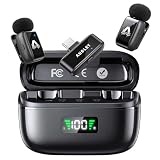
- 48 kHz / 24-bit Audio: Capture clear, detailed sound with this mini microphone’s 48 kHz sampling rate, 24-bit depth and 64 dB signal-to-noise ratio. Its 20 Hz–20 kHz frequency response helps preserve natural voice detail for videos, interviews, livestreams and online teaching
- Microphone for Content Creators: Designed for vloggers, YouTubers, TikTok creators, podcasters, journalists and educators, this mini microphone for vlogging delivers portable audio for social media videos, interviews, podcasts, livestreams and mobile content creation
- AI Noise Reduction and AI Voice Changer: Choose from three AI noise reduction levels to reduce wind, traffic and ambient sounds while keeping your voice clear and natural. The AI voice changer offers three modes—Original, Male and Female—for short videos, livestreams and creative social media content
- Up to 25 Hours with Charging Case: Each transmitter provides up to 5 hours of recording per charge. The compact charging case extends total use up to 25 hours and includes a battery display, helping podcasters, interviewers and video creators check available power before longer sessions
- Two Mics for Two-Person Recording: Two transmitters capture two speakers at the same time for interviews, podcasts, teaching and collaborative videos. The 2.4 GHz wireless system provides approximately 30 ms low latency and up to 65 ft (20 m) range in open areas
How to write and test SSML safely
- Start with plain text. Synthesize it with the intended voice and identify one concrete issue, such as a misread abbreviation, ambiguous date, or awkward transition.
- Add the smallest relevant markup. Confirm the required document wrapper, element, and attributes in the documentation for the exact service and voice.
- Escape literal reserved characters. Inside XML text, characters such as ampersand and angle brackets need escaping. Google lists
",&,',<, and>as escape codes. - Synthesize and listen. Use the provider’s console, demo, API, SDK, or CLI. Microsoft lists Speech Studio audio content creation, the batch synthesis API, Speech CLI, and SDK options; Google and AWS document their own console, API, or CLI workflows.
- Compare marked and unmarked audio. Keep the markup only if it improves the intended reading. Test again with the target language and voice before relying on the result.
- Check limits and metering. Markup can count toward usage limits or billing. Google says SSML characters count toward character limits. Microsoft says punctuation is billable and optional elements used to adjust conversion can count as billable characters. Check current provider rules before scaling.
This illustrative snippet combines a time interpretation, a pause, and an abbreviation expansion. Adapt it to the target service; the tags and attribute values are not guaranteed to work unchanged everywhere.
What’s actually slowing this PC down?
Pick the symptom - the matching free tool is one click away.
<speak>
  Your appointment is <say-as interpret-as="time">3:30 PM</say-as>.
  <break time="400ms"/>
  <sub alias="World Wide Web Consortium">W3C</sub> publishes the SSML standard.
</speak>What SSML cannot guarantee
SSML does not ensure that every engine will pronounce a phrase the same way, honor every element, or sound more natural after markup is added. There is no established cross-provider improvement rate showing that SSML generally improves voice quality. Treat each change as a targeted instruction, and judge it by listening to the generated speech on the voice and service you will actually use.
Quick Recap
Best Value

- Plaud Intelligence: Capture conversations in 112 languages and generate accurate transcripts with the Plaud App and Web. Plaud Intelligence uses leading models like GPT-5.5, Claude Sonnet 4.6, and Gemini 3.1 Pro to transform raw audio into structured insights. Choose from over 10,000 professional templates to generate mind maps and to-do lists, turning hours of discussion into immediate clarity
- Multiple Ways To Wear With Included Accessories: Adapt Plaud NotePin S to any workflow instantly with four included accessories. Wear your device effortlessly as a necklace, wristband, clip, or pin. Plaud NotePin S features a dedicated physical record button for precise, tactile control. Stay professional and keep your intelligence within reach all day
- Enterprise-grade Privacy: Built to the highest standards with ISO 27001/27701, SOC 2, HIPAA, GDPR, and EN18031 compliance. Every conversation is secure and protected. It is the trusted choice for creative, medical, and business professionals handling sensitive info
- Multimodal Input & Multidimensional Summaries: Capture audio, type notes, add images, and press/tap to highlight for richer context with multimodal input. Press the record button to mark key moments in real time. Plaud transforms a single conversation into multiple perspectives, providing faster, clearer insights, and unifies these inputs to deliver role-specific summaries that reflect your intent and priorities
- Lightweight Power and Peace of Mind: Weighing only 0.61 oz, Plaud NotePin S delivers 20 hours of continuous recording and 40 days of standby time. Store up to 64GB of audio locally, ensuring you capture every insight even without an internet connection
Product prices and availability are accurate as of the date/time indicated and are subject to change. Any price and availability information displayed on Amazon at the time of purchase will apply.




