Do these 3 things before closing this tab:
1Repair Windows errors before they cause bigger problems2Fix the driver behind crashes, sound loss and screen glitches3Clear out junk files and repair common Windows errorsTo run a private video-conferencing service, you need more than a video server: you need a client, signaling and room coordination, a media-routing layer, secure public networking, and ongoing operations. For a ready-made conferencing product, start by evaluating Jitsi Meet; for a custom app on a self-hosted media platform, consider LiveKit; choose mediasoup when you want low-level media control and can build more of the surrounding application.
Choose the right implementation path
The main decision is how much of the conferencing product you want to build yourself. These projects occupy different layers, so they are not interchangeable packages with a neutral, directly comparable performance ranking.
As an Amazon Associate I earn from qualifying purchases.
| Option | Best suited to | What your team takes on |
|---|---|---|
| Jitsi Meet | Deploying an integrated conferencing application and customizing it as needed. | Operating its web client, XMPP signaling, conference focus, and video bridge. Recording or telephone access can require additional services. |
| LiveKit | Building a custom product on a self-hostable SFU platform. | Creating the product experience and application behavior around the media platform, then choosing and operating a VM, Kubernetes, or multi-region deployment as appropriate. |
| mediasoup | Teams that need control over media routing and have the engineering capacity to build the surrounding system. | Implementing signaling and application orchestration, then distributing rooms across workers and hosts as demand requires. |
Compare the options by application features included, control required over media, deployment and operations workload, recording or telephony needs, and your team’s ability to test and operate real-time infrastructure. The projects’ documentation describes their architectures and deployment approaches, but does not establish a common benchmark that ranks them under the same workload.
Define the workload before choosing capacity
Write down the meeting patterns the service must support before selecting hardware or advertising a room-size limit. A camera-heavy group call puts different demands on the system than a presentation watched by many people.
#1 Best Overall

- 【Built for Small Conference Rooms】Designed specifically for small meeting spaces, this conference room camera system ensures every participant is clearly visible without crowding.
- 【AI Auto Framing for Group Meetings】Automatically detects and frames all attendees, making it ideal for team meetings, boardroom discussions, and hybrid collaboration.
- 【Presenter Tracking for Business Presentations】Smart AI tracking follows the active speaker, perfect for training sessions, client presentations, and interactive meetings.
- 【120° Wide Angle Covers the Entire Room】Capture the full meeting space without repositioning the camera—no more squeezing into the frame.
- 【Clear Audio Across the Table (Up to 5m)】Dual AI noise-canceling microphones reduce background noise and capture voices clearly across the room.
- Expected number of simultaneous rooms and typical participants per room.
- How many people publish camera video at once, alongside audio and screen sharing.
- Target video resolutions, client platforms, and likely device mix.
- Whether meetings need recording, live streaming, telephone participation, or external media input.
- Where users are located and whether rooms must be served across multiple regions.
Do not promise a maximum meeting size based on a single component’s estimate. Capacity depends on the chosen release, hardware, codecs, network conditions, and room shape; the reviewed project documentation does not establish a generally applicable server size or meeting limit.
Understand the components you need
Client and room experience
The web or mobile client handles the room interface, device selection, participant layout, mute controls, chat, and meeting state. Jitsi’s application uses React and React Native, and its handbook covers feature areas such as authentication, chat, and keyboard shortcuts. A custom product still needs decisions about these user-facing behaviors even if a media platform handles routing.
Signaling and session coordination
Signaling exchanges connection and room state and coordinates participants; it is separate from the audio and video media path. In Jitsi’s architecture, Prosody provides XMPP signaling and Jicofo manages media sessions and bridge selection. With a lower-level media layer such as mediasoup, the application team must build signaling and orchestration rather than assume the media component supplies a complete conferencing product.
Rank #2

- Video-enable huddle and small rooms: All-in-one form factor allows for easy setup of videoconferencing in small and huddle rooms
- Capture with clarity: With an Ultra HD 4K sensor, wide 120° field of view, and 5x HD zoom, see participants and all the action with clarity
- Hear voices with clarity: Beamforming mics capture voices up 4 m away, or extend pick-up to 5m with the optional Expansion Mic
- Motorized pan/tilt: Expand your field of view even further—up to 170°—to pan to the whiteboard or view other areas of interest
- Multiple mounting options: Easily mount to a wall or credenza, or add the TV Mount to place above or below the in-room display for secure mounting
Media plane: SFU or MCU
An SFU receives encoded participant tracks and forwards selected tracks to other participants. It can preserve separate audio and video tracks and adapt spatial or temporal layers to subscriber settings and network capability, without decoding and compositing every participant’s media into a single output. That flexibility has a trade-off: a viewer subscribed to several cameras may receive several streams.
An MCU instead decodes and combines media centrally, then sends a composite stream to each participant. That can reduce client-side bandwidth and simplify the displayed composite, but requires server-side media processing and gives recipients less control over separate tracks. Choose between these approaches based on the product interface, bandwidth profile, and server budget; neither is universally better.
Identity, access, and operations
Decide how users authenticate, who may create or join rooms, and what happens when a host leaves. There is no universal authentication policy established by the reviewed project documentation; configure the chosen stack and application for the audience and risk profile.
Rank #3

- [360° View and 4K Resolution] The COOLPO AI Huddle Pana camera is the solution you need for any video conference system and is designed to make your remote meetings smarter. With its 360 degree all-in-one webcam design, there's no need for stitching. Participants can comfortably sit in a meeting room, like participants in the room rather than watching a meeting. Coolpo camera supports participants immersive and engaging meetings as real face-to-face meetings.
- [Voice Tracking & 8 Mics] With advanced AI, COOLPO smart video conference camera automatically focuses on the active speaker, tracking different people at the same time. Intelligent Zoom optimizes screen space, adjusting focus and display frame based on the highlighted participants. 8 high-quality microphones ensure clear voices within 15ft are captured by this smart meeting camera. The 360° COOLPO all-in-one conference camera with speakers promotes collaboration. Transform spaces into high-end hybrid meeting setups.
- [Secure USB Plug and Play Connect] The COOLPO video conference webcam prioritizes security with its physical USB connection. Setting up the conference room camera is effortless since no driver installation or maintenance is required. Simply select the COOLPO video conference camera as your audio and video device in your preferred meeting software, and you're ready to enjoy smooth online meetings.
- [Stand-alone AI] The COOLPO product algorithms and firmware are stored within the conference webcam's hardware using advanced edge computing technology. This means that all data processing occurs locally, eliminating the need for external data transfers. Also, COOLPO's MeetingFlex AI is built using in-house owned and generated training data, ensuring that no additional data is required from users. This high level of privacy protection is ensured by these robust security measures.
- [After Sale Service] The COOLPO professional customer service team is happy to help you with any additional information you might need, so please contact us anytime and we will answer you in the shortest possible time.
Production operation also includes DNS, TLS certificates, firewall and media networking, secrets, logs, release updates, and storage permissions for persistent application data. These are part of the service, not optional polish after the video works.
Outdated Drivers Are Slowing You Down
One free scan finds every outdated or missing driver and matches the right update for your exact hardware.Free scan · exact hardware matchWindows Errors? Fix Them Before They Spread
Repair common Windows errors and clear accumulated junk for a smoother, more stable PC - no reinstall needed.Free scan · no reinstallDeploy behind a real HTTPS endpoint
Public browser-based WebRTC clients need a secure HTTPS origin and working network configuration. Jitsi’s self-hosting guide recommends an internet server with a certificate for a domain registered in DNS; it warns that direct HTTP access can lead to browser camera and microphone errors. Private-network or self-signed-certificate setups can be more difficult, including on phones.
For Jitsi’s documented Docker route, the broad sequence is to use a release package, create and configure its environment file, set strong internal passwords, prepare writable configuration and storage directories, and start the services with Docker Compose. Set PUBLIC_URL to the actual public domain in a real deployment. Required passwords must be set for the containers to start. Follow the selected project’s current instructions for firewall and media-port settings rather than copying a port list detached from the release and network design.
Rank #4
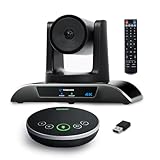
- 【𝟒𝐊 𝐀𝐈 𝐏𝐓𝐙 𝐂𝐨𝐧𝐟𝐞𝐫𝐞𝐧𝐜𝐞 𝐂𝐚𝐦𝐞𝐫𝐚】It has Auto-tracking, 6 gestures control, 5X digital zoom, 120° wide-angle FOV, 1/2.8" Sensor with 8.29 megapixels, Full UHD 4K@30fps resolution, which can rotate 350° horizontally (±175°) and 180° vertically (±90°). Quickly control pan, tilt and zoom by face-tracking, gestures control or remote control(0-9 preset positions). The MENU on the remote allows you to set the PTZ camera parameters. The RS232 & RS485 interfaces support joystick control. USB3.0 Plug & Play.
- 【𝐀𝐮𝐭𝐨-𝐓𝐫𝐚𝐜𝐤𝐢𝐧𝐠 𝐰𝐢𝐭𝐡 𝐆𝐞𝐬𝐭𝐮𝐫𝐞/𝐑𝐞𝐦𝐨𝐭𝐞 𝐂𝐨𝐧𝐭𝐫𝐨𝐥】Gestures enable AI auto-tracking and 5X digital zoom: 👌'OK' to AI-tracking ON and enter multi-human tracking, ✌'V' to enter solo-tracking, 👉'L' to zoom-in(in solo-tracking), ☝'One' to zoom-out(in solo-tracking),👍'Good' to enter multi-human tracking, ✋'Palm' to AI-tracking OFF. AI Function Upgrade: The Gesture function can be ON/OFF in the Menu and Auto-tracking can also be ON/OFF by the remote control.
- 【𝐏𝐫𝐨𝐟𝐞𝐬𝐬𝐢𝐨𝐧𝐚𝐥 𝐂𝐨𝐧𝐟𝐞𝐫𝐞𝐧𝐜𝐞 𝐒𝐩𝐞𝐚𝐤𝐞𝐫𝐩𝐡𝐨𝐧𝐞】multi- connection(USB cable and Dongle), built-In 2400mah battery for 6-8 hours long standby, full duplex audio design with ultra clear sound quality, built-in 2 stereo microphones with noise reduction, 16.4ft/5m audio pickup range, LED indicator & compact design, USB-C/Dongle plug and play, high compatibility.
- 【𝐖𝐢𝐝𝐞 𝐂𝐨𝐦𝐩𝐚𝐭𝐢𝐛𝐢𝐥𝐢𝐭𝐲 & 𝐄𝐚𝐬𝐲 𝐭𝐨 𝐔𝐬𝐞】This 4K PTZ Camera and Speakerphone kit can work with most video conferencing software including Zoom, Skype for Business, Polycom, Microsoft Lync, WebEx, BlueJeans, Facebook Messenger, and more. Compatible with Windows, Mac OS, and Chrome OS. Easy to connect: PTZ Camera -- USB cable -- Computer -- Bluetooth/Wireless Dongle/USB cable -- Microphone.
- 【𝐌𝐮𝐥𝐭𝐢𝐩𝐥𝐞 𝐈𝐧𝐬𝐭𝐚𝐥𝐥𝐚𝐭𝐢𝐨𝐧 𝐎𝐩𝐭𝐢𝐨𝐧𝐬 & 𝐏𝐚𝐜𝐤𝐚𝐠𝐞 𝐋𝐢𝐬𝐭】Package includes 1 * 4K PTZ Camera, 1 * DC 12V/2A power adaptor, 1 * IR remote control, 1 * 9.8ft USB 3.0 cable, 1 * wall mount with screws, 1 * PTZ Camera manual; 1 * Speakerphone, 1 * 4.9ft USB 2.0 cable, 1 * Dongle, 1 * Speakerphone manual. The PTZ camera is available to install on desk, wall mount, tripod mount, ceiling mount. The speakerphone is easy to carry, small and medium-sized meetings can be launched anytime.
A practical first deployment
- Choose one implementation and review the installation instructions for the exact release you intend to run.
- Provision a single-region test environment, register a DNS name, and configure valid TLS.
- Set unique, strong secrets and configure room access for the intended test audience.
- Enable logs and launch a deliberately small test room before adding optional services.
- Document how to update or roll back the deployment, and test the procedure before relying on the service.
Add capabilities only when the product needs them
Recording and live streaming
Jitsi’s Jibri captures rendered conference output by launching Chrome in a virtual framebuffer and encoding with FFmpeg; its Docker instructions configure Jibri as an additional service. LiveKit documents egress for room recording, streaming, and media export. Before enabling recording, decide where files are stored, who can access them, how long they persist, and how participants are informed. The technical documentation does not determine the legal requirements for a particular organization or location.
Telephone, SIP, and external media
Jitsi’s Jigasi gateway allows SIP clients to join, while LiveKit documents a SIP server path. LiveKit also documents ingress for RTMP, WHIP, and external media sources. Each integration adds configuration and operational responsibility, so include it only if it serves a defined user need.
Recommended Free Tools
Geographic distribution and collaboration tools
LiveKit documents multi-region deployment options. Add regions after measuring latency and deciding how rooms are placed and what happens when a region fails. Jitsi’s Docker guide also documents optional Etherpad and Excalidraw integrations; collaborative documents or whiteboards add components that should be treated as separate product requirements.
Best Value

- Spectacular video quality: superb resolution, frame rate, color, and detail, featuring autofocus and 5x digital zoom; this Ultra HD webcam supports up to 4K at 30 fps
- Look great in any light: RightLight 3 automatically adjusts exposure and contrast to compensate for glare and backlighting
- Adjustable field of view: Choose from three dFOV presets to perfectly frame your video; frame an ideal head and shoulders view with 65° diagonal, and more of the room with 78° or 90° diagonal
- Sound excellent anywhere: With dual omnidirectional microphones and noise-canceling tech, this webcam with microphone captures clear audio from up to 1.2 meter away while reducing background noise
- Make it your own: The Logi Options+ app (3) simplifies personal device control with zoom in/out, color presets, color adjustments, set manual focus, and easy firmware updates
Measure and scale with your actual meeting patterns
Load-test the chosen stack under the room shapes and client mix you expect, increasing publishers and subscribers gradually. Record CPU, memory, network throughput, packet loss, reconnection behavior, and audio and video quality. Test camera-heavy calls separately from one-presenter, many-viewer sessions; the number of participants alone does not describe the workload.
For mediasoup, a worker is a C++ subprocess that uses one CPU core, and routers belong to workers. Its scalability documentation says a subprocess can “typically handle over ~500 consumers in total,” conditional on host CPU capabilities. That is an implementation-specific estimate, not a participant guarantee: the same documentation illustrates that four peers each consuming the other three peers’ audio and video create 24 consumers, and warns that a single router can be exceeded in large one-to-many cases.
LiveKit documents an SFU that can split work across nodes and adjust track parameters to subscriber bandwidth, as well as benchmark and deployment material for self-hosting. Treat any published capacity result as specific to its release, hardware, codecs, network, and room shape. There is no directly comparable benchmark across Jitsi, LiveKit, and mediasoup for one shared test environment in the cited documentation.
What’s actually slowing this PC down?
Pick the symptom - the matching free tool is one click away.
Make security and ongoing operations part of the design
- Serve public WebRTC clients over HTTPS with a valid certificate and working DNS.
- Use strong, unique internal passwords and secrets; restrict administrative interfaces.
- Set room creation, authentication, and authorization rules for the audience you intend to serve.
- Define recording consent, retention, and access controls before enabling recording or egress.
- Track releases, configuration migrations, logs, and storage permissions.
- Include capacity, reconnection, and failure tests in the operating plan.
Jitsi’s handbook identifies itself as work in progress, and deployment details can change between releases. Check the selected project’s current documentation for release-specific installation, integrations, and network configuration.
Quick Recap
Product prices and availability are accurate as of the date/time indicated and are subject to change. Any price and availability information displayed on Amazon at the time of purchase will apply.




