Do these 3 things before closing this tab:
1Scan for outdated or missing drivers - takes under a minute2Clear out junk files and repair common Windows errors3Fix the driver behind crashes, sound loss and screen glitchesA second brain is an external store of personal or organizational knowledge that helps you capture information and find it later. Keeping it “fresh” is not one magic feature: it means combining source capture, appropriate syncing, visible staleness cues, and review of changes that could affect important decisions. A system can automate updates; that does not prove that its knowledge is always current or correct.
What a second brain means in practice
A second brain can be a personal knowledge base, a shared organizational system, or persistent memory connected to AI tools. Its purpose is to retain useful information outside your immediate memory and make it retrievable when needed. The form varies: one implementation offers tools to remember, append, update, recall, and forget information shared across AI tools; another turns documents and web pages in a local folder into a cross-linked wiki and answers questions with sources. See the Pesiris Second Brain repository and the PieroSierra SecondBrain repository.


As an Amazon Associate I earn from qualifying purchases.
An academic abstract describes personal knowledge bases as systems for collecting records for future reference and reports a case study of industry researchers using Obsidian. The abstract does not provide detailed findings, so it supports this broad description rather than a claim about what makes one particular setup effective: arXiv preprint, 2025.
What “stays fresh automatically” should mean
Freshness has at least three distinct parts: updating source material, noticing when stored information may be out of date, and deciding whether a change should alter trusted knowledge. These are related, but they are not interchangeable.
#1 Best Overall
- Syncing: Fetching new material from an upstream source on a schedule or when requested can reduce manual copying. The Pesiris repository describes Notion pages syncing nightly or on demand.
- Staleness cues: Dates, links to the original source, and prompts that a fact may be stale help a reader identify what to check. The Second Brain feature page describes source fields and cues for potentially stale facts.
- Validation: A changed source may not justify changing a conclusion automatically. Meta Engineering describes an organizational system in which evolving knowledge can be updated, versioned, and validated, with validated fixes added to a regression suite.
These are product and workflow descriptions, not independently measured tests of accuracy or reliability. A successful sync establishes that content was fetched; it does not by itself establish that the content was interpreted correctly or that a conclusion based on it remains sound. The examples are documented by the Pesiris repository, Second Brain feature page, and Meta Engineering article published September 2, 2026.
How to design a second brain that can be checked
- Capture the source with the note. Keep a link, document reference, or other provenance alongside a claim so a future reader can inspect where it came from. A claim detached from its source is harder to verify when facts change.
- Choose an update method for each source. Use scheduled or on-demand sync when a source can be fetched reliably and updates are useful. For material that does not sync, make refresh a deliberate maintenance step rather than assuming the stored copy is current.
- Make age and change visible. Retain update dates or other cues that help identify information worth checking. Treat a cue as a prompt to inspect the source, not proof that a claim has become false.
- Separate changed inputs from trusted conclusions. Let routine source updates flow through where the stakes are low, but route consequential revisions through review or validation. Preserve version history where silent replacement would make it difficult to understand what changed.
- Check the retrieval path. Confirm that you can find the stored knowledge from the devices or connected AI tools you actually use, and that answers expose their sources when traceability matters.
How to compare second-brain approaches
The implementations described in the available sources differ in scope and update behavior; they are examples, not a comprehensive or independently tested comparison.
Rank #2

- Brain Dump Notepad,Adhd Brain Dump Notebook Planner Pad 50 Page Tear Away To Do List
| Approach | Retrieval scope | Update mechanism described | Traceability and change handling |
|---|---|---|---|
| Pesiris Second Brain repository | Persistent memory shared across AI tools | Notion pages can sync nightly or on demand | Remember, append, update, recall, and forget operations are described; the cited documentation does not establish independent reliability testing. |
| PieroSierra SecondBrain repository | Local-folder knowledge base that converts documents and web pages into a cross-linked wiki and answers questions with sources | Not stated in the cited repository description | Answers with sources are described; a specific review or validation workflow is not stated in the cited description. |
| Second Brain feature page | Memory intended for use across AI tools | Source fields and cues for potentially stale facts are described | Describes safeguards for high-importance entries; these are vendor descriptions, not measured guarantees. |
| Meta organizational system | Organizational knowledge used by AI | Evolving knowledge can be updated | Versioning and validation are described, with validated fixes added to a regression suite; the article does not establish independent reliability results. |
Sources: Pesiris repository, PieroSierra repository, Second Brain feature page, and Meta Engineering.
Where automation helps—and where it needs a human check
Automation is most useful for repeatable maintenance: fetching a changed page, recording its source, surfacing an old fact, or making a revision visible. It is less safe to assume that a changed source should silently rewrite a note that guides a consequential decision. For that kind of knowledge, retain the source and prior version, inspect the change, and validate the revised conclusion before treating it as settled.
Rank #3

- 【Smart Planning Layout】Each sheet has dedicated sections to categorize daily tasks, helping you organize priorities and streamline your schedule at a glance
- 【Portable Yet Roomy】A5 size (5.5" x 8.5") gives you plenty of space for notes, appointments, and projects, while remaining light and compact enough to carry anywhere – home, office, or classroom
- 【Quality Build】50 tear-off sheets per pad, made with premium paper and sturdy cardboard backing. Minimalist design that looks great on any desk
- 【Ready-to-Gift】Each pad comes in a protective polybag. A thoughtful, practical present for teachers, students, coworkers, moms, and more
- 【Effective Planning System】This to do list notepad is a practical way to get organized and keep all your notes in one place. Each sheet includes blocked off sections for categorizing your daily to-dos and streamlining your schedule
Pick the level of review according to consequence. A personal reference note may only need a timestamp and source link. A fact used for a policy, operational process, or important recommendation calls for an explicit validation step. The cited product and engineering descriptions offer examples of these mechanisms, but do not prove that any one setup prevents errors.
Quick Recap
Best Value
Rank #4
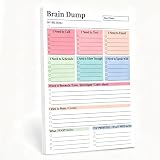
- 【50-Page Tear-Off Design】—Write down your daily thoughts on the Brain Dump Notepad, tear off pages, and stick them on your monitor, refrigerator, or mirror. Plans only work when they're in front of you.
- 【Ink-Free】—80g thick paper, ink won't bleed. Double-sided use, 50 pages feel like 100. Suitable for any handwriting style.
- 【Stable】—With daily page turning and tearing, the Brain Dump Planner won't lose pages or become loose even after months of continuous use. Scratch- and fingerprint-resistant cover—keep your brain-dumping notebook clean.
- 【Minimalist Cover Design】—This handy Brain Dump Notepad has no fancy patterns or childish prints. The clean and simple cover won't look out of place in a meeting room, classroom, or cafe.
- 【Practical Gift】—Suitable for gifts: birthdays, graduations, promotions, Halloween, Christmas. Whether you're a working professional, a student, or a freelancer, you'll love this gift.
Practical signs of a trustworthy setup
- Notes retain inspectable sources rather than only unsourced summaries.
- Update timing is explicit: scheduled, on demand, or manual.
- Potentially stale information is distinguishable from recently checked information.
- Important changes are reviewable and do not silently erase useful history.
- Retrieval works across the devices or tools in scope, and source context is available when needed.
Product prices and availability are accurate as of the date/time indicated and are subject to change. Any price and availability information displayed on Amazon at the time of purchase will apply.




