Red Hat Summit 2025 framed open source as the operating foundation for enterprise production AI. Red Hat’s stated ambition is to let organizations deploy “any model, on any accelerator, across any cloud,” using a stack that combines a supported vLLM distribution, Kubernetes-native inference, Linux, model validation and automation.
The practical announcements were the Red Hat AI Inference Server, the llm-d open-source project and broader capabilities in OpenShift AI, RHEL AI, OpenShift Lightspeed and Ansible Lightspeed. They address different layers of the same problem: moving a model from a demonstration into a governed, supportable service.
As an Amazon Associate I earn from qualifying purchases.
What Red Hat announced at Summit 2025
Red Hat AI Inference Server
Red Hat introduced the Red Hat AI Inference Server as a hardened, supported distribution built from the vLLM community project. It can be used as a standalone container or through RHEL AI and OpenShift AI.
Red Hat says the server is designed to run generative-AI models across accelerators, public and private clouds, datacenters and edge environments. Red Hat AI CTO Brian Stevens described it as a “pre-built, fully supported Red Hat VLM container” for serving models “anywhere, on any hardware.” Those are Red Hat product claims, not an independent performance test.
#1 Best Overall

- Adjustable Depth: 23-40'' adjustable depth is used for servers and network equipment, ensuring enough space for AV equipment, components, and cabling, while allowing you to access ports and equipment from multiple sides.
- Strong Load Capacity: Ground-Mounted Load Capacity: 500 lbs, Wall-Mounted Load Capacity: 150 lbs. The av rack is made of carbon steel for better weldability performance and can help save space while meeting your need to place multiple devices.
- User-friendly Design: Ergonomic design makes the open frame av rack easier to use. The additional top panel is able to place other items with more available space. Roller design moves anywhere and anytime, is convenient, and is more energy-saving.
- Complete Accessories: We provide the accessories you need, including 2 x Pallets, 145 x M5*10 Cross Head Screws, 4 x Casters, 4 x M10*50 Expansion Screws,10 x M6*12 Cage Nuts, 1 x Grounding Wire, 1 x User Manual.
- Wide Application: The server rack wall mount maximizes the use of available space, suitable for retail venues, classrooms, offices, and other places where space is limited.
llm-d for distributed inference
Red Hat launched llm-d as an open-source community for distributed generative-AI inference. Its design combines vLLM, an inference gateway, Kubernetes-native architecture and AI-aware routing.
Red Hat named CoreWeave, Google Cloud, IBM Research and NVIDIA as founding contributors. AMD, Cisco, Hugging Face, Intel, Lambda and Mistral AI were listed as partners. The project is intended to make inference a schedulable, multi-node platform workload rather than a single process on a single GPU.
OpenShift Lightspeed
OpenShift Lightspeed became generally available as a generative-AI assistant in the OpenShift console. It supports multiple model providers and private-AI options, allowing administrators to use conversational help without treating a public model as the only deployment choice.
Do these 3 things before closing this tab:
1Clear out junk files and repair common Windows errors2Fix the driver behind crashes, sound loss and screen glitches3Repair Windows errors before they cause bigger problemsRHEL 10 and RHEL Lightspeed
Red Hat also announced RHEL 10 capabilities including image mode, cloud-optimized images and work on post-quantum cryptography. RHEL Lightspeed adds natural-language guidance to the command line, extending the same assistant approach to Linux operations.
Models, protocols and ecosystem integrations
The Summit announcements included third-party validated models, Llama Stack support and Model Context Protocol support. Red Hat also described expanded collaborations with NVIDIA, Meta and Google Cloud.
Rank #2

- Easy to Install: Please look carefully at the pictures of the strut mounting details ( You can see the installation video on this page )
- Removable Open Frame Rack: Our 15U server racks are equipped with swivel casters and are compatible with a wide range of server / stereo / switch / data / AV / IT equipment. ( Overall size: 19.7”L x 18.8”W x 32.3”H, Mounting Hole Spacing: 18.35"W )
- Extra Storage Space: In addition to being equipped two 1U rack shelves and 5.1ft hook and loop straps, this open frame server rack also features an top and bottom platform design in order to provide you with more storage space
- Excellent Heat Dissipation: With an open ventilated design, the network rack rack is made of cold rolled steel material, which helps to dissipate heat from your equipment
- Durable & Long-lasting: Our AV rack is powder coated to prevent rust and corrosion. It has a weight capacity of up to 200 pounds, which is more than enough to carry all of your equipment
At the application and operations layers, Ansible Lightspeed adds generative assistance to automation workflows. OpenShift AI and EDB Postgres AI support retrieval-augmented generation and agent development, connecting model serving with data and enterprise automation.
How the announced pieces fit together
| Component | Primary job | Deployment or operating context | What is open versus supported |
|---|---|---|---|
| Red Hat AI Inference Server | Serve generative-AI models using a supported vLLM-based distribution | Standalone container, RHEL AI or OpenShift AI; Red Hat says it targets clouds, datacenters and edge | Built from open-source vLLM, packaged and supported by Red Hat |
| llm-d | Coordinate distributed inference with gateway-based, AI-aware routing | Kubernetes-native environments | Open-source community project with the contributors and partners Red Hat announced |
| RHEL AI | Provide a Red Hat Enterprise Linux path for the inference server and related AI workloads | Linux systems where an enterprise operating-system lifecycle matters | Uses Red Hat’s supported distribution rather than requiring teams to assemble vLLM themselves |
| OpenShift AI | Provide a platform context for model operations, RAG and agent development | OpenShift clusters | Combines open components with Red Hat platform support and validation |
| OpenShift Lightspeed | Assist with OpenShift administration and usage | OpenShift console | Generally available assistant with multiple-provider and private-AI options |
| Ansible Lightspeed | Add generative assistance to automation workflows | Ansible-based operations | Integrates AI assistance into an existing automation toolchain |
How llm-d is meant to make inference production-ready
Serving a model reliably involves more than loading weights and answering a request. Production systems need a front door, placement decisions, scaling behavior and a way to operate across a cluster. llm-d’s announced architecture addresses those concerns in four connected layers.
What’s actually slowing this PC down?
Pick the symptom - the matching free tool is one click away.
1. vLLM as the serving engine
vLLM supplies the community inference foundation. Red Hat’s Inference Server packages that foundation into a supported distribution, while llm-d uses it as the model-serving component in a larger system.
2. An inference gateway
The gateway provides a managed entry point for requests. Instead of every client choosing a model process directly, traffic can pass through a common service boundary where authentication, routing and operational policy can be applied.
3. Kubernetes-native deployment
llm-d is designed around Kubernetes, so inference can be deployed alongside the scheduling, service discovery and lifecycle mechanisms already used for other containerized workloads. The announcement does not establish a particular latency, throughput or cost improvement; those depend on models, hardware and configuration.
Rank #3

- Easy to Install: Equipped with a color-printed instruction manual. Please look carefully at the pictures of the strut mounting details ( You can see the installation video on this page )
- Removable and Wall-mountable Rack: Our 2026 new 10U server racks are equipped with swivel casters and are compatible with a wide range of server / stereo / switch / data / AV / IT equipment ( Overall size: 19.7”L x 18.8”W x 23.4”H, Mounting hole spacing: 18.35"W )
- Extra Storage Space: In addition to being equipped two 1U rack shelves and 5.1ft hook and loop straps, this open frame server rack also features an top and bottom platform design in order to provide you with more storage space
- Excellent Heat Dissipation: With an open ventilated design, the network rack is made of cold rolled steel material, which helps to dissipate heat from your equipment
- Durable & Long-lasting: Our AV rack is powder coated to prevent rust and corrosion. It has a weight capacity of up to 200 pounds, which is more than enough to carry all of your equipment
4. AI-aware routing
Traditional load balancing treats backends as interchangeable. AI-aware routing can account for model identity and the characteristics of an inference workload when deciding where a request should go. That is important when a cluster contains different accelerators or multiple model variants.
Quick wins for a faster PC:
Scan for outdated or missing drivers - takes under a minuteDriver Scan →Clear out junk files and repair common Windows errorsFree Scan →Fix the driver behind crashes, sound loss and screen glitchesFind Drivers →In practical terms, llm-d is an operating pattern for distributed inference, not a promise that every model will run optimally on every device. Teams still need to validate model compatibility, memory requirements, autoscaling behavior and economics on their own hardware.
Is Red Hat’s AI stack portable across clouds and GPUs?
Portability is the central design claim, but it has two meanings. The software is intended to provide a common deployment approach across environments; actual portability still depends on accelerator support, drivers, model formats, performance tuning and the services surrounding the model.
| Portability question | What Summit established | What teams must still verify |
|---|---|---|
| Across cloud providers | Red Hat says the Inference Server targets multiple clouds, datacenters and edge locations. | Cloud-specific GPU availability, images, networking, storage, pricing and support boundaries. |
| Across accelerator vendors | Red Hat’s vision explicitly includes any accelerator; the ecosystem announcement names NVIDIA and AMD among the participating companies. | Driver versions, kernel compatibility, supported kernels, memory capacity and model-specific performance. |
| Across deployment scales | The stack spans a standalone container, RHEL AI and OpenShift AI, while llm-d targets distributed Kubernetes inference. | Whether a small deployment needs Kubernetes, and how operational overhead changes as replicas and models grow. |
| Across model providers | Red Hat announced validated third-party models, Llama Stack and Model Context Protocol support. | Licensing, context limits, tool behavior, safety controls and validation results for the exact model version selected. |
Therefore, “portable” should be read as a supported architectural goal and a set of common interfaces, not as evidence that swapping a GPU or cloud is zero-effort or cost-neutral.
What RHEL AI and OpenShift AI are for
RHEL AI: the operating-system-oriented path
RHEL AI is the fit for organizations that want an enterprise Linux foundation around model serving. At Summit, Red Hat positioned the AI Inference Server as available within RHEL AI, giving teams a supported alternative to maintaining a community vLLM installation and its surrounding dependencies themselves.
Rank #4

- ADJUSTABLE DEPTH: 4-Post 25U open frame server rack with 4 vertical rails and adjustable mounting depth 22" to 40" (56,0cm to 101,7cm); Compatible with various servers / switches / data / AV and other IT equipment; EIA/ECA-310-E Compliant
- EASY ASSEMBLY: Mobile network rack with easy-to-follow assembly instructions and online video; Compact flat-pack shipping to avoid damage and facilitate installation; Total product height of 50.8in (129cm) with casters, 48in (122cm) without casters
- COLD ROLLED STEEL: Durable 4 Post 19in open frame rack designed for ventilation with 25U mounting height and 1200lb (544kg) weight capacity (stationary); 3 install options included: casters, levelling feet, or base-plate to secure rack to the floor
- HARDWARE INCLUDED: Rolling computer/data rack includes cage nuts and screws to mount equipment, easy to read Units (U) and depth adjustment markings, cable management hooks for organization, and required assembly tools
- THE IT PRO'S CHOICE: Designed and built for IT Professionals, this 25U rack is backed for 2-years, including free lifetime 24/5 multi-lingual technical assistance
RHEL 10’s image mode and cloud-optimized images are relevant to how those systems are built and maintained. RHEL Lightspeed addresses the operator experience by providing natural-language command-line guidance.
OpenShift AI: the cluster and application path
OpenShift AI is the fit for teams operating models as part of a broader OpenShift platform. The Summit material connects it with model serving, retrieval-augmented generation and agent development. It also provides the context in which llm-d’s Kubernetes-native approach makes sense.
The choice is not simply Linux versus Kubernetes. A RHEL AI deployment can suit a focused serving footprint, while OpenShift AI is more appropriate when model endpoints must share governance, networking, automation and application services with other cluster workloads.
Independent reader supportYour contribution helps us test, update, and keep practical guides available for everyone.Operational features beyond inference
Assistants for platform and Linux teams
OpenShift Lightspeed brings an assistant into the OpenShift console, while RHEL Lightspeed brings natural-language help to the command line. Red Hat said the Ask Red Hat support assistant launched with basic fluency in 12 languages.
Automation and data integration
Ansible Lightspeed connects generative assistance to automation workflows. OpenShift AI and EDB Postgres AI connect model-serving infrastructure to retrieval-augmented generation and agent applications, where data access, permissions and repeatable deployment matter as much as the model itself.
Best Value
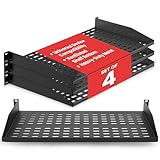
- ENHANCED AIRFLOW DESIGN: This 4-pack of individual 1U server rack shelves features vented metal construction, ensuring excellent air circulation to reduce heat build-up. This maintains safe temperatures, extending equipment lifespan.
- VERSATILE DEVICE SUPPORT: Accommodates a wide range of equipment, including non-rack-mounted and half-rack-width devices. This adaptable rack shelf provides flexibility, making it suitable for various IT, AV, and computer systems.
- PERFECT FOR MULTIPLE SETTING: Whether in a professional studio, a bustling office, or a home network setup, this server rack shelf offers seamless adaptability. Its robust build ensures reliable performance across diverse applications and settings.
- UNIVERSAL COMPATIBILITY: Designed to fit all 19-inch server racks and standard 1U shelves, this tray is compatible with most server and network equipment. Ensures a snug fit with easy installation, making it an essential component for any rack setup.
- HEAVY-DUTY LOAD CAPACITY: Built for strength, this rack shelf supports up to 110 lbs of equipment. The spacious tray dimensions (17.6’’ x 10.0’’) and mounting measurements (19.0’’ x 10.0’’ x 1.7’’) offer ample space for multiple devices.
Validation and governance
Validated models and supported distributions can reduce the number of components an enterprise must evaluate, but “validated” is not the same as universally best. Organizations should ask which model version, accelerator, workload and safety or compliance criteria were covered.
What the evidence does—and does not—show
The Summit catalog described a live demonstration in which IBM Research fine-tuned a 405-billion-parameter LLaMA model on a single-node Red Hat OpenShift AI cluster. That is a demonstration of capability under its stated setup, not a general benchmark for cost, speed or production readiness.
Red Hat’s announcements also provide no neutral market-size, adoption or independent benchmark statistic for the stack. Claims about portability, support and operational benefits should consequently be treated as vendor positioning until independently measured for a particular environment.
Outdated Drivers Are Slowing You Down
One free scan finds every outdated or missing driver and matches the right update for your exact hardware.Free scan · exact hardware matchPC Slower Than It Used to Be?
A free scan shows the junk files, broken settings and background clutter dragging Windows down - then fixes them in one click.Free scan · Windows 10 & 11How to evaluate the stack for a real deployment
- Define the serving target: identify models, context lengths, request volumes, latency objectives and whether workloads are batch, interactive or agentic.
- Choose the operating layer: evaluate standalone inference containers, RHEL AI and OpenShift AI against your existing Linux, Kubernetes and support requirements.
- Test accelerator portability: run the same model and workload on the GPU or accelerator types and cloud regions you may actually use.
- Assess distributed needs: determine whether a gateway and AI-aware routing solve a real multi-replica or multi-model problem before adding llm-d’s operational scope.
- Check governance: review model licenses, validation coverage, private-AI options, data handling, identity integration and audit requirements.
- Price the whole lifecycle: include engineering skills, cluster operations, support subscriptions, accelerator time, storage, networking and model refresh work. Open source alone does not guarantee lower total cost or better accuracy.
Bottom line
Red Hat Summit 2025’s production-AI proposition is a layered stack rather than a single product: vLLM-based serving through the Red Hat AI Inference Server, distributed coordination through llm-d, and enterprise operations through RHEL AI, OpenShift AI, Lightspeed assistants, validated models and automation integrations. Its strongest value is a common, supported approach across hybrid environments. Its portability and economics still need to be demonstrated against the models, accelerators and controls in each organization.
Quick Recap
Product prices and availability are accurate as of the date/time indicated and are subject to change. Any price and availability information displayed on Amazon at the time of purchase will apply.




