Free tools Windows power users keep installed
One-click scans. No signup required.
Precision analog measurement is the controlled measurement of continuous voltage, current, resistance, and sensor signals with known error and repeatability. The result depends on the entire signal chain—not merely on an ADC’s bit count. Sensor behavior, protection, amplifier characteristics, filtering, reference stability, conversion, grounding, temperature, calibration, and the test instrument all set the final limit.
Define the measurement before choosing hardware
Write the requirement in measurable terms. Include:
As an Amazon Associate I earn from qualifying purchases.
- Input range, maximum transients, polarity, and common-mode voltage
- Differential or single-ended connection and allowable input loading
- DC, low-frequency AC, transient, or pulsed behavior
- Bandwidth, sample rate, throughput, and settling time
- Absolute accuracy, repeatability, minimum detectable change, and calibration interval
- Source resistance, temperature range, channel count, isolation, safety, power, and interface constraints
For example: “Measure 0–10 mV from a bridge sensor with ±1 µV repeatability, over 0–40 °C, at 10 samples per second, with input impedance above 10 MΩ.” That statement immediately raises questions about gain, offset drift, noise bandwidth, excitation stability, reference error, and calibration.
Do these 3 things before closing this tab:
1Repair Windows errors before they cause bigger problems2Scan for outdated or missing drivers - takes under a minute3Clear out junk files and repair common Windows errorsAccuracy, precision, resolution, and noise are different
Resolution
For an ideal N-bit converter, LSB size = VFS/2N. A 12-bit ADC with a 1.024 V full-scale range has 1.024/4096 = 250 µV per code, the approximate value documented for AMD’s 7-series XADC under its cited conditions (AMD documentation). Quantization, thermal and shot noise, reference noise, driver settling, nonlinearity, offset, and gain error reduce usable resolution. Use noise-free resolution or effective number of bits when available, not the headline bit count.
#1 Best Overall

- 【9999 Counts & Rechargeable】FNIRSI DMT-99 digital multimeter features high-resolution 9999-count True RMS for accurate AC/DC measurements across various electrical systems. The built-in 1500mAh rechargeable lithium battery with Type-C charging eliminates frequent battery replacement, making it ideal for extended electronics repair and field testing
- 【Smart Auto-Identification】Streamline troubleshooting with Auto-Mode, which instantly detects AC/DC voltage, resistance, and continuity. This rechargeable multimeter also supports AC/DC current, NCV, frequency, and diode testing—providing comprehensive coverage for automotive diagnostics and household electrical safety
- 【Graphic Waveform & Monitoring】This automotive multimeter plots real-time ripples via Graphic View, visualizing voltage/current fluctuations as waveforms to capture transient spikes traditional meters miss. Monitoring Mode triggers automatic alarms based on custom thresholds—enabling hands-free tracking of intermittent faults for efficient diagnostics
- 【Vivid Screen & Anti-Burn Pro】This multimeter features a 2.4" HD TFT color screen with adjustable brightness for crystal-clear visibility in any lighting. Engineered for maximum safety, it incorporates dual ceramic fuses and advanced protection circuitry to reducing the risk of accidental burn-outs during complex automotive circuitry and industrial tasks
- 【User-friendly Design】Includes ultra-fine multimeter test leads perfected for SMD and tight circuit boards. This compact multimeter features a back-integrated kickstand and storage slots, delivering a grab-and-go solution that eliminates clutter for technicians demanding precision on the move
Accuracy
Accuracy is closeness to an accepted or traceable value. Offset, gain, linearity, hysteresis, temperature coefficients, reference error, calibration uncertainty, and sensor error all contribute.
Precision
Precision is repeatability for the same input. A tight cluster around the wrong value is precise but inaccurate; scattered results around the true value are accurate on average but imprecise. National Instruments defines precision as instrument stability and repeatability and identifies low-noise amplification as one way to improve analog sample quality (NI).
Noise and sensitivity
Noise is unwanted variation and is bandwidth-dependent. Sensitivity is output change per unit input. Averaging can lower uncorrelated noise while leaving drift, coherent mains pickup, and settling errors untouched.
Rank #2

- Pro-Grade Safety & Protection: Engineered for peace of mind. The FS899L meets strict CAT.III 1000V and CAT.IV 600V safety standards, featuring dual ceramic fuses and full-range overload protection. Whether you're troubleshooting an industrial panel or a car battery, you’re shielded from surges and accidental shorts.
- Precision You Can Count On: Stop guessing and start measuring. Powered by True RMS technology and a 6000-count resolution, this meter delivers lab-grade accuracy for AC/DC voltage, current, resistance, and capacitance. It’s the reliable precision a pro needs to diagnose complex electrical issues with total confidence.
- Vibrant Color Display & Worklight: Forget squinting at blurry numbers. The massive 4.8-inch high-definition color screen offers crystal-clear readings even in direct sunlight or pitch-black basements. Paired with a built-in flashlight and Data Hold, it turns cramped, dimly lit workspaces into manageable jobs.
- The Ultimate All-in-One Tool: From HVAC temperature checks to NCV (Non-Contact Voltage) detection, this tool handles it all. It’s a versatile powerhouse that measures continuity, frequency, and live wires, making it the go-to diagnostic companion for household repairs, shop work, and industrial maintenance.
- USB-C Power: Always Ready: Stop hunting for spare batteries. The modern USB-C rechargeable design offers a fast 2-hour charge for a full day of continuous field use. It’s a cost-effective, eco-friendly solution that ensures your most important tool is always powered up and ready for the next task.
Anatomy of a precision signal chain
Sensor or source
Determine output impedance, common-mode voltage, amplitude, source noise, bias-current sensitivity, ground relationship, excitation requirement, and dynamic range. Bridge and RTD systems require stable excitation, lead-resistance control, common-mode rejection, and thermal management. High source resistance makes leakage and input bias current critical.
Protection and switching
Protection networks can add leakage, capacitance, series resistance, charge injection, distortion, noise, and recovery time. Select them for the actual fault environment and signal range. Multiplexers must be evaluated for on-resistance, leakage, charge injection, and channel-to-channel settling. Analog Devices shows protection and fault-tolerant switching as part of complete ultra-precision chains (Analog Devices).
Instrumentation or differential amplifier
For small differential signals on a large common-mode voltage, examine input offset and drift, gain error and drift, common-mode rejection, bias current, voltage and current noise, common-mode range, output swing, bandwidth, settling, EMI behavior, and supply range. Texas Instruments identifies offset, gain error, drift, and common-mode rejection as central instrumentation-amplifier specifications (TI).
Rank #3

- CAT III 600V Safety Rating: Ensuring your safety when working on electrical systems in common residential and commercial settings
- AC/DC Voltage Measurement up to 1000V: Quickly and accurately measure both AC and DC voltage in a wide range of applications, from automotive systems to electrical panels to commercial equipment.
- AC/DC Current Measurement up to 10A: Accurately measure AC and DC current for diagnosing electrical problems such as overloading, short circuits, and faulty wiring.
- Voltage, Resistance, Continuity, Capacitance: Essential measurement functions for troubleshooting electrical issues in a wide range of systems, allowing you to quickly diagnose and repair problems.
- Input Terminal for AC/DC Current Measurements to 10A: Allowing you to get accurate readings for a variety of electrical applications.
Gain and scaling
Use the ADC range efficiently without clipping expected transients. Consider fixed or programmable gain, attenuation, level shifting for bipolar inputs, rail headroom, resistor tolerance and temperature coefficient, and noise gain. Excessive gain magnifies offset and drift and reduces overload recovery margin.
The Tool Desk
Outbyte Driver Updater FREEScan for outdated or missing drivers - takes under a minuteDriver Scan →Outbyte PC Repair FREEClear out junk files and repair common Windows errorsFree Scan →Filtering and ADC driving
Low-pass filtering limits noise; an anti-alias filter is required before sampled conversion. RC networks must settle against ADC input capacitance. More filtering increases response time, and filter resistors add thermal noise and bias-current error. SAR converters often need a low-impedance, fast-settling driver; Analog Devices discusses distortion and ringing caused by ADC-driver and RC-filter interaction (Analog Devices).
Reference
Reference initial accuracy, drift, noise, long-term stability, hysteresis, load regulation, output impedance, decoupling, and layout directly affect conversion scale. An internal reference simplifies design; an external one can improve control and stability. Ratiometric conversion can cancel some excitation variation in bridge measurements, but not sensor nonlinearity, wiring effects, or thermal gradients.
Rank #4
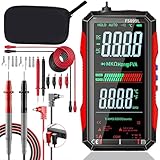
- 【Built Tough, Tested Safe】 Your safety is non-negotiable. The FS899L is engineered with dual safety ratings (CAT.III 1000V / CAT.IV 600V) to handle high-energy circuits without compromising protection. Double fuses and overload safeguards prevent burns and shocks, while CE and RoHS certifications back its reliability—whether you're under the hood or in the panel.
- 【True RMS Precision You Can Trust】 Get lab-accurate readings every time. With 6000 counts and True RMS technology, this meter delivers precise measurements across the board: AC/DC Voltage (60mV-600V, ±1.2-1.5%), Current (300mA-10A, ±2.2-2.5%), Capacitance (10nF-60mF), Resistance (600Ω-60MΩ), plus frequency and ambient temperature—everything a pro needs to diagnose with confidence.
- 【One Tool, Endless Diagnostics】 From household outlets to industrial machinery, the FS899L handles it all. Measure AC/DC current & voltage, continuity, resistance, capacitance, frequency, and even detect live wires without contact (NCV). Plus, ambient temperature readings make it a go-to for HVAC and appliance troubleshooting—versatility built in.
- 【Work in the Dark, See It All】 Cramped panels and dim basements? No problem. The massive 4.8" backlit screen delivers crystal-clear readings in low light, while the built-in torch lights up your workspace. Freeze measurements with the data hold function—perfect for awkward angles or when you're elbows-deep in a fix.
- 【USB-C Rechargeable, Always Ready】 Ditch the disposable batteries. Charge in 2 hours via USB-C and work continuously for up to 8 hours—perfect for long jobs in the shop, lab, or field. Modern, cost-effective, and always ready when you are.
ADC and isolation
ADC choice must include noise-free resolution, sample rate, full-scale range, INL/DNL, offset and gain error, reference needs, input impedance, digital-filter latency, multiplexer settling, power, interface, and calibration support. Isolation may be necessary for floating or high-voltage sources, safety, and ground-loop control; verify common-mode limits, isolation ratings, creepage, clearance, and return paths.
Choosing SAR, sigma-delta, or integrated acquisition
| Requirement | Usually favors | Trade-off |
|---|---|---|
| Very high DC resolution and low bandwidth | Sigma-delta ADC | Digital-filter latency and slower settling |
| Fast acquisition, multiplexing, and low latency | SAR ADC | Demanding driver and reference design |
| Many slow sensor channels | Multiplexed sigma-delta | Channel-switching and settling time |
| Simultaneous channels | Simultaneous-sampling ADC | Higher cost, power, and data rate |
| Simple monitoring | Integrated MCU ADC | Less guaranteed performance and more digital coupling |
Analog Devices notes that sigma-delta oversampling and noise shaping can deliver very high precision when speed is less important, while nominal bits can exceed useful bits (Analog Devices). Its examples include the manufacturer-stated dual-channel 24-bit, 2 MSPS AD4630-24 SAR, 32-bit 10 kSPS AD7177-2 sigma-delta with 100 µs settling, and AD5791 20-bit DAC with stated 1 ppm performance and ±1 LSB INL; these are component specifications, not complete-system accuracy (source).
PC Slower Than It Used to Be?
A free scan shows the junk files, broken settings and background clutter dragging Windows down - then fixes them in one click.Free scan · Windows 10 & 11Crashes, No Sound, or Screen Glitches?
Random freezes, missing sound and display glitches usually trace back to one bad driver. Find and replace yours safely.Free scan · under a minuteNoise, interference, and layout
Random sources
- Resistor thermal noise
- Amplifier voltage and current noise
- ADC and reference noise
- Power-supply, shot, sensor, and 1/f noise
Deterministic interference
- 50/60 Hz mains and harmonics
- Switching regulators, clocks, displays, motors, and digital interfaces
- Ground loops, RF rectification, crosstalk, and USB/Ethernet return currents
Use differential sensing where appropriate, short protected input routes, deliberate analog/digital return planning, data-sheet decoupling, clean reference layout, suitable pre-ADC filtering, low-noise regulation, guarding for high-impedance nodes, and symmetrical low-thermal-EMF construction. Test with the input shorted, grounded, and connected to a known source. Shielding cannot repair a broken return-current path.
Best Value

- Versatile Digital Multimeter - Accurately measures AC/DC Current, AC/DC Voltage, Capacitance, Frequency, Duty Cycle, Resistance, Diode, Continuity and Temperature.
- Thoughtful Design - Support Data Hold, Large LCD Backlit Screen, Auto Shut-off and Kickstand make the process of measurements easier. Professional level is reflected in some features include Auto-Ranging capability, and True RMS for measuring both AC Current and Voltage.
- Suitable For Many Occasions - This Multimeter is a golden partner to help to troubleshoot a variety of automotive and household electrical problems safely and accurately.
- Ensure Safety - Double ceramic fuse is anti-burn and protects from overloading,and it will be more secure and reliable; F400mA/600V and F10A/600V explosion-proof ceramic fuse tubes can protect the multimeter effectively.
- Additional Tips - Please take off the cap before using the test leads. Check the manual for more usage information.
Temperature, drift, and thermal EMFs
Offset drift, reference drift, resistor-ratio drift, ADC gain drift, sensor drift, self-heating, PCB gradients, airflow, connectors, relays, and warm-up time often dominate field error. Zero-drift amplifiers reduce offset drift but can introduce switching artifacts and different input-current behavior. At microvolt levels, thermoelectric voltages from dissimilar metals, airflow, and mechanical stress can exceed the signal; use matched materials, symmetry, minimized gradients, and temperature-dependent validation.
Calibration and uncertainty
Distinguish factory calibration, one-point offset correction, two-point gain-and-offset correction, multipoint linearization, in-situ adjustment, verification, and traceability. A basic correction is:
ycorrected = Gcal ymeasured + Ocal
Build an uncertainty budget containing reference and standard uncertainty, repeatability, resolution, temperature, drift, sensor error, wiring, and contact resistance. Calibration does not reliably remove random noise, hysteresis, aliasing, poor settling, ground-loop interference, intermittent connections, or temperature behavior outside the calibration range.
What’s actually slowing this PC down?
Pick the symptom - the matching free tool is one click away.
Which instrument fits the task?
| Instrument | Best use | Important limitations |
|---|---|---|
| Digital multimeter | Stable DC voltage, current, resistance | Slow updates, burden voltage, range switching, hidden averaging |
| Oscilloscope | Transients, ripple, oscillation, settling, waveform noise | Usually lower DC accuracy, probe loading, ground hazards, limited vertical resolution |
| DAQ | Multichannel logging and automation | Multiplexer settling, channel mismatch, shared grounds, aggregate sample-rate limits |
| Source-measure unit | Controlled sourcing plus simultaneous measurement | Specialized and more complex; ideal for semiconductor, battery, and electrochemical work |
| Precision source or calibrator | ADC, amplifier, and instrument verification | Requires suitable standards and uncertainty control |
Analog Devices describes PMUs and SMUs as systems that apply voltage or current while measuring both (parametric measurement) and presents SMU solutions for programmable, high-resolution test platforms (SMU solutions).
Quick Recap
Verification procedure
- Define range, bandwidth, accuracy, environment, and response time.
- Check the instrument or ADC against an appropriate reference.
- Verify polarity, gain, input range, common-mode limits, and protection.
- Measure a shorted or correctly terminated input.
- Record offset and noise over the required observation period.
- Apply stable inputs near zero, mid-scale, and full-scale; test both directions for bipolar systems.
- Validate multiplexer transitions and settling.
- Repeat at relevant temperatures and after warm-up.
- Inspect mains and switching-frequency components with spectral or time-domain tools.
- Compare observed error with the uncertainty budget and document calibration conditions.
Failure modes that commonly invalidate results
- Equating nominal ADC bits with system accuracy
- Ignoring reference noise, drift, and load behavior
- Using an amplifier outside its common-mode range or assuming rail-to-rail is ideal at the rails
- Driving a SAR input from a high-impedance source
- Sampling immediately after a multiplexer switch
- Selecting low voltage noise while ignoring current noise and source resistance
- Using very large resistors without accounting for thermal noise, leakage, and humidity
- Connecting oscilloscope grounds without checking safety and return paths
- Averaging a drifting or coherent-interference signal and calling it more accurate
- Calibrating at one temperature and claiming wide-range accuracy
- Routing clocks through sensitive analog areas or omitting protection
- Confusing peak, RMS, average, and DC quantities
Design checklist
- Have range, common-mode, bandwidth, settling, and overload limits been written down?
- Is the source impedance compatible with bias current, leakage, noise, and ADC drive requirements?
- Are amplifier offset, drift, CMRR, noise, input range, and settling specified for the operating conditions?
- Are reference noise, drift, layout, and ratiometric options included?
- Does the ADC’s noise-free performance—not just nominal resolution—meet the input-referred requirement?
- Have grounding, shielding, isolation, thermal gradients, warm-up, and return currents been designed?
- Is there an uncertainty budget and a repeatable calibration and verification procedure?
- Does the chosen DMM, oscilloscope, DAQ, SMU, or custom converter match the task?
Product prices and availability are accurate as of the date/time indicated and are subject to change. Any price and availability information displayed on Amazon at the time of purchase will apply.




