What’s actually slowing this PC down?
Pick the symptom - the matching free tool is one click away.
Power over Ethernet (PoE) delivers electrical power and network data over the same Ethernet link to compatible equipment. It lets devices such as IP cameras, wireless access points and VoIP phones receive power through their network cable rather than a separate local power connection.
What is PoE?
PoE is a standards-based method for supplying power over Ethernet cabling while the cable carries network data. It can simplify installation when a device needs an Ethernet connection but a separate power outlet is inconvenient. The method is defined by IEEE 802.3 standards; it is not simply a matter of sending power through any Ethernet cable to any device.
As an Amazon Associate I earn from qualifying purchases.
IEEE describes power delivery as a connection between a power-sourcing equipment unit (PSE) and a powered device (PD). The PSE supplies power, and the PD receives it. The PSE may be at an endpoint or midspan, as described in the IEEE 802.3af abstract.
Recommended Free Tools
How does PoE work?
A PoE connection needs a compatible PSE, a compatible PD, and an Ethernet link between them. A PoE-capable switch is a common PSE: it supplies power from the network endpoint. A midspan injector is another option; it adds power to a compatible Ethernet link between the switch and the PD.
#1 Best Overall

- 【Convert Non-PoE to PoE】With no need to replace your existing non-PoE switch/device, you can easily have PoE enabled with the use of PoE160S
- 【Gigabit Ports Ensures High Speed】Experience lightning-fast wired speeds with 1× Gigabit Ethernet Input Port + 1× Gigabit Ethernet Output port
- 【802.3at/af PoE Compliant 】PoE160S supplies power and data via one single ethernet cable to 802.3at/af PoE devices and expands network to areas with no power lines or outlets
- 【Plug and Play】Easy setup with no software installation or configuration needed
- 【Long Range Transmission】Deliver Power up to 100 meters (328ft.), perfect for IP cameras or access point deployment in large areas
- PSE: Power-sourcing equipment that supplies power. Examples include PoE switches and injectors.
- PD: Powered device that receives it. Examples include compatible IP cameras, wireless access points and VoIP phones.
PoE standards include power classification and negotiation mechanisms. Before connecting equipment, confirm that the PSE and PD support compatible IEEE types and that the source can provide the device’s required power.
What are PoE, PoE+ and PoE++?
These names refer to generations of PoE capability associated with IEEE standards. The familiar designations include 802.3af, 802.3at and 802.3bt. IEEE 802.3bt specifies power delivery using all four cable pairs and extends the classification information exchanged between equipment. The IEEE listing for 802.3bt-2018 marks that amendment as superseded, so it should not be described as the latest standalone standard.
Rank #2

- GIGABIT PORTS: 1 x Gigabit Ethernet port and 1 x PoE plus Gigabit Ethernet port. Integrated power supply.
- NDAA + TAA COMPLIANT: With our NDAA and TAA compliant Injectors, you can plan and install networking solutions that Government customers demand today (U.S. and Canada Only)
- MANUFACTURER PROTECTION: We stand by the quality of our products.The TPE-115GI Gigabit Power Over Ethernet Plus Injector is backed and supported with 3 years of TRENDnet Manufacturer Protection.
- RELIABLE TECH SUPPORT: Our team of advisors, support and tech experts are English speaking, and available for all your needs during normal business hours. We take pride in being there for our customers.
- PoE POWER SUPPLY: This gigabit PoE plus injector supplies a PoE device with PoE (15.4W) or PoE plus (30W) power.
NETGEAR publishes the following figures as practical vendor guidance. They distinguish the maximum a PSE may supply per port from the minimum power listed at the PD; actual compatibility depends on the equipment’s IEEE type/class and specifications.
| Common designation | Maximum per-port source figure | Power listed at the PD |
|---|---|---|
| PoE | 15.4 W | 12.95 W minimum guaranteed |
| PoE+ | 30 W | 25.5 W |
| PoE++ | 60 W or 90 W | 45 W minimum guaranteed, as stated in the vendor guidance |
These figures are from NETGEAR’s PoE overview, which does not show a publication date in the retrieved article. Its PoE++ grouping is not a full IEEE type-and-class table: do not assume every device marketed as PoE++ has the same endpoint wattage. For a specific installation, use the device datasheet and compare its IEEE type/class and power requirement with the PSE documentation. IEEE’s 802.3 catalogue provides standards context.
Rank #3

- 48V passive PoE supported
- Auto-determine the necessary power requirements
- Convenient wall-mounting design
- Gigabit speed support
- Plug-and-Play, requires no configuration
How much power can PoE devices supply?
The answer depends on the PSE’s supported standard, its per-port rating, the device’s negotiated class and the power lost along the cable. A switch’s advertised maximum per port is not necessarily the power that reaches the PD. Cable resistance causes loss, and longer runs lose more power, as NETGEAR notes in its PoE guidance.
There is also a switch-wide limit. A switch can have a total PoE power budget smaller than the sum of the maximum ratings advertised for all its ports. If many devices draw power at once, the available total budget—not just the rating of an individual port—determines whether the switch can supply them all. Check both the per-port capability and the aggregate budget against the expected simultaneous load.
Rank #4
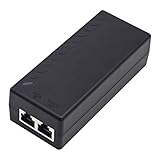
- High-power Performance: Our 30W Gigabit PoE Injector is compliant with IEEE802.3af/at and provides a power budget of up to 30W alongside a 1000Mbps internet speed, with 1 Gigabit Ethernet input and 1 PoE/PoE+ Gigabit Ethernet output port
- Automatic Detect Technology: Equipped with auto-sensing technology, this gigabit poe injector provides up to 30W power and 1Gb data for PoE+ devices via a single ethernet cable. It's backward compatible with 802.3af (15.4W) devices
- Long-distance Transmission: The UltraPoe powerline ethernet adapter can effectively convert a non-PoE Gigabit port to a PoE/PoE+ Gigabit port. It can provide adequate power and transfer data distance up to 100 meters (328 feet), making it a solution for network cameras or access points deployed over a wide area
- Easy to Install: With our plug-and-play gigabit PoE injector, you can easily connect your PoE network device. It's suitable for most installation scenarios and fulfills a wide range of installation needs such as powering IP cameras, wireless APs, and other network devices
- Wide Application: Our small size gigabit PoE adapter is crafted from flame retardant plastic housing, making it safer and more reliable. It is compatible with IEEE 802.3af/at Standard and works with CCTV Cameras, IP Phones, wireless APs, IEEE 802.11n/ac/ax router, access points, network attached storage (NAS), smart TV and more
PoE standards and compatibility: what to check
Newer-generation PSEs can power older-generation PDs in the compatibility cases NETGEAR describes, but that is not a guarantee for every product. Check the documentation for the exact PSE and PD rather than relying on a label such as PoE+ or PoE++ alone.
- Find the PD requirement. Check its datasheet for the IEEE standard or type/class and the power it needs.
- Check the PSE port. Confirm that the switch port or injector supports a compatible standard/type and can supply the PD’s required power.
- Check the aggregate budget. Add the expected load of the devices that may operate simultaneously and compare it with the switch’s total PoE budget.
- Account for the cable run. Longer runs have greater power loss; make sure the available power at the PD remains adequate.
NETGEAR’s compatibility guidance discusses generation compatibility and the practical power limits. The IEEE’s 802.3af abstract establishes the PSE/PD terminology and endpoint-or-midspan arrangement; use product documentation for the exact device pairing.
Best Value

- Convert non-PoE Devices to PoE Devices: Enable PoE functionality without replacing existing non-PoE switches or devices
- Efficient and Reliable: Auto-sensing technology delivers up to 30W to the device, with backwards compatibility for 802.3af PoE devices, ensuring optimal power delivery at all times
- High-Quality Design: Featuring a 1 Gigabit Ethernet port input and a PoE+ Gigabit Ethernet port output, this PoE switch power over adapter is built to last
- PoE Power Supply: This gigabit PoE plus injector supplies a PoE device with PoE (15.4W) or PoE plus (30W) power, Integrated power supply
- Easy Installation: This compact and cost-effective Gigabit PoE/PoE+ injector is plug-and-play, requiring no configuration. Simply connect your PoE network device and you are ready to use
PoE switch or injector: which source fits?
A PoE switch is useful when multiple compatible network devices need power from the network switch. An injector is a midspan source for adding power to a compatible single Ethernet link. In either case, match the source to the PD’s standard and power demand; for a switch, also verify the total power budget.
PoE is most useful when a compatible device can be reached over Ethernet but would be difficult to power locally. It reduces the need for a separate power connection at that endpoint, but it does not remove the need to plan for standards compatibility, cable loss and the PSE’s available power.
Quick Recap
Product prices and availability are accurate as of the date/time indicated and are subject to change. Any price and availability information displayed on Amazon at the time of purchase will apply.
Quick wins for a faster PC:
Clear out junk files and repair common Windows errorsFree Scan →Fix the driver behind crashes, sound loss and screen glitchesFind Drivers →Repair Windows errors before they cause bigger problemsFix Now →



