Choose the Nintendo Switch – OLED Model if you regularly play in handheld or tabletop mode and want a larger display, a more adjustable stand, and enhanced onboard audio. Choose the standard Nintendo Switch if you mostly play on a TV and would rather pay less at Nintendo’s listed U.S. suggested price. Both play the full Switch game library, and Nintendo lists the same estimated battery range for both.
What’s different between the Switch OLED and standard Switch?
The OLED model’s main advantage is its built-in screen: it is larger and uses OLED technology, while the standard model has a smaller LCD. Both displays have a 1280×720 resolution, so the OLED model does not provide more pixels in handheld mode. The OLED version also has twice the internal storage, a wider adjustable stand, enhanced onboard audio, and a dock with a wired LAN port.
| # | Preview | Product | Price | |
|---|---|---|---|---|
| 1 |

|
Nintendo Switch – OLED Model w/White Joy-Con | $388.44 | Buy on Amazon |
| 2 |
|
Nintendo Switch OLED Model w/ White Joy-Con (Renewed) | $256.00 | Buy on Amazon |
| 3 |

|
Nintendo Switch – OLED Model w/Neon Red & Neon Blue Joy-Con | $384.98 | Buy on Amazon |
| 4 |

|
Nintendo Switch 2 System | $499.00 | Buy on Amazon |
| 5 |
|
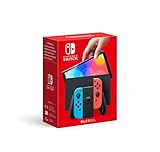
Nintendo Switch (OLED Model) - Neon Blue/Neon Red (Renewed) | $259.00 | Buy on Amazon |
As an Amazon Associate I earn from qualifying purchases.
| Feature | Nintendo Switch – OLED Model | Standard Nintendo Switch |
|---|---|---|
| Built-in display | 7.0-inch OLED touchscreen; 1280×720 | 6.2-inch LCD touchscreen; 1280×720 |
| Listed U.S. MSRP | $399.99 | $339.99 |
| Internal storage | 64 GB | 32 GB |
| Nintendo-estimated battery life | Approximately 4.5–9 hours | Approximately 4.5–9 hours |
| Stand and onboard audio | Wide adjustable stand; enhanced onboard audio | Standard stand; Nintendo’s comparison does not list the OLED-specific audio enhancement |
| Included dock | Wired LAN port | No built-in wired LAN port |
| Game compatibility | Full Nintendo Switch game library, with a caveat for some Labo Toy-Con accessories | Full Nintendo Switch game library |
Figures and specifications are from Nintendo’s [Switch comparison], [technical specifications], and [OLED product page], accessed in 2026. The listed prices are suggested U.S. prices, not a guarantee of what a retailer currently charges; check the price and availability where you plan to buy.
Recommended Free Tools
Which model is better for the way you play?
Choose the OLED model for handheld and tabletop play
The 7-inch OLED screen gives handheld games more display area than the standard Switch’s 6.2-inch LCD. Nintendo describes the OLED display as offering vivid colors and contrast; how much that matters is a matter of preference. The bigger screen, wide adjustable stand, and enhanced onboard audio are most relevant if you often play away from a TV or set the console on a table.
#1 Best Overall
- Vivid 7” OLED screen
- Local co-op, online, and local wireless multiplayer
- 64 GB internal storage (a portion of which is reserved for use by the system)
- Enhanced audio in handheld and tabletop modes
- Wide adjustable stand
Choose standard Switch for TV-first play and a lower listed price
If the console will spend most of its time docked, the built-in screen is less central to the decision. Both systems connect to a TV through their docks and support up to 1080p output over HDMI in TV mode. The standard model’s listed U.S. MSRP is $60 lower, while the OLED dock’s built-in wired LAN port is an extra convenience for players who want a wired network connection.
Nintendo’s comparison identifies differences in screen, storage, stand, audio, and dock; it does not establish a general processing or frame-rate advantage for the OLED model. Don’t buy it expecting a performance-generation upgrade.
Rank #2
- Vivid 7” OLED screen
- Local co-op, online, and local wireless multiplayer
- 64 GB internal storage (a portion of which is reserved for use by the system)
- Enhanced audio in handheld and tabletop modes
- Wide adjustable stand
How much storage do you need?
The OLED model includes 64 GB of internal storage; the standard Switch includes 32 GB. Some of that space is reserved for system use, so it is not all available for games and other content. Both models can use compatible microSDXC cards for expansion up to 2 TB, according to Nintendo’s [Switch FAQ]. If you mainly buy physical games, the difference may matter less; if you download many games, extra storage may be useful. Choose a card capacity based on how much you expect to keep installed.
Does the OLED model last longer on battery?
No longer battery-life estimate is listed for the OLED model: Nintendo gives approximately 4.5–9 hours for both compared systems, depending on the game and conditions. Nintendo cites approximately 5.5 hours for The Legend of Zelda: Breath of the Wild as an example, not a guaranteed runtime for every game or player. For an older used standard Switch, identify the specific unit and assess its condition rather than assuming it matches the current listed estimate; Nintendo notes that original Switch consoles sold before August 2019 may have different battery life.
Rank #3
- Vivid 7” OLED screen
- Local co-op, online, and local wireless multiplayer
- 64 GB internal storage (a portion of which is reserved for use by the system)
- Enhanced audio in handheld and tabletop modes
- Wide adjustable stand
Will your games, dock, and accessories work?
The OLED model is compatible with the full Nintendo Switch game library. Nintendo cautions that some physical Nintendo Labo Toy-Con accessories may not fit or behave the same because the console and screen differ in size.
Nintendo says the docks can be used interchangeably. The OLED dock includes a wired LAN port. If you use the original Switch dock with wired networking, Nintendo says a system update may be needed to use that dock’s wired LAN port.
Rank #4
- The next evolution of Nintendo Switch
- One system, three play modes: TV, Tabletop, and Handheld
- Larger, vivid, 7.9” LCD touch screen with support for HDR and up to 120 fps
- Dock that supports 4K when connected to a compatible TV*
- GameChat** lets you voice chat, share your game screen, and connect via video chat as you play
Bottom line: Which Switch should you buy?
- Buy the Switch OLED if handheld or tabletop play is a regular part of your routine and the larger OLED screen, adjustable stand, and enhanced onboard audio are worth the price difference to you.
- Buy the standard Switch if you expect to play mainly on a TV and want the lower listed U.S. MSRP.
- If you already own a standard Switch, consider upgrading for the screen and tabletop improvements, not for a promised boost in game performance or battery life.
Check Nintendo’s [current comparison] and retailer listings before purchase, since suggested prices and availability can change.
Quick wins for a faster PC:
Repair Windows errors before they cause bigger problemsFix Now →Fix the driver behind crashes, sound loss and screen glitchesFind Drivers →Quick Recap
Product prices and availability are accurate as of the date/time indicated and are subject to change. Any price and availability information displayed on Amazon at the time of purchase will apply.




