Choose M12 if the tools you need are available in that system and a compact tool is especially useful for tight spaces or overhead work. Choose M18 if your planned tools or sustained, demanding workloads call for M18 models and battery options. In either case, compare the specific tool and battery—not voltage alone.
- M12: A practical fit when compactness and access matter and its lineup covers your jobs.
- M18: A better fit when the specific tools you need or the demands and duration of your work point to M18.
Important: M18 and M12 batteries do not cross-fit. Milwaukee says M18 batteries work with M18 tools and chargers, and M12 batteries work with M12 tools and chargers.
As an Amazon Associate I earn from qualifying purchases.
What choosing a platform means
Buying into M12 or M18 connects you to that family of tools and batteries. A pack from one family cannot power a tool from the other, so an existing battery collection is a strong reason to stay within its platform—provided it includes the tools you need.
There is one useful exception for charging: Milwaukee documents an M18/M12 charger that accepts packs from both families. That lets someone who owns both systems charge either type; it does not make the batteries interchangeable in tools.
#1 Best Overall

- INCLUDES: • (1) 3404-20 M12 FUEL™ Hammer Drill Driver Bare Tool • (1) 3
How to decide between M12 and M18
Start with the exact tools you need
List the actual models or tool types for your work—such as a drill, impact driver, saw, light, plumbing tool, or automotive tool—and check whether each is available in the platform you are considering. Milwaukee offers broad tool systems, but a platform-wide label does not tell you how two particular models compare. Verify current model availability and compare the exact tools before buying.
If the tools you need are available in both systems, compare their specifications and complete configurations: the tool, battery, weight, and intended workload. The available evidence does not establish a neutral, model-by-model winner for performance, runtime, weight, or price.
Rank #2

- Subcompact design: superior balance and control, ideal for overhead drilling or driving as well as accessing tight spaces Drill: Only 5.4" in length / Impact: Only 4.3” in length Drill: 350 in-lbs. of torque / Impact: 1100 in-lbs. of torque Drill: 0-450 RPM in low & 0-1550 RPM in high / Impact: Variable speed 0 -3,000 RPM Drill: 2 lbs. with CP battery / Impact: 1.7 lbs. with CP battery
- Metal 3/8 in. chuck on the drill & Internal Metal Gearcase in the impact driver for maximum durability REDLINK Intelligence: Advanced overload protection defends against heavy duty applications and monitors the temperature to prevent damage and ensure maximum tool & battery life REDLITHIUM Battery: Superior pack construction, electronics, and performance deliver more work per charge and more work over pack life than any battery on the market 5 year tool warranty, 2 year battery
Consider access and handling
M12 is the sensible starting point when compactness is a priority and its available tools meet the job. But do not assume every M12 tool is smaller or easier to handle than every M18 tool. The exact tool and battery combination determines what you will carry and how it fits into a confined space or overhead task.
Match the platform and battery to the workload
For extended or high-demand work, consider the specific tool’s requirements and how long you need it to run. Milwaukee describes M18 battery formats as a size-and-runtime trade-off: CP is its most compact format, XC balances size, weight, power, and runtime, and HD is larger for high-power, longer-duration demands. Those descriptions can help narrow an M18 pack choice, but they do not establish a runtime comparison between M18 and M12.
Rank #3

- RECESSED FORWARD - BACKWARD SWITCH on the back of the head prevents you from accidental actuations in the middle of an important job
- LOW PROFILE HEAD DESIGN allows you to work in an engine bay without issue
- ONBOARD FUEL GAUGE: Lights on the side of the unit will let you know how much power you have left
- LED LIGHTING on the front of the unit allows you to see your job in dimly lit conditions
- REDLINK INTELLIGENCE: A smart chip in this unit allows it to communicate with the M12 battery plugged into it. This prevents it from receiving too much power and overheating, saving it from unnecessary damage
What the batteries tell you
M12: a compact system with HIGH OUTPUT options
M12 is not simply an obsolete or toy-size platform. In a release dated June 29, 2022, Milwaukee said its new M12 HIGH OUTPUT batteries delivered 25% more power on high-demand tools and ran 25% cooler through heavy applications than standard M12 REDLITHIUM batteries. These are Milwaukee’s claims, not independent comparative test results. The release also said the CP2.5 and XC5.0 packs maintained the footprint of the previous M12 CP and XC batteries and were compatible with the M12 line.
Milwaukee’s 2022 release described M12 as having more than 125 power tool products at that time. That is a dated manufacturer figure, not a current catalog count. Check the present lineup for the particular tool you need.
Rank #4
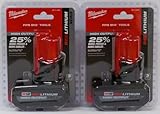
- Provides protection against oils, greases and solvents due to resistant housing
- Delivers fade free power in all weather
- Works with more than 125+ cordless power tools
- 2 pack 12V Battery Pack
M18: choose a pack format for the job
For M18, Milwaukee’s guidance distinguishes compact CP packs, balanced XC packs, and larger HD packs intended for high-power, longer-duration demands. Think about how long and hard the tool will work, as well as how much battery size and weight matter to you, rather than choosing by voltage alone.
Milwaukee says M18 battery packs have maintained compatibility across M18 solutions since the system’s introduction in 2007. This is the company’s historical statement about M18 compatibility; it does not mean M18 packs fit M12 tools.
Best Value

- Brushless Motor delivers up to 1,500 in-lbs. of torque
- Illuminates workspace with three LED lights
- Up to 3600 RPMs in Mode 3
- 4-Mode Drive Control with dedicated self tapping screw mode
- Light Weight at 2 lbs for tool belt portability and less fatigue in the work day
What to check before buying a kit
- Write down your tool list. Confirm that the platform offers the specific current models you need.
- Match tools to your work. Consider how demanding and prolonged the applications are, then compare the relevant tool specifications and battery options.
- Check the working environment. For tight spaces or overhead jobs, assess the size and weight of the exact tool-and-battery combination.
- Account for batteries you already own. Packs stay within their M12 or M18 family; do not count batteries from the other system as usable tool batteries.
- Compare complete kit contents. Check which tools, batteries, and charger are included, and whether you would need extra packs for your workload.
- Decide whether two systems are worth maintaining. A dual-voltage Milwaukee charger can charge packs from both families, but tools and batteries remain platform-specific.
Milwaukee also publishes charge-time figures for particular M18 packs using an M18 Super Charger: in the company’s room-temperature testing, FORGE XC6.0 charged fully in 25 minutes, HIGH OUTPUT XC8.0 in 45 minutes, and XC5.0 in 60 minutes. Milwaukee cautions that actual results vary and depend on the pack, charger, and environment. These figures apply to those tested M18 combinations; they are not a general comparison of M18 and M12 charging.
Quick Recap
Product prices and availability are accurate as of the date/time indicated and are subject to change. Any price and availability information displayed on Amazon at the time of purchase will apply.




