The Tool Desk
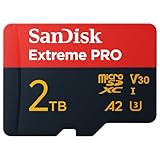
Outbyte PC Repair FREEClear out junk files and repair common Windows errorsFree Scan →Outbyte Driver Updater FREEScan for outdated or missing drivers - takes under a minuteDriver Scan →The largest microSD card documented in the official product sources reviewed is a 2TB SanDisk Extreme microSDXC UHS-I card. That reaches the SDXC standard’s 2TB limit. SDUC allows capacities up to 128TB, but that is a standard ceiling—not evidence that a 128TB card is commercially available.
What is the largest microSD card?
SanDisk lists a 2TB capacity for its Extreme microSD UHS-I card, and its product data sheet identifies it as a microSDXC card. These official product sources document 2TB as the largest product capacity; they do not establish a fully audited, worldwide list of every card on sale.
As an Amazon Associate I earn from qualifying purchases.
SDXC covers capacities above 32GB through 2TB. A 2TB card is therefore at the upper limit of SDXC, the format named for this product.
Recommended Free Tools
Does the microSD standard allow cards larger than 2TB?
Yes. The SD Association defines SDUC as covering capacities above 2TB through 128TB. That figure describes what the standard permits, not a verified retail product. The Association says manufacturers determine when larger-capacity cards enter the market, so a standard’s maximum and the largest documented product are different things.
#1 Best Overall

- Compatible with Nintendo-Switch 1 (NOT compatible with Nintendo-Switch 2), smartphones, and tablets
- Boost your gaming experience with up to 160MB/s read for fast load times
- A2-rated app performance lets you quickly access and enjoy games and apps without lag for an enhanced gaming experience and a competitive edge
- Store more of your favorite games and other content with capacities up to 2TB
- Built to endure with temperature resistance, waterproofing, x-ray protection, and more
The Association lists microSD’s physical dimensions as 11 × 15 × 1.0 mm. SDXC and SDUC cards use exFAT.
Will a 2TB microSD card work in your device?
Not automatically. Check the exact device’s user manual for supported card capacity and speed class before buying. The SD Association advises users to follow the manual. Its compatibility guidance says SD and SDHC devices do not support newer SDXC cards; an SDXC-compatible device can support SDXC, SDHC, and SD cards.
Rank #2

- Compatible with Nintendo-Switch (NOT Nintendo-Switch 2)
- Expand your storage in a flash: ideal for Android smartphones and tablets, Chromebooks, and Windows laptops.
- Increase your TV show, movie, and Full HD video recording collections dramatically with up to a massive 1.5TB. (Full HD (1920x1080) video support may vary based upon host device, file attributes, and other factors. See SanDisk official website for more info. 1GB=1,000,000,000 bytes. 1TB=1,000,000,000,000 bytes. Actual user storage less.)
- Transfer files fast with up to 150MB/s read speeds and SanDisk MobileMate USB 3.0 microSD card reader. (Engineered with proprietary technology to reach speeds beyond UHS-I 104MB/s, require compatible devices capable of reaching such speed. Based on internal testing; performance may be lower depending on host device, interface, usage conditions, and other factors. 1MB=1,000,000 bytes. Reader sold separately.)
- Load apps faster with A1-rated performance. (A1 performance is 1500 read IOPS, 500 write IOPS. Based on internal testing. Results may vary based on host device, app type, and other factors.)
Capacity support is only one check: the card’s speed class and interface also need to suit the device and your workload. A camera’s recording requirements, for example, may differ from what is needed for ordinary file storage. Follow the device maker’s specifications rather than assuming that physical fit means full compatibility.
Free tools Windows power users keep installed
One-click scans. No signup required.
What speeds does the 2TB SanDisk card claim?
SanDisk advertises up to 240MB/s read and 140MB/s write for the 2TB version. Those are manufacturer maximums, not guaranteed real-world results: its data sheet says performance can be lower depending on the host device, interface, usage, and other factors. The claimed read speed exceeds the 104MB/s UHS-I barrier and depends on compatible equipment. Treat the figures as product specifications, not a promise of the speed you will see.
Quick Recap
Rank #4

- EXTREME PERFORMANCE: U3, V30 speed class performance with read speeds up to 200MB/s, and write speeds up to 150MB/s when used with PNY Performance Prime microSD Card Reader¹
- RECORD & TRANSFER: Record and transfer videos, photos, music, files and more from microSD enabled host devices such to laptop and desktop computers using the Performance Prime Card Reader for extreme speeds facilitating accelerated workflows when editing content
- RATED A2 APP PERFORMANCE: A2 App Performance enables apps to run directly from the microSD card, delivering faster app launch and performance. A2 provides minimally 4000 IOPS (Read) and 2000 IOPS (Write)
- USE WITH LATEST DEVICES: Compatible with Android smartphones and tablets, action and surveillance cameras, drones, computers and more (Not compatible with Nintendo Switch 2)
- SD COMPATIBILITY: Included SD adapter for compatibility with SD enabled host devices including DSLR cameras, video cameras, desktops, and laptops
Rank #3
- INCREDIBLE LIFELIKE 5K AND 4K UHD. Record fantastic 4K UHD point-of-view video and brilliant high-resolution photos with U3 and V30 video speeds.
- SPEED OBSTACLES BLOW AWAY. AGAIN. Capture valuable moments with huge read speeds of up to 250MB/s and write speeds of up to 150MB/s when used with the SanDisk QuickFlow microSD UHS-I card USB-A reader (sold separately).
- MAXIMIZE WITH MAXIMUM CAPACITY: Record longer and capture more with up to 2TB of storage that holds up to 2808 minutes of 4K UHD video recorded at 30fps (641MB/min).
- ALSO AT BARRE CONDITIONS. Designed to perform under extreme conditions, rough handling and despite continuous use, SanDisk microSD memory cards continue to do their job with unwavering resilience.
- RECOVERY WHAT Matters MOST. Recover and restore files for free for two years with RescuePRO Deluxe data recovery software.
How to choose a high-capacity microSD card
- Check the capacity standard and device limit: confirm whether the device supports SDXC or SDUC, and verify its maximum capacity in the manual.
- Match the speed class to the workload: use the card rating and device requirements for the kind of recording or app use you need.
- Account for the host and interface: advertised maximum speeds depend on compatible equipment and operating conditions.
- Separate standards from products: a card capacity listed by a manufacturer is evidence of a product; a standard’s upper limit alone is not evidence of a card available to buy.
Sources
- SD Association: SD, SDHC, SDXC and SDUC capacity ranges
- SD Association: consumer FAQ and device compatibility guidance
- SanDisk: Extreme microSD UHS-I product page
- SanDisk: Extreme UHS-I microSD data sheet
Product prices and availability are accurate as of the date/time indicated and are subject to change. Any price and availability information displayed on Amazon at the time of purchase will apply.




