X-ray imaging and AI-assisted image processing let researchers watch two spacecraft heat-shield materials change internally as they were heated in a laboratory. The study found distinct structures: cork-containing SLA-561V developed more open pores, while SLA-220 formed a dense network of interconnected channels. The results offer measurements that may help improve future ablation models; they are not a flight test or proof that either material performs better in space.
What the researchers did
In a peer-reviewed study published in npj Materials Degradation, researchers examined two superlight ablators, SLA-220 and SLA-561V, using in situ X-ray micro-computed tomography (micro-CT) at beamline 8.3.2 of the Advanced Light Source at Lawrence Berkeley National Laboratory. Micro-CT produces three-dimensional views of a sample’s internal structure. Because the researchers collected scans while the samples were being heated, they could track structural changes during the experiment rather than comparing only before-and-after images. The study
As an Amazon Associate I earn from qualifying purchases.
The samples were heated in a controlled environment in which temperature, pressure and gas mixture could be managed. Berkeley Lab reports that the experiment reached 900 °C (1,652 °F), the upper temperature range at which the materials began to decompose. This was a laboratory study of material behavior under heating—not a full simulation of atmospheric reentry, which also involves flight velocity and aerodynamic conditions. Berkeley Lab’s account of the experiment
Free tools Windows power users keep installed
One-click scans. No signup required.
What X-rays and AI contributed
X-rays captured internal structure during heating
Micro-CT scans reveal internal features in three dimensions, but the experiment involved a trade-off between resolution and field of view: higher-resolution scans covered a smaller area, while the in situ scans could capture a larger volume at lower resolution. That matters when trying to see fine features across a changing sample.
#1 Best Overall

- 【Premium 0.5mm Thick, Heavy-Duty & Durable】 Made from extra-thick 0.5mm embossed aluminum, this shield is built for superior durability and lasting performance, far outlasting standard thin-gauge or fabric alternatives.
- 【Withstands 1022°F Heat & Flexible for Easy Fit】 Engineered to sustain extreme temperatures up to 1022°F (550°C) while remaining highly flexible. Easily bends and contours, allowing for a perfect, custom fit around any component.
- 【Complete Kit for DIY Installation】 Includes everything for professional results: 1 roll (16"x78.7") of aluminum sheet, 20 stainless steel zip ties. Simply cut to size and secure – no special tools needed.
- 【Protects Critical Automotive Components】 Effectively reflects and manages heat to safeguard vital parts like exhaust systems, mufflers, fuel tanks, chassis, and catalytic converters from heat damage and wear.
- 【Wide-Ranging Heat Shield Applications】 Aluminum Heat Shield material is versatile solution for cars, motorcycles, and industrial use. Ideal for underbody heat shielding, pipe insulation, firewall protection, and more.
AI-assisted processing increased image detail
The team used a generative adversarial network (GAN) super-resolution workflow. It was trained with high-resolution image data and used to increase the detail of lower-resolution scans across materials and heating stages. The AI was part of the imaging and data-processing workflow; the physical heating and X-ray measurements remained the experiment. The enhanced reconstructions should be understood as processed views derived from measured data, not as an independent observation or an AI-run spacecraft test. The study’s methods and findings
How the two materials changed
| Material | Structural change reported | Volume change reported | Tortuosity trend |
|---|---|---|---|
| SLA-220 | Developed a dense, interconnected channel network during decomposition. | Shrank by 12% by 900 °C in the study’s test conditions. | Increased as the material decomposed. |
| SLA-561V | Contains cork as a filler; decomposition of the cork phase left open pores. The study reported a larger increase in open porosity for this material. | Swelled by 5% during early decomposition, then shrank by 32% between 450 °C and 900 °C in the study’s test conditions. | Decreased as the material decomposed. |
These figures describe samples in the reported laboratory experiment, not general specifications or flight-scale performance guarantees. The opposing tortuosity trends accompany the distinct pore and channel structures, but they do not by themselves show which material would protect a spacecraft better. The study
Rank #2
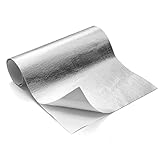
- Withstands Extreme Heat — Made with aluminized finish which is flexible and durable woven silica, this Aluminized Adhesive Backed Heat Barrier can withstand scorching temperature above 2000 degrees Fahrenheit. Its reflective surface can still screen off the heat and provide utmost protection.
- Reflects 95% of Heat — Keep the back of the heat shield at a normal temperature to prevent damage from high temperature, Capable of reducing up to 95% of radiant heat.
- Suitable Size — We offer five different sizes, 12 x 12 inch, 12 x 24 inch, 12 x 40 inch, 24 x 24 inch, 24 x 40 inch, thickness: 0.032''(0.8MM). You can choose the size that is more suitable for your project, you can simply trim the sheet into wanted shape or size to satisfy your various projects.
- Convenient to Apply — Innovatively designed with adhesive composite on its back, the heat shield protection barrier cover can be easily wrapped or laid on to any desired surfaces with a professional-like finish, make it clean and tidy, also a penny-saver from hiring service.
- Multi-Purpose Adhesive Backed Heat Barrier — No matter what area of your Automobile or Home needs heat prevention; this barrier can be of sure help. May it be plastic components, painted surfaces, hoses, firewalls, refrigerator, cabinets near ovens, car bottom insulationdoors, hoods, and a lot more.
Why changing pores and channels matter
Ablation is the controlled decomposition and loss of outer heat-shield material that helps absorb and dissipate heat. It is not necessarily ordinary combustion. As a material decomposes, its internal structure changes; those changes affect properties relevant to how it responds to heat. The study’s authors conclude that constituent chemistry, mass and volume fractions, and the distribution of phases influence degradation, porosity and effective properties. Berkeley Lab’s explanation of ablation
Recommended Free Tools
That is why observing microstructure as it evolves can be useful to engineers. The measurements provide data that could support development and validation of higher-fidelity ablation-response models. The study does not report that operational heat-shield simulations have already been updated or that its findings have been shown to improve flight outcomes. The study
Quick Recap
Best Value
- Withstands Extreme Heat — Made with aluminized finish which is flexible and durable woven silica, this Aluminized Adhesive Backed Heat Barrier can withstand scorching temperature above 2000 degrees Fahrenheit. Its reflective surface can still screen off the heat and provide utmost protection.
- Reflects 95% of Heat — Keep the back of the heat shield at a normal temperature to prevent damage from high temperature, Capable of reducing up to 95% of radiant heat.
- Suitable Size — We offer five different sizes, 12 x 12 inch, 12 x 24 inch, 12 x 40 inch, 24 x 24 inch, 24 x 40 inch, thickness: 0.032''(0.8MM). You can choose the size that is more suitable for your project, you can simply trim the sheet into wanted shape or size to satisfy your various projects.
- Convenient to Apply — Innovatively designed with adhesive composite on its back, the heat shield protection barrier cover can be easily wrapped or laid on to any desired surfaces with a professional-like finish, make it clean and tidy, also a penny-saver from hiring service.
- Multi-Purpose Adhesive Backed Heat Barrier — No matter what area of your Automobile or Home needs heat prevention; this barrier can be of sure help. May it be plastic components, painted surfaces, hoses, firewalls, refrigerator, cabinets near ovens, car bottom insulationdoors, hoods, and a lot more.
Rank #4

- 【Adhesive Backed Heat Shield Heat Shield Barrier】—- The self-adhesive heat shield protection cover is made of fiberglass, with an aluminized outer facing, durable and reliable to use, heat barrier sheet can provide ultimate protection from extreme heat as well as chemical and oil spills, dirt, grease and road grime.Protect parts from damaging radiant heat well.
- 【Heat Shield Mat Adhesive Backed Heat Barrier Sheet】—- The aluminized heat shield thermal barrier adhesive is easy to apply on your parts which need protection. It is designed with adhesive composite on the back, the heat barrier shield mat cover can be easily wrapped or laid on to any desired surfaces with a professional-like finish, make it clean and tidy.
- 【Heat Shield Automotive Withstand High Temp 】—- The heat barrier insulation can withstand high temperature. Reflective surface of the material is premium quality of withstanding radiant temperatures up to 2000 degrees. Capable of reflecting 90% of radiant heat.
- 【Size of Adhesive Backed Heat Shield】—- The aluminized heat barrier is 12inch width and 48inch length. It can be cut into any size you want and also be trimmed for wanted shape to satisfy your various projects.
- 【adhesive heat shield After-Sale Service】—- We offer lifetime service for this self adhesive heat barrier shield. Any issue about this backed aluminized heat barrier sheet, please feel free to contact us.
Rank #3

- Ultra-light material: Aerogel is one of the lightest solids in the world. It has a loose structure and feels almost weightless in the hand. It is of great scientific research and popular science value.
- Porous structure: It has a nano-scale pore structure inside. It not only has high light transmittance and stunning visual effects, but also is an important sample for studying heat conduction and material properties.
- Excellent thermal insulation: It has strong thermal insulation and flame retardant properties. It is an ideal material for demonstrating experiments such as heat conduction and heat shielding. It is widely used in education and research.
- Strong hydrophobicity: The surface has good hydrophobicity and can be used to demonstrate the principle of waterproof materials in experiments, improving the fun and practicality of teaching.
- Science gift: It is suitable as a scientific gift for students, children or teachers to stimulate interest in learning. It is a high-quality auxiliary prop for classroom teaching and popular science display.
What this experiment establishes—and what it does not
- It establishes: under the study’s controlled heating conditions, SLA-220 and SLA-561V developed different internal structures, and in situ micro-CT with GAN-based super-resolution provided detailed 3D records of those changes.
- It does not establish: how either material performs in an actual spacecraft reentry, which is superior in flight, or whether a mission’s operational thermal-protection model has changed as a result.
- Its engineering value remains prospective: the observations can inform future models, but model development and validation are distinct from demonstrating flight performance.
Product prices and availability are accurate as of the date/time indicated and are subject to change. Any price and availability information displayed on Amazon at the time of purchase will apply.




