Do these 3 things before closing this tab:
1Clear out junk files and repair common Windows errors2Fix the driver behind crashes, sound loss and screen glitches3Repair Windows errors before they cause bigger problemsDepth of field is the range of distances in a scene that appears acceptably sharp when a camera focuses at a particular distance. The exact range is not a hard optical boundary: the plane of focus is sharpest, and detail becomes progressively less sharp in front of and behind it.
How depth of field works
A lens brings points at one subject distance into its best focus on the sensor. Points closer to or farther from that plane form small blur spots instead of perfect points. If those spots are small enough to look sharp in the finished image, they fall within the depth of field.
As an Amazon Associate I earn from qualifying purchases.
Photographers describe the acceptable blur using a circle of confusion: the largest blur spot that still counts as acceptably sharp under specified viewing conditions. It defines the near and far limits of depth of field; it does not mean that everything between those limits is equally sharp. The transition is gradual, with the best focus at the chosen distance. Cambridge in Colour explains the circle-of-confusion concept and viewing conditions, while ICAO’s Annex E on focus and depth of field describes the threshold in technical terms.
Recommended Free Tools
What changes the depth-of-field range?
Aperture
A wider aperture, represented by a smaller f-number, generally produces shallower depth of field. Closing the aperture to a larger f-number generally increases the range that appears sharp, all else equal. Aperture is a practical control when deciding whether to isolate a subject or keep more of a scene in focus. Nikon’s guide to depth of field discusses aperture alongside the other main factors.
#1 Best Overall

- 75-300 millimeter telephoto zoom lens with f 4-5.6 maximum aperture for Canon SLR cameras
- Improved mechanism makes zooming smoother; front part of zoom ring sports silver ring
- Measures 2.8 inches in diameter and 4.8 inches long; weighs 16.8 ounces; 1-year warranty
- 4.9-foot closest focusing distance; 32- to 8-degree diagonal angle of view
- Image Stabilization: No
Focus distance
Focusing closer generally reduces depth of field at the same aperture; focusing farther away generally increases it. This is why close-up subjects can have only a narrow zone of apparent sharpness even when the camera’s settings are otherwise unchanged. The result still depends on the rest of the setup.
Focal length, framing, and magnification
Focal length matters, but it is not a reliable standalone rule for predicting depth of field. A longer lens is often used for portraits with a narrower angle of view and greater subject magnification, which can make the background look more blurred and the subject more isolated. The visible result depends on how the image is framed and compared, including subject distance and magnification. Sony’s guide to focal length and depth of field explains the role of angle of view and magnification. ICAO likewise identifies focal length, effective aperture, and focus distance as relevant factors.
Rank #2

- Comprehensive Gear – This 58mm lens kit for Canon EF-S 18-55mm IS II STM is a comprehensive equipment set essential for photographers. It bundles a vast array of professional tools into one convenient package, including 43x Wide Angle Lens, 2.2X Telephoto Lens, 3pc Filter Kit, 4pc Close Up Filters, Tulip Lens Hood, Soft Lens Hood, Lens Cap, and Cap Keeper.
- Wide Angle and Telephoto Lens – With its 0.43x wide angle lens, it allows you to add depth and dimension to your shots and this can be split into two macros. The 2.2x telephoto lens offers you the ability to zoom in on distant subjects.
- Compatibilities - This 58mm lens kit is compatible with Canon EOS 80D 77D 1100D 700D 650D 600D 550D 7D, Mark II 6D Mark II 5DS 5D Mark IV 1D Mark II, Rebel T8i T7 T7i T6i T6 T6s T5i T5 T4i T100, and SL3 SL2 SL1.
- Lens Compatibilities - Our 58mm lens filters are compatible with the following models - Canon EF- S 18-55mm f/4-5.6 & f/3.5-5.6 IS STM, EF 50mm f/1.4 USM, EF-S 55-250mm f/4-5.6 IS STM, EF 75- 300mm f/4-5.6 III USM, EF 85mm f/1.8 USM, Nikon AF-P & AF-S, NIKKOR 50mm f/1.4G & f/1.8G, 70-300mm f/4.5-6.3G ED VR, Fujifilm XC 16-50mm f/3.5-5.6 OIS II, Olympus M.Zuiko Digital ED 40- 150mm f/4-5.6 R, and Panasonic Lumix G X Vario 12-35mm f/2.8 II
- Superior Build Quality - With a durable steel barrel design, our 58 mm lens filter kit uses multi coated anti-reflection glass. The high-grade 58mm UV filter component shields your lens against dust, scratches, and sun glare for durable usability. The close-up filters enable macro photography using a standard lens.
Why “acceptably sharp” depends on the final image
Depth of field is a viewing judgment, not a guarantee that every point in the range will be critically sharp at pixel level. A blur spot that appears negligible in a small image may be visible in a large print or when viewed closely. The accepted circle-of-confusion threshold therefore depends on the intended image size and viewing conditions, as well as the camera-format assumptions used in a calculation. A depth-of-field estimate is meaningful only with those assumptions in mind.
The Tool Desk
Outbyte PC Repair FREEClear out junk files and repair common Windows errorsFree Scan →Outbyte Driver Updater FREEScan for outdated or missing drivers - takes under a minuteDriver Scan →Near and far limits, and hyperfocal distance
The near limit is the closest distance that meets the chosen acceptable-sharpness criterion; the far limit is the farthest. Together they describe the depth-of-field range for a particular setup. A technical manual such as the US government’s Basic Photography gives equations for estimating these limits from subject distance and hyperfocal distance, using specified lens and sharpness assumptions. The manual’s formulas are useful for calculations, but their outputs are conditional on the inputs rather than universal distances.
Rank #3

- 50 millimeter focal length and maximum aperture of f/1.8
- Great for portraits, action, and nighttime photography; Angle of view (horizontal, vertical, diagonal): 40º, 27º,46º
- Minimum focusing distance of 1.15 feet (0.35 meter) and a maximum magnification of 0.21x
- Stepping motor (STM) delivers near silent, continuous move Servo AF for movies and smooth AF for stills
- 80 millimetre effective focal length on APS C cameras, 50 millimetre on full frame cameras. Lens construction: 6 elements in 5 groups
Hyperfocal distance is a planning aid: focusing at that distance can be used to estimate how much of the scene, from the near limit toward the far distance, will meet the selected sharpness criterion. It is not a separate kind of depth of field, and its usefulness depends on the aperture, focal length, and acceptable-blur assumption for the image.
Quick Recap
Best Value

- LENS ATTACHMENT: Easily screws on to the front of your lens, and instantly expands the field of view for breathtaking wide-angle photography. Features a detachable macro lens for extremely high-resolution close-ups of small objects.
- LENS COMPATIBILITIES: Popular 58MM Lens models including Canon EF-S 18-55mm f/4-5.6 IS STM, Canon EF-S 55-250mm f/4-5.6 IS STM, Canon EF 75-300mm f/4-5.6 III USM, Canon EF-S 18-55mm f/3.5-5.6 IS STM, Canon EF 85mm f/1.8 USM, Canon EF 50mm f/1.4 USM, Nikon AF-P DX NIKKOR 70-300mm f/4.5-6.3G ED VR, Nikon AF-S NIKKOR 50mm f/1.8G, Nikon AF-S NIKKOR 50mm f/1.4G, Olympus M.Zuiko Digital ED 40-150mm f/4-5.6 R, Lumix G X Vario 12-35mm f/2.8 II, Fujifilm XC 16-50mm f/3.5-5.6 OIS II
- Compatible with the following cameras when paired with a 58mm thread size lens: Canon EOS Rebel T7, T7i, T6i, T6, T6s, T5i, T5, T4i, T3i, T100, SL3, SL2, SL1, 90D, 80D, 77D, 70D, 1100D, 700D, 650D, 600D, 550D, 7D Mark II, 6D Mark II, 5DS, 5D Mark II, 1D Mark II, M3, M5, M6, M10, M50, M100, M200, R, and RP.
- NOTE: PLEASE VERIFY YOUR CAMERA'S LENS THREAD SIZE BEFORE ORDERING. This Wide-Angle is compatible with 58MM lenses only. Lens sizes vary regardless of camera brand or model. Your camera's lens thread size will be marked somewhere on the lens barrel or printed underneath your lens cap. This number is always preceded by a ''Ø'' (diameter) symbol. For example: Ø58 = 58mm lens thread size.
Rank #4
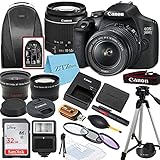
- Viewfinder type: Optical
- Wi-Fi connectivity also enables wireless remote control over the camera from linked mobile devices using the Camera Connect app; Built-in Wi-Fi with NFC permits pairing the DSLR with a smartphone or tablet for wirelessly sharing photos and movies for instant online posting
- Lens type: Telephoto, Prime, Wide Angle
- Wi-Fi connectivity also enables wireless remote control over the camera from linked mobile devices using the Camera Connect app; Built-in Wi-Fi with NFC permits pairing the DSLR with a smartphone or tablet for wirelessly sharing photos and movies for instant online posting
How to get more of a scene in focus
- Choose a smaller aperture. Use a larger f-number to increase depth of field, while accounting for the exposure change this causes.
- Focus farther away when the composition allows. Moving the focus distance away from a close subject generally widens the acceptable range.
- Plan using the intended output. Judge sharpness at the size and viewing distance that matter; a limit calculated for one viewing condition may not suit another.
- Check the result. Review the image at the intended display or print scale. The calculated limits describe acceptable sharpness, not equal sharpness throughout the scene.
Product prices and availability are accurate as of the date/time indicated and are subject to change. Any price and availability information displayed on Amazon at the time of purchase will apply.




