The Tool Desk
Outbyte PC Repair FREEClear out junk files and repair common Windows errorsFree Scan →Outbyte Driver Updater FREEFix the driver behind crashes, sound loss and screen glitchesFind Drivers →Spend first on the graphics card that best fits your games, resolution, and target frame rate; pair it with a CPU that can keep up. Save on prestige features and specifications that do not improve your actual experience, but do not cut below compatibility, cooling, power, or fit requirements. There is no universal percentage split: the right allocation depends on your budget, country, games, display, and other workloads.
Set the build target before assigning the budget
Write down your total budget and country, the games you play, your display resolution and refresh rate, and whether you plan to stream, create content, or use heavy mods. Those answers determine which parts deserve money. A graphics-heavy game at a higher resolution can place more emphasis on the GPU; high-refresh gaming at 1080p can make CPU performance more important.

As an Amazon Associate I earn from qualifying purchases.
Compare performance in the games and settings you actually care about, then check local prices and stock on the day you buy. The component examples and prices in PC-building guides can become stale quickly, particularly for graphics cards and memory. The sources here are primarily US-market guides; do not assume their availability or dollar pricing applies elsewhere.
Quick wins for a faster PC:
Clear out junk files and repair common Windows errorsFree Scan →Scan for outdated or missing drivers - takes under a minuteDriver Scan →Where to spend for gaming performance
Graphics card: make it the performance anchor
Begin by finding the best-fitting GPU within your price band, not simply the most expensive one you can afford. Intel’s build guide says the GPU, alongside the CPU, directly affects in-game frame rate and is important for demanding graphics-heavy games. Tom’s Hardware likewise identifies the GPU as gaming’s most important and most expensive component. These are priority recommendations, not a basis for assigning a fixed share of your total budget.
#1 Best Overall

- System: AMD Ryzen 7 8700F 4.1GHz 8 Cores | AMD B850 Chipset | 16GB DDR5 | 1TB PCIe 4.0 NVMe SSD | Windows 11 Home
- Graphics: NVIDIA GeForce RTX 5060 Ti 8GB Graphics | 1x HDMI | 2x DisplayPort
- Connectivity: 2 x USB-C 3.2 | 4 x USB-A 3.2 | 2 x USB-A 2.0 | 1 x LAN | WiFi 6 | Bluetooth 5.3 | 7.1 Channel Audio
- Tempered Side Case Panel | Custom RGB Lighting | Keyboard and Mouse
- 1 Year Parts & Labor Warranty, Free Lifetime Tech Support
Compare cards using benchmarks for your games at your target resolution and settings. Also weigh current local price and stock, VRAM for those settings, power requirements, physical dimensions, and any ray-tracing or upscaling features you value. Peak performance in a different game or setting may not translate to the experience you want.
CPU: match it to the GPU and workload
Choose a CPU with strong gaming results for your intended use, while keeping the full platform cost in view: processor, motherboard, memory, power, and cooling. Tom’s Hardware notes that the CPU can have a substantial effect on 1080p gaming. High-refresh play, streaming, and other simultaneous tasks can also affect what makes sense; Intel notes that cores and threads help with multitasking and some multithreaded games.
Do not assume that a higher price or more cores automatically means better gaming. Compare CPU benchmarks at the resolution you intend to use, and make sure the selected GPU and CPU are a sensible pairing. A previous-generation platform can be worth considering if the complete CPU, board, and memory combination is compatible and its gaming performance meets your needs; verify model-specific benchmarks and upgrade options rather than relying on the generation label.
Recommended Free Tools
Rank #2

- AMD Ryzen 9 7900X, NVIDIA GeForce RTX 5070 12GB, 32GB DDR5 RGB 4800MHz 16x2 1TB NVMe SSD, WIFI Ready, Windows 11 Home
- Connectivity: 6 x USB 3.1 | 1x RJ-45 Network Ethernet 10/100/1000 | Audio: On board audio
- Special Add-Ons: Tempered Glass RGB Gaming Case | 802.11AC Wi-Fi Included | 16 Color RGB Lighting Case | Free iBuyPower Gaming Keyboard & RGB Gaming Mouse | No Bloatware | AI Workstation PC ready
Power supply: buy for the actual system
Choose a reputable PSU with enough capacity and the connectors required by your selected GPU and other components. Tom’s Hardware’s guidance mentions 750 or 850 watts or more for higher-end builds, but the correct capacity depends on the exact parts. Check the GPU maker’s requirements and the PSU’s available connectors; wattage or an efficiency certification by itself does not establish overall quality.
Where to save without undermining the build
Motherboard: pay for support and features you will use
A less expensive board is a sound saving when it supports the chosen CPU and memory generation, fits the case, and includes the connections and upgrade features you need. Compare CPU support, form factor, memory type, I/O and networking, M.2 slots, and the firmware-update path. Confirm support for the exact CPU and whether the board needs a firmware update before it can run it. An enthusiast chipset or unused connectivity does not improve gaming by itself.
Memory: prioritize capacity and support over appearance
Capacity guidance varies by workload and budget. Intel’s general guide gives 16GB as a minimum for modern gaming and says streaming, multitasking, or heavy mods can require more. Tom’s Hardware’s 2026 guide prefers 32GB when possible; PC Gamer’s guide treats 16GB as a possible budget compromise and 32GB as its preferred future-oriented target. These are editorial recommendations, not guarantees that every game needs the same amount. Check the motherboard’s supported memory type and capacity, and choose enough for your games and other applications.
Once capacity and compatibility are covered, let value guide the choice of speed. Tom’s Hardware describes performance differences between memory options as slight. Avoid paying extra for RGB or a marginal speed increase unless benchmarks show a meaningful benefit for your particular workload.
Storage: buy usable capacity before headline speed
Tom’s Hardware’s 2026 guide regards a 1TB SSD as a solid starting point and 2TB as preferable, while noting that PCIe 5.0 drives are faster but poor value for many builds. A compatible PCIe 4.0 M.2 SSD is a practical value target in that guide. For a typical game library, compare usable capacity and price per gigabyte before paying a premium for peak sequential speed. Check the motherboard’s supported interface and available M.2 slots; add storage later if the board and budget allow.
Cooling and case: pay for temperatures, fit, and airflow
If the CPU includes a cooler that is adequate for your use, there may be no need to buy another one. Otherwise, select cooling appropriate to the processor’s thermal needs and the case’s clearances; an all-in-one liquid cooler is not required for every build.
Rank #4
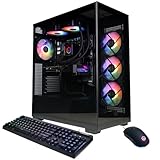
- System: AMD Ryzen 9 9900X 4.4GHz 12 Cores | AMD B850 Chipset | 32GB DDR5 | 1TB PCIe 4.0 NVMe SSD | Windows 11 Home
- Graphics: NVIDIA GeForce RTX 5070 12GB Graphics | 1x HDMI | 3x DisplayPort
- Connectivity: 2 x USB-C 3.2 | 4 x USB-A 3.2 | 2 x USB-A 2.0 | 1 x LAN | WiFi 6 | Bluetooth 5.3 | 7.1 Channel Audio
- Liquid Cool CPU | Tempered Side Case Panel | Custom RGB Lighting | Keyboard and Mouse
- 1 Year Parts & Labor Warranty, Free Lifetime Tech Support
Choose a case that fits the motherboard and parts while providing suitable airflow. Confirm GPU length, CPU-cooler height, and any radiator clearances before buying. Premium finishes, lighting, glass, and elaborate fan or radiator support are optional unless they meet a specific need.
Independent reader supportYour contribution helps us test, update, and keep practical guides available for everyone.Compare parts as a complete system
A part that looks like a bargain on its own can raise the cost elsewhere or fail to meet your target. Compare alternatives using the whole configuration:
Do these 3 things before closing this tab:
1Clear out junk files and repair common Windows errors2Scan for outdated or missing drivers - takes under a minute3Repair Windows errors before they cause bigger problems- GPU: game benchmarks at the target resolution and settings, local street price and stock, VRAM, power and PSU needs, card dimensions, and valued ray-tracing or upscaling features.
- CPU: game benchmarks at the intended resolution, total CPU-platform cost including motherboard and memory, power and cooling requirements, and non-gaming workload needs.
- Motherboard: exact CPU support, memory generation, form factor, required I/O and networking, M.2 slots, firmware-update path, and total platform cost.
- SSD: capacity, price per usable gigabyte, interface compatibility, documented endurance and warranty, and performance in relevant workloads—not just peak sequential speed.
Run a compatibility check before ordering
- Match CPU and motherboard: check the board’s support for the exact processor and whether a firmware update is necessary.
- Match memory to the board: verify memory generation, supported capacity, and the configuration you plan to install.
- Check case clearances: confirm motherboard size, GPU length, cooler height, and radiator fit against the case specifications.
- Verify power: make sure the PSU has suitable capacity and every connector required by the GPU and the rest of the system.
- Check storage installation: confirm the SSD interface is supported and that the board has an available M.2 slot if you plan to use one.
Keep dated recommendations in perspective
Guides can help identify sensible categories and trade-offs, but model picks, prices, and availability are snapshots. Tom’s Hardware labels its build guide for 2026; PC Gamer notes unusually high memory and SSD pricing in its current guide; TechSpot’s component examples and dollar prices are from early 2025 and should not be treated as current. Check live prices and stock in your region, and compare current benchmarks before committing to a named part.
Quick Recap
Product prices and availability are accurate as of the date/time indicated and are subject to change. Any price and availability information displayed on Amazon at the time of purchase will apply.




