Do these 3 things before closing this tab:
1Fix the driver behind crashes, sound loss and screen glitches2Repair Windows errors before they cause bigger problems3Scan for outdated or missing drivers - takes under a minuteTo get more from an interactive conference roundtable, prepare one relevant point, example, or question, listen for the topic the group is actually discussing, and contribute briefly in response. Follow the moderator’s participation cues, make room for other voices, and note a useful takeaway or next step afterward. The exact format varies, so check the session instructions rather than assuming every roundtable works the same way.
Before the session: prepare for its actual question
Start with the session description, agenda, participant list, and any briefing materials. Identify the central question and prepare one concise contribution grounded in your experience: a practical example, a useful observation, or a question that could move the conversation forward. This is an attendee-focused application of the Government Office for Science’s advice to clarify a roundtable’s purpose and questions and to brief participants with an agenda and questions (Government Office for Science roundtable guide).
As an Amazon Associate I earn from qualifying purchases.
- Check whether the session is an open participant discussion, an expert-led exchange, or a virtual session with chat or breakout rooms.
- Consider how your point relates to the session’s stated question, rather than preparing a general introduction or mini-presentation.
- If the format or participation rules are unclear, look for event instructions or ask the organizer in advance.
Know what kind of roundtable you are joining
“Roundtable” does not guarantee one fixed format. Some sessions are led by experts; others are participant-led. Contributions might happen in one shared conversation, through moderator-led questions, or in smaller groups. Online events may use chat or breakouts. The Royal Geographical Society describes different ways roundtables can be organized, while the American College of Cardiology’s moderator guidance emphasizes making clear how and when attendees can participate (Royal Geographical Society; American College of Cardiology).
| Format element | What to look for | How to adapt |
|---|---|---|
| Who sets the topic | Organizer or expert-led discussion, or a topic shaped by participants. | In an expert-led session, respond to the question or exchange underway. In a participant-led session, be ready to offer a relevant issue or experience. |
| How people contribute | Open verbal discussion, moderator questions, audience responses, chat, or breakouts. | Use the channel and timing specified by the moderator or event instructions. |
| Group arrangement | One shared conversation or smaller table and breakout groups. | Address the people in your group and help keep the discussion connected to its purpose. |
| Attendee role | Listening to an expert exchange or contributing experience, examples, and questions. | Match your level of participation to the format; do not assume that every session expects the same kind of contribution. |
The Government Office for Science’s guide, updated 4 August 2026, offers organizer planning guidance of one overarching question and two to three subquestions for a 90-minute roundtable, and says roundtables normally involve 10–12 experts. Those figures describe that guide’s planning recommendations; they are not requirements for every conference or instructions for attendees to enforce (Government Office for Science roundtable guide).
#1 Best Overall
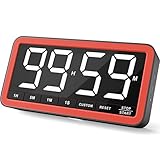
- Your Classroom & Kitchen Command Center - Take back control of your teaching or cooking time. The extra-large 7.8-inch display with 2.3-inch tall numbers keeps everyone—whether students or your family—informed and on task. With 3 brightness levels, it’s equally clear in a sunlit classroom or a dim kitchen. Set it once to track a quiz, a simmering sauce, or screen time, and replace the questions “How much time is left?” or “Is dinner ready?” with focused, productive time
- Library-Quiet & Family-Friendly Alerts - Manage any environment with 4 alert options. Activate Silent Mode for zero noise—just a discreet screen flash—perfect for libraries, exams, or naptime. For active settings, choose from 3 distinct audible alarms & beep with 3 adjustable volume levels to match your classroom or kitchen noise
- 99-Hour Timer for All-Day Management - Move beyond the kitchen. Count down from 99:59:59 or use count-up as a stopwatch. Perfect for timing a 90-minute exam, tracking a 3-hour meeting, managing a 1-hour workout or your child’s daily screen time. From science experiments to gym intervals, two modes handle any task
- Marathon Battery Life & Universal USB-C Charging - Designed for your relentless schedule. Enjoy over 7 days of continuous use on low brightness—enough to power through an entire school week or family routine on a single charge. Need more light? Get over 7 hours on high brightness for demanding tasks. Recharge effortlessly via USB-C (cable and 5V charger included). A clear low-power warning ensures you’re never caught off guard
- Versatile, Kid-Proof Placement - Strong silicone-covered magnets hold securely to any fridge, locker, or whiteboard. Use the built-in stand for your desk, or the hanging hole for a pantry or classroom hook. Intuitive, separated buttons make it foolproof for you, your students, or your kids to operate
During the discussion: contribute to the conversation, not over it
Expect to participate rather than simply observe, while remembering that the moderator is guiding the discussion toward its goal. The NIH meeting toolkit describes roundtables as small-group discussions in which participants are generally expected to contribute (NIH meeting toolkit).
- Listen for the question on the table. The conversation may have moved beyond the wording in the session description. Connect your contribution to what the group is discussing now.
- Make one concise point. Offer the relevant example or observation without turning it into a prepared speech. APPAM’s 2026 conference participant guidance asks speakers to stay within their allotted time; for attendees, brevity is a practical way to leave room for discussion, not a quoted attendee rule (APPAM 2026 Conference Participant Guidelines & Resources).
- Invite a response or yield the floor. If useful, follow your point with a focused question, then let others answer. ACC moderator guidance recommends succinct questions so there is time for a response and discussion; GOV.UK guidance likewise advises questions that can be answered in the available time (ACC moderator guidance; Government Office for Science roundtable guide).
- Build on what others say. Respond to a point you heard rather than waiting only for your turn to deliver something prepared. A useful contribution can clarify, add an example, or ask what follows from someone else’s observation.
- Follow the moderator’s directions. Use the requested microphone, chat, question timing, or turn-taking process. If you are unsure how to enter the conversation, wait for a cue or use the participation method the moderator has specified.
Afterward: capture a takeaway and follow up appropriately
Write down one useful idea, an unresolved question, or a next step while the discussion is fresh. If it makes sense, thank a participant or share a relevant resource. Whether you can exchange contact details or circulate notes depends on the event, so follow its rules rather than assuming those steps are welcome. For sessions with confidentiality requirements, observe the event’s specific ground rules; the Government Office for Science guide advises organizers to brief attendees on confidentiality where relevant and recommends sharing a final note and next steps as part of follow-up (Government Office for Science roundtable guide).
Quick Recap
Best Value

- TIME MANAGEMENT — The 60-minute learning clock assists with organization and concentration among tasks. The desk timer is ideal for kids and adults to improve time management and productivity while completing activities
- SPECIAL NEEDS — The countdown analog timer can be understood intuitively by all ages and abilities, including those with autism, ADHD or other learning disabilities. The visual timer provides a calm transition for every activity and ease workload during stressful situations
- EASY TO USE — The homework timer features 4 different removable silicone covers (not included) that encourage a creative and energetic environment for all ages and abilities. Each available color can be assigned to a different learning timer for a designated activity, such as gym timer, homework timer, kitchen timer, study timer or work timer
- OPTIONAL AUDIBLE ALERT — The timer for kids provides an optional alert feature for sound-sensitive environments to avoid distractions and interrumptions while doing your activity. This option is ideal for activities such as doing projects, reading, studying or taking tests
- PRODUCT DETAILS — The school desk timer requires 1 AA battery (not included). You can choose from more available colors — cotton ball white, lake day blue, dreamsicle orange and pale shale (not included)
Rank #4

- [PRECISE TIMER] High accuracy and sensitivity for optimal performance
- [VERSATILE FUNCTION] Suitable for cooking, fitness, reading, and other tasks
- [EASY VIEWING] Digital display with large screen for clear time tracking
- [ROBUST CONSTRUCTION] ABS shell for durability and impact
- [STABLE BASE] Portable stand for secure placement on any
Rank #3

- NO BATTERIES REQUIRED - Completely mechanical countdown timer for school classroom, office working, kitchen cooking, gym body building, and more! High accurate mechanical timing. No batteries needed
- IDEAL TIME MANAGEMENT TOOL - Improve time management, increase productivity with daily tasks. Excellent timer to help children understand the passage of time visually. Recommended for parents and teachers—especially special education and K-12 teachers
- FOR SPECIAL NEEDS - The countdown clock can help those with special needs. As the time elapses, the bright colored disc disappears. The visual design of this timer helps increased productivity for people of all abilities
- SMALLER FOOTPRINT WITH MULTIPLE PLACEMENT OPTIONS – 1) Features powerful magnetic backing panels to place on refrigerators, whiteboards, and more! 2) It can open up for placement on flat surfaces like desks and countertops. 3) Easily wall mounted
- EASY TO USE – To activate the timer before EACH USE, turn the control knob clockwise to the 55-minute position, then turn it counterclockwise to the desired time
Rank #2

- TIME MANAGEMENT — The 60-minute learning clock assists with organization and concentration among tasks. The desk timer is ideal for kids and adults to improve time management and productivity while completing activities
- SPECIAL NEEDS — The countdown analog timer can be understood intuitively by all ages and abilities, including those with autism, ADHD or other learning disabilities. The visual timer provides a calm transition for every activity and ease workload during stressful situations
- EASY TO USE — The homework timer features 4 different removable silicone covers (not included) that encourage a creative and energetic environment for all ages and abilities. Each available color can be assigned to a different learning timer for a designated activity, such as gym timer, homework timer, kitchen timer, study timer or work timer
- OPTIONAL AUDIBLE ALERT — The timer for kids provides an optional alert feature for sound-sensitive environments to avoid distractions and interrumptions while doing your activity. This option is ideal for activities such as doing projects, reading, studying or taking tests
- PRODUCT DETAILS — The school desk timer requires 1 AA battery (not included). You can choose from more available colors — cotton ball white, lake day blue, dreamsicle orange and pale shale (not included)
Product prices and availability are accurate as of the date/time indicated and are subject to change. Any price and availability information displayed on Amazon at the time of purchase will apply.




