Quick wins for a faster PC:
Fix the driver behind crashes, sound loss and screen glitchesFind Drivers →Repair Windows errors before they cause bigger problemsFix Now →A robot is safe only when its complete application has been assessed and the right safeguards have been designed, integrated, and checked. A “collaborative” label does not by itself make a robot safe to work beside, and there is no single safe distance, speed, or gripping force that applies to every robot and task. Start by identifying the hazards, who could be exposed, and what can happen during both normal operation and foreseeable setup or maintenance.
Start with the whole application, not the robot alone
For an industrial robot, assess the robot together with its end effector, workpiece, task, surrounding equipment, workspace, and the people who may enter it. The same arm can pose different risks with a blunt gripper than with a sharp tool, or while moving a light part than while carrying a heavy one. OSHA identifies risk assessment and safeguarding as central to industrial robot safety in its Technical Manual chapter on robot safety.
As an Amazon Associate I earn from qualifying purchases.
Include foreseeable situations beyond the automatic cycle: installing or changing a tool, programming, testing, adjustment, clearing a jam, restarting, and maintenance. OSHA notes that many robot accidents occur under non-routine operating conditions. A protective measure that works during production may not protect someone who is inside the work area troubleshooting a fault.
Do these 3 things before closing this tab:
1Repair Windows errors before they cause bigger problems2Fix the driver behind crashes, sound loss and screen glitches3Clear out junk files and repair common Windows errors- Identify people who could be exposed, including operators, maintenance staff, and others who may approach the work area.
- Consider how the robot, tool, workpiece, and nearby equipment could injure someone or create a hazard when they move, stop, or fail.
- Account for access during setup and service, not only access during normal production.
- Choose safeguards for the identified hazards, then validate the integrated application under the conditions in which it will be used.
The applicable requirements depend on the robot type, use, and jurisdiction. Industrial workplace guidance should not be treated as a certification recipe for a household, educational, mobile, or public-access robot.
#1 Best Overall

- 37 Sensors kit
- 37 Sensors Assortment Kit for Arduino MCU Education
- Touch sensor moduleHeartbeat detection module
- Infrared sensor receiver module
Choose safeguards according to whether people may enter or touch the robot
Collaborative operation is not one single safety feature. ISO describes four methods used in collaborative industrial applications: safety-rated monitored stop, hand guiding, speed-and-separation monitoring, and power-and-force limiting. They address different operating situations; none makes an application safe without assessment and suitable implementation.
| Approach | How it manages exposure | When it may fit | Key design and validation issue |
|---|---|---|---|
| Physical guard or interlocked access | Separates people from the robot’s hazardous motion; an access control can prevent or stop operation when a protected entry is opened. | When people do not need to share the workspace during operation. | Consider who needs access and whether stopping behavior and the protected area are adequate for the application. |
| Safety-rated monitored stop | Monitors a stop condition for a collaborative task; the robot is stopped while a person is present for the relevant activity. | When a person needs to enter or work in the area while hazardous robot motion is halted. | Assess how entry is detected and how the robot is prevented from moving unexpectedly during the task. |
| Hand guiding | Allows a person to guide robot motion using a suitable control arrangement. | For tasks designed around direct guidance rather than an unattended automatic cycle. | Assess the hand-guiding arrangement, tool and workpiece hazards, and the conditions under which motion is permitted. |
| Speed-and-separation monitoring | Uses suitable detection and safety control so robot motion slows or stops before a person can be struck as separation changes. | When people may approach or share the broader work area, but contact should be prevented. | Account for the person’s movement, robot response and stopping behavior, and uncertainty in sensing and system performance. |
| Power-and-force limiting | Constrains the application so contact, if it occurs, is limited under assessed conditions. | When contact is an intended part of a collaborative industrial application and has been specifically engineered and assessed. | Evaluate the particular robot, tool, task, and contact condition; a “collaborative” designation alone does not establish acceptable contact risk. |
These approaches are not interchangeable, and a system may require more than one safeguard. A physical barrier may reduce access but complicate loading; monitoring can preserve access but depends on appropriate detection and safety-control integration. The right choice depends on the hazards, the task, how people need to use the workspace, and the consequences of a sensor or control fault. A safety-rated presence sensor or laser scanner is only one possible component: its selection, placement, integration, and validation are application-specific.
Rank #2

- 1. Ranging and Alarm Kit: Composes of a HC-SR04 ultrasonic Ranging sensor module, a buzzer and a STC89C25 chip(Programmed to use).
- 2. Easy to Solder: Clear symbols on the PCB board for simple welding provide a good experience of electronics soldering.
- 3. Two power supply options for choice: AAA battery or USB power supply. (a AAA battery case and a USB cable Included).
- 4. Easy to Setup: Press the +/- button to set the alarm distance and the buzzer will alarm loundly when measurment distance is less than the preset one.
- 5. Parameter: 4.5-5.5V DC. Measurement distance range: 1.96" - 157.5". Please go to "Product Information" section below for user guide if need..
Do not pick a universal safe distance
A person’s separation from a robot cannot be set responsibly from a generic distance chart. In speed-and-separation monitoring, the protective separation has to account for how the person may move, how quickly the robot responds and stops, and uncertainty in the sensing and control system. NIST’s paper on implementing speed-and-separation monitoring in collaborative robot workcells addresses these system-level factors.
That means a distance that is adequate for one robot, tool, speed, layout, and sensing arrangement may not be adequate for another. Do not substitute a fixed number for an application-specific assessment and validation of the complete protective system.
Rank #3

- Using infrared reflective sensor TCRT5000
- TCRT5000 infrared reflection sensor, detecting reflection distance, suitable for 1mm~25mm, comparator output, clean signal, good waveform, strong driving ability, over 15mA, with potentiometer adjustment sensitivity
- IR Infrared Obstacle Avoidance Sensor Module TCRT5000 Photoelectric Switch Barrier Line Track Sensor Module for Smart Car w/Cable 3.3V-5V
- Easily Installation:Design with bolt holes for easy installation.Use wide voltage LM393 comparator,With potentiometer to adjust sensitivity
- Output form: digital switching output (0 and 1),Comparator output, clean signal, good waveform, strong drive capability, over 15mA
Protect fragile objects with task-specific handling and validation
Preventing breakage requires considering the object and the way it is picked up, moved, and set down. There is no universal gripping pressure, impact force, acceleration, or clearance that guarantees an arbitrary fragile item will not break. The industrial robot guidance cited above supports assessing the application, but it does not establish one set of fragile-object limits that fits every material and shape.
- Keep the object stable and supported where it is picked up and placed.
- Use gripping surfaces and a gripping approach suited to the actual object, rather than assuming a general-purpose tool will handle it gently.
- Design motion to avoid unnecessary abrupt movement or contact with nearby objects.
- Validate the tool, motion, placement, and handling sequence using the actual object or a suitable representative under the intended task conditions.
These are design considerations, not substitutes for a risk assessment. A fragile item can also create a hazard if it breaks, spills, or leaves sharp fragments, so consider both damage to the object and consequences for people nearby.
Rank #4
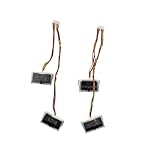
- Compatibility: Compatible replacement for iRobot Roomba Plus 405, 4020, 504, 505 robot vacuum cleaners, including RCF-Y1, G181020, G181220, G185020, G185220, K151020, N185020, N185040, N185060 Vac and Combo Mop series.
- Infrared Detection: Uses infrared technology to detect edges and prevent falls.
- Fix Common Issues: Resolves problems like missed edge detection, random stopping, or navigation errors.
- Complete Set: Includes multiple cliff sensors with wiring and connectors for full replacement.
- Reliable Performance: Ensures accurate and stable signal detection.
Apply the right standards to the right kind of robot
The current editions of ISO 10218 were published in 2025. ISO 10218-1:2025 covers industrial robots; ISO 10218-2:2025 covers industrial robot applications and cells. ISO/TS 15066:2016 supplements ISO 10218 for collaborative industrial robot systems.
Outdated Drivers Are Slowing You Down
One free scan finds every outdated or missing driver and matches the right update for your exact hardware.Free scan · exact hardware matchWindows Errors? Fix Them Before They Spread
Repair common Windows errors and clear accumulated junk for a smoother, more stable PC - no reinstall needed.Free scan · no reinstallISO 10218-1:2025 explicitly excludes consumer products and service robots where the public can access them. Industrial cobot guidance should therefore not be presented as a household-robot safety standard or as proof that a public-facing service robot is safe.
Best Value

- 【Rich Motion Modes】It is equipped with 8 MG90 servos to support multi-degree-of-freedom flexible movement. It features 6 adjustable walking postures and 9 built-in preset stunt actions.
- 【Intelligent Control System】WiFi mobile phone remote control, infrared physical remote control and ultrasonic sensor automatic obstacle avoidance. Switch control modes freely according to usage scenarios.
- 【Safe & stable circuit】The expansion board supports direct charging for convenient power supply. Built-in reverse connection protection circuit, safety fuse and large-capacity filter capacitor effectively avoid circuit damage caused by misoperation and voltage fluctuation.
- 【Complete STEM Learning】Comes with systematic step-by-step learning tutorials. The open-source program and modular hardware structure lower the learning threshold perfectly for beginners to grasp robotic development knowledge efficiently.
- 【Wide Application 】Suitable for STEM classroom teaching, school tech exhibitions, university laboratory research, maker creation competitions and daily electronic DIY projects, meeting learning, demonstration and scientific research demands all in one kit.
OSHA’s robotics standards page lists consensus standards such as ISO 10218 and ISO/TS 15066 as guidance from their originating organizations and states, “These are NOT OSHA regulations.” OSHA also says there are currently no specific OSHA standards for the robotics industry; applicable workplace duties and other requirements may still apply. Consult the requirements for the country and use case involved, and have industrial machinery safeguards assessed by qualified safety professionals against the current standards applicable in that jurisdiction.
Quick Recap
Product prices and availability are accurate as of the date/time indicated and are subject to change. Any price and availability information displayed on Amazon at the time of purchase will apply.




