Do these 3 things before closing this tab:
1Clear out junk files and repair common Windows errors2Fix the driver behind crashes, sound loss and screen glitches3Repair Windows errors before they cause bigger problemsA puzzle feels satisfyingly difficult when players can understand its rules, make meaningful progress, and see why a solution works—even if reaching it takes effort. Frustration is more likely when the game obscures what players need to learn, demands skills they have not practised, or leaves them repeating actions without useful feedback. Build difficulty by combining familiar ideas and increasing the reasoning they require; use playtest behaviour and player feedback to find where that progression breaks down.
Difficulty and frustration are different design problems
Difficulty is not one number. A puzzle may challenge players’ reasoning, the precision of their actions, the decisions they must make, or their emotional tolerance for setbacks. Those dimensions can overlap, but they point to different causes and different fixes.
As an Amazon Associate I earn from qualifying purchases.
For example, a player might understand the rule but struggle to execute a timed move. Another might act confidently while misunderstanding the rule. A completion rate can show whether players finish, but not which of these experiences produced success or failure. Treat difficulty measures as diagnostic aids, not as a universal setting or a guaranteed frustration threshold.
Teach rules before combining them
When a mechanic is new, make it the main thing a player needs to notice and use. Avoid introducing a new rule, unfamiliar controls, and a new objective all at once: if the player gets stuck, it will be difficult to know which part was unclear.
#1 Best Overall

- Tabletop Strategy Game: Bring the fun of the classic digital game to the tabletop & experience the fun of Tetris in real life with this multiplayer strategy game of rotating, dropping & line making
- Classic Tetris with a Competitive Twist: Drop a Tetrimino on a black Garbage Drop Icon in your grid to gain the power to add a piece to an opponent’s grid to block their line & their path to victory
- Puzzle Game: Tetris fans of all ages will have a blast dropping the semi-translucent pieces straight from the video game while having fun strategizing & problem solving; for 2-4 players, ages 8 & up
- Family Game Night: Keep the fun going with more Spin Master Games to add to your family’s board game shelf: Hedbanz, Beat the Parents, Family Feud, Jumanji, Wicked: The Game, Mind the Gap & more
- Spin Master Games & Toys: Looking for kids games, yard games & card games for adults, kids or teens? Find family favorite puzzles & games for family game night, travel games, kids puzzles & more
An analysis of Portal, Portal 2 Co-operative mode, Braid, and Lemmings found a recurring progression: games introduced key skills separately, used simple puzzles for basic practice, gave players a chance to integrate new and previously learned skills, and raised puzzle complexity until another new skill appeared. This is a useful pattern, not a guaranteed recipe for every genre. Linehan et al. (2014)
- Isolate the mechanic. Create a low-complexity puzzle where the new mechanic is the main thing to learn.
- Give it a small variation. Let players use the mechanic again in a slightly different situation so they can practise rather than merely repeat a demonstration.
- Combine it with familiar skills. Once players have had a chance to use the new mechanic, ask them to integrate it with rules they already know.
- Raise complexity before adding another rule. Add steps, interactions, or inferences while keeping the relevant rules familiar. When you introduce the next mechanic, temporarily reduce the load and teach it in isolation.
Find out what kind of challenge players experience
Before changing a puzzle, identify whether players are struggling to think through it, decide what to do, perform an action, or cope emotionally with setbacks. CORGIS distinguishes performative, emotional, cognitive, and decision-making challenge, offering a useful set of lenses for playtests.
Rank #2

- WHAT ARE THE CHANGES: The Uzzle 3.0 Family Board Games for Adults now comes with IMPROVED QUALITY, bigger blocks, 100 Unique Puzzles, & 4 Difficulty Levels. Levels 1-2 are great for young kids. Whereas, levels 3-4 are extremely difficult for adults.
- SUPER FUN AND EASY TO LEARN: The Uzzle is loved by over 150,000 customers worldwide. The game can be learned in under 5 minutes and enjoyed time and time again.
- FAST-PACED AND ACTION-PACKED: Play individually or with up to 4 players. You can play with unlimited players if you get extra games. It’s fun because these players race to crack the puzzle on the card by flipping, spinning, and merging identical sets of 5 patterned blocks. Sharp eyes, fast hands, and quick minds prevail in this fun-filled pattern-matching frenzy!
- IMPROVES KID's PROBLEM SOLVING & COGNITIVE SKILLS: You will need to have sharp eyes, quick thinking ability, strong observation power, and fast hand speed all at the same time. The Uzzle board game is great for enhancing problem-solving and many cognitive skills in children.
- A PERFECT GIFT: The Uzzle Kids Game is the perfect gift for Christmas, Easter, birthday gifts, back to school, and many other occasions! It's also a great choice for travel games.
In its 2020 study, Denisova et al. developed the scale using exploratory factor analysis with 394 participants, then validated it with nearly 1,000 players. That work supports treating challenge as multidimensional; it does not establish a universal numeric difficulty target for puzzle games. If you use the categories informally in a questionnaire, describe it as your own feedback tool rather than presenting it as a validated CORGIS instrument. Denisova et al. (2020)
Watch the path to the solution, not just completion
Completion rate can tell you how often players succeed, but it cannot reveal how they got there or why they stopped. A statistical model developed by Kristensen, Burelli, and Valdivia described distributions of player actions within levels as well as success probability. The model was fitted and evaluated on data from Lily’s Garden; it should not be treated as a universal model for every puzzle game. Kristensen, Burelli, and Valdivia (2021)
Rank #3
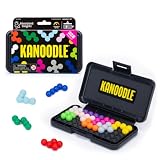
- BRAIN PUZZLE FOR KIDS: Kanoodle is a TikTok-viral line of brain teasers for kids & adults with over nine million games sold; fill in the board with the right arrangement of pieces to solve the puzzle
- 228 PUZZLE CHALLENGES: Put your spatial reasoning, critical thinking, and problem-solving skills to the test with 228 puzzles ranging from beginner to expert in both 2D and 3D configurations
- PORTABLE BRAIN GAME INCLUDES: 12 colorful Kanoodle puzzle pieces, compact case, and guide; case doubles as the game board and fits all pieces, making Kanoodle an ideal travel puzzle toy
- SCREEN-FREE FUN: Keep yourself and your kid or teen entertained without a phone or tablet; single player logic games and mind games help improve critical thinking and problem-solving skills
- GIFTS FOR EVERYONE: Educational Insights brain games are amazing birthday gifts for kids, holiday stocking stuffers, Easter basket toys, and back-to-school presents for teachers & students
In your own playtests or telemetry, consider looking beyond wins and losses to action sequences, repeated dead ends, resets, pauses, hint use, and places where players stop progressing. These are practical diagnostic suggestions, not a set of measures validated by that study. Pair behaviour data with player feedback: an unusual sequence can suggest where to investigate, but it does not by itself explain what a player was thinking.
The Puzzle Challenge Analysis tool is another example of an approach designed for cognitive challenge rather than borrowed uncritically from score-based action-game measurements. Its paper used The Witness and Untitled Goose Game as case studies, and examined generalisability with Baba Is You. The authors describe the tool as a way to analyse and compare puzzle challenge and produce more in-depth insights into player experience. Pusey, Wong, and Rappa (2021)
Rank #4

- 60, 000+ POSSIBILITIES IN THE BOX: STEM puzzle game with the combination of dice, location of the blockers, and set of color shapes, there are 62, 208 POSSIBLE SOLUTIONS in the 6X6 grid! Think about it… what is the possibility you will beat your opponent?
- GAME OF THE YEAR: Product Of the Year / Educational Product Of the Year / Top Toy Award Winners! Well-made table game that includes 2 grids, 7 dice, 2 sets of 7 blockers, and 2 sets of 9 colored shapes. Easy to travel with, easy to teach and learn, and simply enjoy the time! This puzzle game is SIMPLY GENIUS!
- EASY TO LEARN, BE FAST TO WIN: Promotes problem solving and motor manipulation skill training. Roll the seven dice together and place a blocker in each of the co-ordinates that appear on the faces. Now. . . RACE to fill every other space on the grid! Speed up your brain and hands! Who'll win?!
- SHARE THE JOY WITH SOMEONE, OR ENJOY ALONE: You can rack your brains against friends and family to see who fill out all the spaces first! Or you can challenge yourself against the clock! Either way… be the GENIUS one!
- FIND THAT ONE SOLUTION…OR MORE THAN ONE?: This board game is confirmed that all of arrangements have AT LEAST one possible solution for each, and maybe even more! Some are very easy, and some are much harder. Find a solution first, then challenge yourself to find another one… and… another one?
Choose an intervention that matches the problem
When a puzzle causes trouble, first work out whether players lack a prerequisite, cannot read the intended rule, or understand the rules but face too much reasoning. The table pairs common diagnoses with interventions and their trade-offs.
| What you observe | Intervention | Trade-off |
|---|---|---|
| Players have not learned the mechanic the puzzle depends on. | Teach or simplify: add a focused introduction or a simpler prerequisite puzzle. | Preserves the difficulty of the later puzzle while making its prerequisite visible. |
| Several rules or skills arrive together and players cannot tell what to practise. | Re-sequence or scaffold: spread learning across more steps and combine skills after practice. | Can make progression clearer, but may add content and pacing overhead. |
| Players do not recognise the intended rule or what an interaction does. | Revise affordances or feedback so the relevant rule is easier to perceive. | Can reduce ambiguity without reducing the reasoning challenge. |
| Players understand the rules, but the reasoning burden is excessive. | Reduce puzzle complexity or offer staged hints. | Directly eases the challenge; optional support can help without requiring every player to use it. |
| Players with different skill levels need different levels of support. | Measure and tune adaptively, using evidence about player behaviour. | Requires enough reliable behavioural evidence, and adaptation can feel arbitrary if players cannot understand it. |
These are design recommendations, not interventions proven best by the cited studies. The available work supports analysing challenge and level behaviour; it does not establish a single best fix or adaptation algorithm for all puzzle games.
Best Value

- 【Fun Family Bonding Game】: One player designs a colorful, tangled challenge while the other races to solve it! This brain-teasing board game strengthens relationships and creates lasting memories for kids and adults. Protected by U.S. Appearance Patent: D1101871.
- 【How to Play】: "Insert both ends of 10 vibrant ropes (plastic-tipped) into the board’s 22 holes, twisting into knots or crosses. Adjust difficulty with 3-10 ropes! Players move rope tips OVER others—never under—to empty holes. Remove untangled ropes and clear all to win—For detailed instructions, watch the video: How to Play – Rope Untangling Challenge."
- 【Multi-Level Difficulty for All Ages】: "From simple board games for kids (3-4 ropes) to complex puzzles for adults (10-rope mazes), this game grows with you! More knots = tougher challenges, perfect for fans of strategy-based board games!"
- 【A Fun Way to Keep Kids Off Screens】: "This hands-on logic puzzle game beats screen time! Kids build spatial awareness, sharpen focus, and learn problem-solving—like a tactile upgrade to traditional board games or video games!"
- 【The Perfect Gift for All Ages】: "Packed in a travel-ready case, this interactive family board game sparks friendly competition, boosts critical thinking, and unites everyone—ideal for playdates, holidays, or group games for kids and adults seeking screen-free fun!"
Use playtests to locate the break in progression
- Observe without rescuing too soon. Note when a player pauses, repeats an action, resets, asks for a hint, or stops. Record what happened immediately before the stall.
- Ask what they thought the rule was. If their explanation differs from the intended one, look at how the mechanic is taught and signalled before making the puzzle easier.
- Ask what kind of effort felt difficult. Separate reasoning, decisions, execution, and emotional response rather than asking only whether the puzzle was “too hard.”
- Change one relevant thing and test again. Depending on the diagnosis, revise the teaching sequence, affordance, complexity, or hint support. Check whether the change addressed the observed sticking point rather than merely increasing completion.
What the evidence can—and cannot—tell you
The cited work spans a video analysis of four games, a puzzle-challenge analysis framework with commercial-game case studies, a statistical difficulty model fitted to one mobile puzzle game, and a challenge-scale validation study across digital games. Together, these sources offer design patterns and ways to investigate player experience, not a universal difficulty curve, completion-rate target, or threshold at which players become frustrated.
There is no single metric that can tell you whether a puzzle is fair or frustrating. Use progression principles to make rules learnable, examine how players behave when they get stuck, and ask what kind of challenge they experienced. Then tune the specific puzzle and validate the result with players of your own game.
Quick Recap
Product prices and availability are accurate as of the date/time indicated and are subject to change. Any price and availability information displayed on Amazon at the time of purchase will apply.




