Free tools Windows power users keep installed
One-click scans. No signup required.
You usually cannot identify a satellite from reception symptoms alone. Signal loss, noise or dropouts can also come from misaligned equipment, incorrect settings, faulty hardware, nearby terrestrial networks, adjacent satellites or unauthorized transmissions. Start by logging what happens and when, then ask your provider or satellite operator to check its network. Operators and regulators can use carrier monitoring and, when needed, specialist geolocation to investigate the source.
What counts as evidence of satellite interference?
A dish meter reading, a spectrum screenshot, a coincidental frequency match or a service outage can document a problem, but none by itself proves that a particular satellite caused it. The International Telecommunication Union (ITU) distinguishes monitoring and measurement from signal identification and geolocation; those tasks may require equipment and expertise available to operators, administrations or specialist providers. The ITU’s Report ITU-R SM.2424-0 (2018) covers monitoring of geostationary (GSO) and non-geostationary (non-GSO) satellites, satellite identification, orbit measurement and geolocation methods, along with factors that affect accuracy.
As an Amazon Associate I earn from qualifying purchases.
One possible aid is a unique Carrier ID (CID) embedded in a transmission. The ITU says it can help operators identify a signal’s source, but it does not establish that every transmission carries one or that a consumer can decode it. As the ITU puts it, “Interfering signals are first detected through carrier monitoring.” Detection is the starting point; identifying the transmission and locating its source are separate steps. See the ITU’s “Reliable space services: Why and how?” (October 2021).
The Tool Desk
Outbyte PC Repair FREEClear out junk files and repair common Windows errorsFree Scan →Outbyte Driver Updater FREEFix the driver behind crashes, sound loss and screen glitchesFind Drivers →Rule out common explanations without assuming the cause
Before describing an incident as satellite interference, check ordinary service and equipment issues. These checks can help narrow the problem, but they do not conclusively prove or disprove an external transmission.
#1 Best Overall

- High Quality Component: and professional design; Designed with a compass for easier and quicker tuning. Powered by the receiver, nice tool for campers.
- Less Signal Loss:Built-in amplifier compensates insertion loss.We offer one year warranty and 24 hours customers survice~
- Useful Tool|:Connect to your LNB and receiver to the satellite finder to track the clearest setting for the satellite you wish to tune to.
- Easy To Use:With electronic buzzer, easy operation, audio tone and LCD display with backlight to show the satellite signal intensity.
- No External Power or batteries required: power supplied from your satellite receiver.
- Confirm the provider’s receiver status and troubleshooting guidance; inspect cabling and connections.
- Check that the antenna has not shifted and that trees, buildings or new obstructions are not blocking its view.
- Note local weather and compare it with the timing of the disruption.
- Record recent installation, configuration or equipment changes, including frequency, timing and polarization settings where applicable.
- Ask the provider about outages or other known service-side issues.
The ITU lists wrong operating frequency or timing, antenna misalignment and faulty equipment among possible causes. Its list also includes nearby terrestrial networks using the same or nearby frequencies, adjacent-satellite interference, unauthorized transmissions and deliberate jamming. These possibilities are why “suspected interference” is more accurate than naming a satellite before network-side analysis. See the ITU’s overview of causes and prevention.
Build an incident log that an operator can investigate
Write down observations as they happen rather than relying on memory. Use UTC for timestamps so the provider, operator or regulator can compare your record with monitoring data across time zones. Mark unknown readings as unknown; do not estimate values you have not measured.
Rank #2

- 【DVB-S/S2/S2X Satellite Finder】GTMEDIA V8 Finder2 satellite signal meter supports DVB-S/S2/S2X satellite signal detection, spectrum analysis, loop search, and calculation of azimuth and elevation angles. Designed for satellite dish alignment and signal checking. Not compatible with DIRECTV or ATSC
- 【3.5-Inch LCD Screen & Setup Guide】View satellite lists, signal intensity and signal quality on the 3.5-inch LCD screen. To begin, connect the satellite LNB cable to LNB IN, open Menu > Installation, select the satellite, and configure the LNB settings. Select an active transponder, adjust the dish for signal quality and lock, then press the blue Scan key to search for channels
- 【Rechargeable Battery & Built-In Speaker】The V8 Finder2 digital satellite finder combines a built-in rechargeable battery, integrated speaker, and on-screen battery-level indicator for convenient on-site operation. Monitor the remaining battery level during satellite dish adjustments and recharge when the low-battery warning appears
- 【Satellite Finder & H.264 Decoder】Combining a satellite signal meter and DVB-S/S2/S2X receiver, the V8 Finder2 supports H.264 decoding and compatible free-to-air satellite channel viewing on the built-in screen. HDMI and AV outputs provide external display connections. Channel reception requires a compatible satellite dish, LNB, and correct installation settings
- 【Setup & Dish Alignment】Connect the satellite LNB cable to LNB IN, then open Menu > Installation. Select the target satellite and configure the LNB frequency, power, 22K, and DiSEqC settings to match the installation. Select an active transponder and slowly adjust the dish while monitoring Signal Quality and the Lock indicator. Once the signal is locked, press the blue Scan key to search for channels
| Record | What to include |
|---|---|
| Affected service and equipment | Service, receiver, antenna, LNB, cabling and relevant equipment configuration. |
| Location and timing | Site or location, date, and exact UTC start and end times. Say whether the disruption is continuous or intermittent. |
| Signal details | Frequency or channel and bandwidth, if known; signal level or quality readings; polarization, if known. |
| Observed pattern | What changed—such as loss of lock, reduced quality, noise or recurring dropouts—and how the symptom varies over time. |
| Conditions and changes | Weather, recent installation or configuration changes, and troubleshooting steps already taken. |
| Supporting records | Time-stamped screenshots, receiver or spectrum logs, measurement details and the provider’s case number. |
The ITU’s Recommendation ITU-R SM.2149-0 (2022 edition) describes the technical and operational details used in interference reporting, including geolocation information where available. A spectrum instrument may help a technically experienced user save measurements, but a measurement is evidence of what was observed, not proof of which satellite transmitted it. Do not transmit test signals on licensed satellite frequencies.
Follow the right diagnostic route
1. Ask the provider or satellite operator to check the service
Send the incident log and ask whether network monitoring shows a carrier, an adjacent-satellite issue or a known outage. The ITU describes carrier monitoring as the first detection step; a CID, when embedded, may help an operator identify a signal. A consumer’s measurements can help focus the investigation but do not independently identify the transmitting satellite.
Rank #3

- [Dish Satellite Finder Signal Meter]: Antenna signal meter, digital satellite finder meter are small and lightweight, easy to carry, you can use satellite dish signal finder anytime, anywhere; Made of high quality materials, satellite signal receiver is sturdy and durable and can be used for a long time
- [Professional Signal Finder]: This satellite finder signal finder, satellite dish alignment meter is easy to locate and adjust the satellite dish for maximum signal of the product
- [Input Level Parameter]: Satellite dish aligner, dish network sat finder satellite digital, dish network signal finder with LNB to REC connector and dB level control; Sensitivity is 7dBS, measurement accuracy is -40dBm to -10dBm
- [Elegant Appearance Design Digital Satellite Finder]: Satellite detect device is elegant appearance design, signal strength meter is small size and lightweight, tv antenna signal meter is easy to carry, convenient to use, satellite dish signal meter can meet more your needs
- [Digital Satellite Signal Tracker Ease to Use]: Satellite dish alignment tool is handy tool to align any satellite dish in minutes for digital satellite signal meter finder with black background and white sat finder; sattelite dish signal tester is extremely sensitive meter that indicates very small changes in signal strength, sat finder digital
2. Contact your national communications regulator if harmful interference is suspected
Ask the regulator which process applies to suspected harmful interference affecting a space service. Procedures and contact channels vary by country. According to the ITU’s “Preventing harmful radio interference” (last updated January 2025), initial action relies mainly on direct contact between the administrations concerned. When a source is non-domestic, a report through the national regulatory agency to the ITU Radiocommunication Bureau can help assess and resolve the case. The Bureau may seek help from administrations or designated monitoring stations and provide findings and recommendations; this is an official coordination route, not a consumer shortcut for naming a satellite.
3. Let the regulator or operator handle international reporting
The ITU’s Space Interference Reporting and Resolution System (SIRRS) supports reports and information exchange for harmful interference affecting space services under Resolution 55 (Rev. WRC-23). Its SIRRS access information describes registered-user access: administrations nominate an Administration Manager, who assigns users, and access is for registered TIES users. It is not a general public consumer form. If your case may need international coordination, work through your provider or regulator, which can advise on the applicable route.
Rank #4

- Test suitable antenna for walkie talkie use. High sensitivity. Frequency bandwidth: 1000KHz to 3000MHz. Measurement of radio field strength. The pointer amplitude can be adjusted (to protect the meter)
- It requires Amp to run the meter. Please ensure that the whip antenna is parallel with the polarity of the antenna you are reading.
- Please use different frequency antennas to test signals with different frequencies for better effect and sensitivity. The pointer amplitude can be adjusted (to protect the meter).
- If the field strength indicator indicates that the maximum range is exceeded, the "amplitude adjustment" can be adjusted to let the pointer indicate the appropriate position.
- If you have any problem with this unit, please check the appropriate section of this manual. If the problem is not mentioned, please feel free to contact us.
What professional monitoring can establish
Carrier monitoring can detect an interfering signal. Further identification or geolocation is a specialist task: the ITU’s monitoring report describes methods that can use two or three GSO satellites, or a single GSO satellite when the relevant system requirements are met, and notes that accuracy depends on practical factors. Operators, administrations and specialist providers may have access to suitable monitoring facilities. A log from one receiving site is useful input to that process, not a substitute for it.
Quick wins for a faster PC:
Fix the driver behind crashes, sound loss and screen glitchesFind Drivers →Clear out junk files and repair common Windows errorsFree Scan →Quick Recap
Best Value
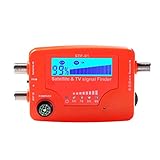
- 【Microprocessor Controlled】2 in 1 satellite and TV signal finder is microprocessor controlled, making it very reliable and accurate. Compact and lightweight, easy to use.
- 【Clearer LCD Display】Digital LCD screen displays signal strength graphically, with backlight to enhance reading experience greatly; clear to read no matter in the day or at night.
- 【Sensitive and Accurate】It's very sensitive and can detect the weakest of signals; strong incoming signals (power full satellite, big dishes, BVB-T Antenna, TV antenna) can easily be attenuated for better readout.
- 【Better Signal with high Buzzer Tone】It can also present pitchs tones on a buzzer; the higher tone, the better signal.
- 【Compass Function】Humanized design, with compass function for reference purposes.
Product prices and availability are accurate as of the date/time indicated and are subject to change. Any price and availability information displayed on Amazon at the time of purchase will apply.




