PC Slower Than It Used to Be?
A free scan shows the junk files, broken settings and background clutter dragging Windows down - then fixes them in one click.Free scan · Windows 10 & 11Crashes, No Sound, or Screen Glitches?
Random freezes, missing sound and display glitches usually trace back to one bad driver. Find and replace yours safely.Free scan · under a minuteStart by photographing and transcribing every identifier on the game, packaging, and inserts before cleaning, opening, or testing it. Then use the platform, serial or product code, region, version, and—on discs—inner-ring markings to find and compare catalog records. Treat a catalog result as a likely match until the physical details agree; an unusual label or shell alone does not establish that a game is a prototype.
Document the item before you handle it further
Make a record of what is actually present before trying to clean the item, open a cartridge, or put a disc into a console or computer. A label can be damaged, a case can be mismatched, and opening or cleaning may change evidence that could help identify the item. Photograph the object as found, then transcribe the visible details exactly—including odd spelling, punctuation, and letter-number combinations.
As an Amazon Associate I earn from qualifying purchases.
Photograph every relevant surface
- For a cartridge, photograph the front label, back, connector side, and any visible markings on the shell. If the cartridge is already open, record the board and its markings without assuming that a particular board proves a release identity.
- For a disc, photograph both sides, the center hole and inner ring, and the disc label. Capture the case, spine, and any inserts separately.
- For a boxed item, include the front, back, spine, barcode, and inserts. Make clear which materials belong together rather than assuming that a game and its case are an original set.
Transcribe identifiers and descriptive clues
Record the printed title, platform logo, publisher and developer names, serial or product code, barcode, region marks, language, and version or revision number. Note the media type and any label or packaging text that may distinguish a regional or revised release. Keep the original wording and punctuation in your notes; a small difference can separate two otherwise similar records.
Do not publish a scan that exposes a serial key or registration code. For cataloging, MobyGames’ standards emphasize verifiable release information and distinguishing media details. That is a useful principle for private identification too: separate what you can observe directly from what you infer.
#1 Best Overall
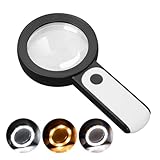
- HIGH POWER MAGNIFICATION: This magnifying glass provide Optical high magnification, allowing users with low vision to read text, no matter the size.
- ULTRA BRIGHT 18 LED WITH 3 MODES: The built-in energy-saving 18 LED lights provides extra luminance to ensure an overall better reading experience even at night or dark places. The stepless dimmable 3 lighting modes (cold, warm and mixed) can be switched based on different light condition, which can reduces visual fatigue, which is very useful for people with macular degeneration or far-sightedness/feyopia.
- EASY TO USE: Comes completely assembled, just requires 3x AAA batteries (not included). Easy to operate with a simple ON / OFF button switch, making it perfect for the elderly or those requiring an intuitive magnification system.
- LARGE LENS(Diameter 3.15"): Magnifies without optical distortion. Optimal to enhance reading and viewing very fine details in books, newspapers, magazines, photographs, maps, electronics, miniatures, jewelry, pill bottles, medications, hobbies, models, and crafts of all kinds.
- PERFECT GIFT FOR THE ELDERLY: Great magnifier for seniors, Most elderly have difficulty reading the small print on coupons, prescription,medical bottle.clear magnifier with light also a great choice for those who have low or impaired vision of most types.
Establish the likely platform and format
Use connector shape, cartridge shell, disc format, and case design to narrow the possibilities, not to name a release. Generic shells and cases can look alike across different games, and packaging may have been swapped. Compare physical clues with platform logos, printed text, and identifiers rather than relying on shape alone.
Make a short candidate description that combines the strongest clues—for example, the platform marking, exact title text, and visible serial—before searching. If the platform is uncertain, preserve that uncertainty and search the title or code without forcing the item into a system based on appearance.
Rank #2

- High magnification : Feosky magnifying glass can provide a magnification of 10X to enlarge blind spots and provide you with a clear field of view of tiny objects
- Lens Material: Made of lightweight and long-lasting acrylic material, it can ensure the best performance and provide clear images
- Ergonomic handle design: The handle is made of anti-skid material, which is easy to operate, hold and use, and is not easy to damage,it can be used for a long time
- Size: The total length of the magnifying glass is 6.8 inches, and the inner diameter of the lens is 3 inches. The handle is 3.5 inches long and weighs only 2.25 ounces, long term use will not cause sore arms
- Wide range of uses: to help the elderly and people with low vision read books, newspapers, and small font prints, and also suitable for adults to observe fine details in stamps, jewelry, needlework and various handicrafts
Search catalogs using the strongest identifier
Choose the lookup path that matches the medium. Redump is the primary disc-preservation lookup path for optical discs; No-Intro provides an online database and DAT resources useful for cartridge-oriented cross-checking and ROMs. MobyGames can help compare cataloged releases and their verifiable details. These resources serve different purposes, so a missing result in one is not proof that an item is unidentified or unique.
For an optical disc
- Search Redump by the title printed on the disc. If the title is regional or foreign-language, try that wording as well as any English title printed on the package.
- Search by the disc serial when one is present. Transcribe it carefully; confusing a letter and a number can hide the relevant record.
- If a verified dump exists and you have its hash, that hash can also be searched. Do not treat an unverified file name or an unverified dump as equivalent evidence.
- Compare the result against the physical disc, including serial, region, version, and inner-ring markings when available.
For a cartridge
- Search No-Intro’s online database or DAT resources using the exact title and any visible product code or serial.
- Cross-check the likely release in MobyGames when catalog details such as publisher, platform, region, or packaging can help distinguish candidates.
- Compare the record with the cartridge and its packaging rather than stopping when a title appears in a search result.
Catalog coverage can be incomplete, and records can change. If a search returns nothing, recheck transcription and try another identifier or title spelling before concluding that the object is rare, unreleased, or a prototype.
Rank #3

- 5X MAGNIFICATION & LARGE 100MM LENS: The 100mm (4 in.) lens offers a wide viewing area, making it easier for seniors to read books, newspapers, labels, and fine print
- REAL GLASS LENS, NOT ACRYLIC: Made from real glass and precision-ground for clear, distortion-free images and excellent clarity
- ERGONOMIC SOFT-GRIP HANDLE: The soft rubberized handle provides a comfortable, non-slip grip for easy handling during extended use
- PROTECTIVE LENS HOUSING: The lens is securely encased to help prevent damage from accidental drops and everyday use
- AVAILABLE SINCE 2019: This magnifier has been offered since 2019 and is suitable for reading, books, newspapers, hobbies, insect observation, classroom science, crafts, and inspection.
Compare candidate records against the physical copy
When several entries look plausible, compare them systematically. A title match is only one part of identification; a release may differ by region, language, revision, media, or packaging. Keep your conclusion at the level the evidence supports: a candidate or likely match is different from a confirmed identification.
| Clue | What to compare |
|---|---|
| Platform and media | Platform marking and whether the record describes the same type of cartridge or disc. |
| Title | Exact spelling, punctuation, and any regional or foreign-language title. |
| Serial or product code | Every visible character on the physical item and the corresponding record. |
| Region and language | Region marks and language information on the item, package, and catalog entry. |
| Version or revision | Any printed version number or revision detail, including a confirmed version on a PC disc. |
| Barcode and packaging | Barcode and package details, while checking that the case or box actually belongs with the media. |
| Disc inner-ring code | Stamps on either side of the inner ring, where visible, against any distinguishing record details. |
Redump cautions that finding a database record does not rule out the specific disc being a revision or a new disc. Therefore, do not report a disc as an exact match merely because its title and serial resemble an entry. Record the differences and describe what matches and what remains unconfirmed.
Rank #4

- 2 Pack handheld Rubber reading magnifier ,One orange and one green.
- the handle is comfortable and easy to hold,gives you a clearer experience.
- The rubber design makes the magnifying glass easy to hold.
- This item’s ideal for book reading, and hobbyist observations
- If you have any product quality problems, please get in touch with us
Read disc serials and inner-ring stamps
A disc serial is usually printed on the disc itself. The inner ring can add another identifying detail: record stamps on both sides where visible, since one side may show information not legible from the other. Some stamps are very small; a handheld magnifying glass can help read them, but it cannot identify the title on its own.
What’s actually slowing this PC down?
Pick the symptom - the matching free tool is one click away.
Transcribe the code exactly, including spacing or punctuation if present. If a mark is too faint or obscured to read confidently, describe it as uncertain instead of silently filling in a character. For PC discs, a confirmed version number can also help distinguish candidates. A version number should be recorded as printed or otherwise confirmed, not inferred from a catalog match.
Best Value

- High-Definition Magnification: This reading magnifier offers 10X-30X magnification, enlarging tiny details to provide a clear view of small objects. It's perfect for elderly reading, children observing insects and science projects, as well as craft work.
- Lightweight and Premium Material: Crafted from lightweight and durable acrylic material, this magnifier is effectively scratch-resistant and anti-glare. The large 90mm lens ensures clear magnification while reducing the overall weight, making it comfortable for long periods of use without causing arm fatigue.
- Ergonomic Handle Design: The handle is made of non-slip material and features an optimal length for easy operation, gripping, and use. It's sturdy and resistant to damage, ensuring comfort even during extended use.
- Magnifier Dimensions: The magnifying lens has an inner diameter of 3.54 inches, with a handle length of 4.72 inches. The total length is 8.3 inches, and it weighs only 2.41 ounces—exceptionally lightweight.
- Versatile Applications: This magnifier aids the elderly and visually impaired in reading books, newspapers, and small-print materials. It's also ideal for adults examining fine details in stamps, jewelry, needlework, and various crafts. An excellent gift choice for birthdays or special occasions.
Decide whether the evidence supports a prototype claim
A blank or altered label, marker writing, an unusual shell, or an unfamiliar board is an observation—not proof of prototype status. Those features may make an item worth investigating, but they do not establish when, why, or by whom it was made. The sources available for this identification process do not establish one universal visual test for prototypes.
Build a provenance record
- Preserve original photographs and transcriptions, including packaging and any inserts.
- Write down what is physically unusual without converting the observation into a conclusion. For example, describe a handwritten label rather than calling it a development label.
- Keep any reliable documentation or ownership history associated with the item, and distinguish documented history from a seller’s or previous owner’s account.
- Seek corroboration from reliable documentation or an experienced specialist before presenting prototype provenance as established.
If corroboration is unavailable, use a qualified description such as “unidentified cartridge with handwritten label” or “possible prototype; provenance unconfirmed.” That communicates what is known without claiming more than the evidence demonstrates.
Report the identification with an explicit confidence level
A useful identification note lets another person check your reasoning. Include the exact visible identifiers, the catalog record or records considered, and any mismatch between the item and the record. Separate direct observations from interpretation.
Free tools Windows power users keep installed
One-click scans. No signup required.
- Observed: the text, marks, media, and physical details visible on the item.
- Candidate match: a catalog entry that shares some identifiers but has not been checked against all distinguishing details.
- Likely match: the strongest available record agrees with the key visible details, while any remaining uncertainty is named.
- Confirmed identification: use only when the identifying details have been checked sufficiently to distinguish the item from plausible revisions or regional variants.
This phrasing is especially important when a database result is close but does not document the same physical medium or revision. A careful partial identification is more useful than a confident label that hides unresolved differences.
Quick Recap
Common identification mistakes to avoid
- Searching only the familiar title: use the printed regional title, serial, or product code when the first search is inconclusive.
- Treating a case as proof: compare the media itself; cases and packaging can be separate from the item inside.
- Assuming a database result is the exact copy: check region, version, media, barcode, and disc-ring codes where relevant.
- Calling an odd-looking item a prototype: document the unusual feature and seek corroboration rather than inferring provenance from appearance.
- Changing the evidence before recording it: photograph and transcribe first, so the original state is documented.
Product prices and availability are accurate as of the date/time indicated and are subject to change. Any price and availability information displayed on Amazon at the time of purchase will apply.




