The Tool Desk
Outbyte Driver Updater FREEFix the driver behind crashes, sound loss and screen glitchesFind Drivers →Outbyte PC Repair FREEClear out junk files and repair common Windows errorsFree Scan →Evaluate a legal document management system by testing whether it enforces your firm’s confidentiality rules across real users, matters, documents, and administrative actions—not by relying on general security assurances. Before a demonstration, define who should be allowed to do what, under which conditions, and what evidence would prove the system allowed or denied the action. Then compare the results with your firm’s risk assessment, client and contractual terms, retention needs, and applicable law.
What should an evaluation cover?
Assess controls at both the service and application levels, in the cloud configuration your firm would actually use. In a SaaS service, a vendor may manage some components while your firm configures or operates others; responsibilities vary by service model. NIST Special Publication 800-210 describes access control across cloud service models. Ask the vendor to map each relevant control to the party responsible for configuring, operating, and verifying it.


As an Amazon Associate I earn from qualifying purchases.
For a legal DMS, the practical question is not simply whether users can sign in. It is whether the system can consistently limit access to the correct matter and documents, restrict particular actions, remove access when circumstances change, and provide trustworthy evidence of what happened.
Recommended Free Tools
How do you turn confidentiality policy into testable scenarios?
Write the expected result before the vendor demonstration. Use realistic cases from your own work, including routine access, changes in responsibility, and attempts to reach restricted information by alternate routes. Treat these as evaluation tests, not assumptions that any particular product supports a specific control.
- A newly assigned matter-team member should receive only the access required for the assigned work.
- A lawyer moving to another practice group should gain the permissions needed for the new role without retaining access that is no longer justified.
- A departing contractor’s access should be revoked, including any temporary or delegated access that remains active.
- An external co-counsel invitation should follow the firm’s approval and scope rules.
- A user without authorization should be denied access to a restricted document when trying to reach it through search, a shared link, an API, or a mobile client, if those routes are in scope for the service.
- An administrator supporting the service should have only the access needed for that support task, with appropriate oversight for sensitive actions.
For every case, ask the vendor to demonstrate the allow or deny outcome and show where an authorized administrator can verify it. A demonstration that tests only the normal desktop workflow does not establish that restrictions hold through other enabled access paths.
Can the system express your matter and document permissions precisely?
Ask how permissions are represented and inherited, and whether policy can distinguish among matters, folders, individual documents, and operations such as viewing, editing, sharing, exporting, or administering. Find out how exceptions are recorded, approved, reviewed, and removed. The right granularity depends on the firm’s policy; a long list of configurable options is not useful if administrators cannot apply and maintain the intended rules reliably.
Ask whether authorization can use roles or groups alone, or whether it can also evaluate attributes or relationships. NIST Special Publication 800-205 describes attribute-based authorization as evaluating attributes associated with the subject, the object, the requested operation, and sometimes the environment against policies or rules. For example, a policy might need to consider not just who a user is, but which matter a document belongs to and what action the user is attempting. Ask the vendor to demonstrate the specific policy patterns your firm requires rather than inferring capability from terminology in product materials.
Rank #2
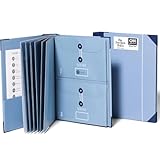
- Keep important documents safe: A document organizer designed to protect papers from getting lost. Store birth certificates, social security cards, wills, tax forms, insurance policies, titles & more in one secure place.
- Easy to organize and find: Folders with pockets and a table of contents help track where documents live, while 33 hand-illustrated labels show what to save. Acid-free materials protect your papers for years to come.
- Fits documents of various sizes: This document binder includes 3 vertical and 3 horizontal envelopes for 8.5 x 11 inch papers, plus 4 half-size envelopes for smaller keepsakes and important details.
- Practical and easy to use: An important document folder organizer with a front pouch that provides a quick landing space for papers before filing, making it easy to stay organized as documents come in.
- Premium quality, timeless style: Made with custom-dyed cloth, reinforced edges, and acid-free paper for long-term durability. An elegant file organizer designed to beautifully complement your office or living room décor.
Does access follow least privilege through the full user lifecycle?
Least privilege means granting users and processes only the access needed for their assigned tasks, reviewing that access, and changing or removing it when it is no longer needed. NIST Special Publication 800-171 Revision 3 addresses these practices. Ask for the default roles and privilege model, then establish who can create, change, delegate, approve, and revoke permissions.
Test onboarding, a transfer, temporary access, emergency access, and termination. For each change, check how the relevant permissions are updated, who can authorize exceptions, and how the firm can verify the resulting state. Ask how often access reviews can be performed and what information reviewers can see. Avoid treating an account deactivation as proof that every separately granted, delegated, or external permission has also been removed; have the vendor demonstrate the applicable revocation process.
Can powerful administrative duties be separated and reviewed?
Map who administers user identities, access policies, security settings, and audit information. Ask whether sensitive actions can be separated between people, require approval, or receive independent review. NIST Special Publication 800-171 Revision 3 discusses separation of duties and notes the value of ensuring that access-control administrators do not also administer audit functions.
Rank #3
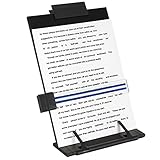
- Great for Body Health: The document holder is adjustable with 7 position at the backstand to adjust height and angle to make you easily reading without straining your back, shoulders or neck, then you can enjoy reading books while promoting a proper posture and even improve the spinal health.
- HIGH PRACTICAL: Design with Highlighting Line Guide makes you're easier to see where you left off and keep your track while typing, reading or transcribing. Comes with page holder clip to ensure documents do not slide. Help you work more efficiently.
- Really Sturdy & Stable: The bottom is designed with a page support clip to keep the book open on the page you need to read. The metal backplate, easily supports your documents. Very sturdy and can withstand multiple sizes of papers, recipes, books, magazines, textbooks and catalogs.
- Premium Material: The Book Stand is made of high-quality metal and ABS, with a polished and baked-on finish, it's durable, smooth, not easily broken, easy to clean and looks stylish, and has rounded corners to protect hands from injury or scratches.
- Foldable & Compact: 13.9" x 8.3" (35.5cm x 21cm). Fold quickly and store easily. Portable and lightweight, easy to carry to library, home, office and outdoor. Great gift for colleague, children, friend and family.
During the demonstration, ask who can change a permission and who can inspect the resulting audit record. If one administrator can both make sensitive changes and control the evidence used to review them, ask what compensating oversight is available. The specific design should be judged against the firm’s risk and operating model.
Do these 3 things before closing this tab:
1Scan for outdated or missing drivers - takes under a minute2Clear out junk files and repair common Windows errors3Fix the driver behind crashes, sound loss and screen glitchesHow should you assess sign-in, federation, and tokens?
Ask which authentication and federation patterns the service supports, how identity-provider integration works, how accounts and sessions are managed, and what happens when an identity or credential is revoked. Request current technical documentation for the configuration being considered, including how the service protects and verifies tokens and assertions, manages keys, controls token lifecycles, and monitors activity.
NIST Special Publication 800-63-4 provides digital identity guidance, and a NIST report published September 15, 2026 addresses protection of tokens and assertions in single sign-on, federation, and API access. These sources provide evaluation context, not a universal assurance level for every law firm. Determine the appropriate identity requirements from the firm’s risk, client and contractual terms, and applicable obligations.
Will audit evidence support investigation and oversight?
Ask the vendor to show a representative audit trail for user access and administrative changes. Check whether records can be searched and exported, who can access them, whether they can be altered or deleted, and how events are monitored and investigated. Determine whether the firm can set retention and alert requirements that fit its obligations and incident process.
Do not assume a standard event list or retention period is appropriate for every legal DMS. The reviewed NIST guidance supports protecting security-relevant and audit information, but does not establish a universal event list or duration for these systems. Define the events and retention needs your firm requires, then ask the vendor to demonstrate how the deployed service meets them.
Crashes, No Sound, or Screen Glitches?
Random freezes, missing sound and display glitches usually trace back to one bad driver. Find and replace yours safely.Free scan · under a minutePC Slower Than It Used to Be?
A free scan shows the junk files, broken settings and background clutter dragging Windows down - then fixes them in one click.Free scan · Windows 10 & 11How will the service preserve document authenticity and integrity?
Ask how authenticity and integrity are maintained during document ingestion, modification, export, backup, and transfer. Request an explanation of relevant storage and work-process controls, along with evidence that applies to the service and configuration under consideration.
Best Value

- Double Layers Protection: Our newly designed file folder uses different materials than other folder.Double Layered design, high quality Black Non-itchy Liquid Silicone Coated Fireproof Fiberglass which can withstand temperatures as high as 1832℉,this bag is FIRE and WATER RESISTANT.Fireproof file folders can fully protect your important documents, paper,birth certificate, passport.
- Size: 16" x 10.6" x 0.8"(Legal size) ,Weight:450g/15.9ounce,13 individual pockets. Fireproof file folder makes it suitable for daily filing and storing of documents(with Color Labels).
- Wide Range of Applications: Fireproof zipper added security and safe transport.It's very durable.Not only can you put your file folder at home, office, car,it's also a good decision to put it in the safe box. You can be 100% assured that your important information is in a safe place.
- Perfect Gift:Beautiful design and creative folders can also be used as anniversaries or personal gifts for students, employees, colleagues, etc.
- Customer Service: ENGPOW provide friendly after-sale service and no risk refund for our customers. If you have any issue,please contact us and we will try out best to solve your issue!
ISO 19475:2021, Document management — Minimum requirements for the storage of documents, is a document-storage standard whose public listing describes controls for work processes while maintaining the authenticity and integrity of received documents. The listing does not establish that a particular vendor or product conforms to the standard.
What assurance evidence should you request?
Request current third-party reports and certificates that apply to the exact service, product scope, operating locations, and features being considered. Check the report dates, exceptions, scope boundaries, and any complementary customer responsibilities. A report for a related product or a different service scope should not be treated as evidence for the offering being procured.
NIST Special Publication 800-63-4 recommends comparable standards such as ISO/IEC 27001 for non-federal organizations implementing its guidelines. Treat standards and reports as evidence to examine, not as substitutes for testing the firm’s actual access policies. No vendor-specific certification or audit status is established here.
How should you compare shortlisted systems?
Use the same scenarios and evidence requests with every candidate. Record whether each requirement was demonstrated in the relevant product scope, documented but not demonstrated, or left unresolved. That classification is an evaluation method, not a claim about any vendor’s capabilities.
| Comparison area | What to compare |
|---|---|
| Policy precision | Whether matter, document, role, attribute, or relationship rules can express the firm’s required access decisions. |
| Least privilege and lifecycle | How much effort is needed to assign, review, change, and revoke access as people’s responsibilities change. |
| Identity and federation | Identity-provider, SSO, federation, and token-lifecycle controls relevant to the intended deployment. |
| Administrative oversight | Whether access administration and audit duties can be separated or independently reviewed. |
| Audit evidence | How accessible, protected, searchable, and exportable the evidence is for the firm’s monitoring and investigation needs. |
| Document integrity | What evidence supports authenticity, integrity, and storage controls across the document lifecycle. |
| Independent assurance | Whether third-party evidence is current and covers the service, locations, and features actually being procured. |
Where a requirement remains unresolved, document the gap and decide whether it is acceptable, requires a contractual commitment or compensating control, or rules out the candidate. Base that decision on the firm’s own risk and obligations rather than a vendor’s general assurance language.
Where do legal and client-specific requirements fit?
General security standards do not determine a particular firm’s professional obligations. Requirements can depend on jurisdiction, client instructions, contracts, records practices, and the firm’s risk assessment. Have the appropriate legal, security, and operational stakeholders map those requirements to the scenarios and evidence the vendor must satisfy before selection.
Quick Recap
Product prices and availability are accurate as of the date/time indicated and are subject to change. Any price and availability information displayed on Amazon at the time of purchase will apply.
Free tools Windows power users keep installed
One-click scans. No signup required.




