ChatGPT can help you draft a clear guide to an Excel workbook’s sheets, columns, formulas, assumptions and changes. Treat its output as a draft: check it against the workbook before relying on it or sharing it. For a one-off review, upload a spreadsheet and ask focused questions; to work inside an open workbook, use ChatGPT for Excel if it is available for your account and workspace.
Choose how to work with ChatGPT
| Approach | Best for | What to check |
|---|---|---|
| Upload and analyze | Asking questions about an attached workbook without directly editing the open file. | Supported file types and account limits vary. OpenAI lists XLSX, XLS, CSV and TSV among spreadsheet formats, subject to plan and account limits. OpenAI’s data analysis guide and file upload FAQ describe current details. |
| ChatGPT for Excel | Working with a workbook directly in Excel, where the ChatGPT for Excel workflow is available. | Availability depends on plan, account, workspace settings and client. Review any proposed workbook changes before saving or sharing. OpenAI’s ChatGPT for Excel guide explains the workflow. |
Prepare the workbook for analysis
Before asking ChatGPT to document a file, make its structure easier to interpret. OpenAI recommends descriptive column headers, one record per row, and avoiding unrelated tables on the same sheet or empty rows and columns that divide data. These practices help reduce ambiguity; they do not guarantee that ChatGPT will detect every formula, dependency or workbook feature.


As an Amazon Associate I earn from qualifying purchases.
Ask for documentation in a reviewable format
Start with a bounded request. Ask ChatGPT to describe each sheet’s purpose, list its important columns, explain notable formulas and dependencies, and identify assumptions or questions that require a human answer. Tell it to mark uncertain interpretations rather than infer missing context.
What’s actually slowing this PC down?
Pick the symptom - the matching free tool is one click away.
For example:
Document this workbook using only information you can verify from its sheets and formulas. For each sheet, state its apparent purpose, important columns, notable formulas and dependencies. List assumptions separately and flag anything you cannot determine. Do not invent business rules. Return a concise draft I can verify in Excel.The wording is a practical prompt, not a guarantee of complete detection. Check formula descriptions and business interpretations in Excel, especially where a formula’s meaning depends on context outside the file.
Plan edits before making them
If you want ChatGPT to change a workbook as part of documenting it, request a proposed plan first. Ask it to identify the tabs and ranges it would change and specify what must remain untouched. OpenAI’s guidance gives the example of limiting changes to an Inputs tab while preserving formatting. Review the proposal and the resulting workbook before saving or sharing; OpenAI explicitly advises, “Review the workbook changes before saving or sharing.” See the ChatGPT Work guidance.
Keep explanations and decisions with the workbook
Once you have checked the draft, keep context in Excel where future users will encounter it. Use a threaded comment when collaborators need a discussion tied to a cell. Use a note for a simple annotation or reminder; Microsoft’s guidance puts it plainly: “If you don’t need to have a discussion about the data, then use a note.” The Comments Task Pane can help review workbook comments. Microsoft explains comments and notes here.
Rank #2
Use history for the right kind of change control
Excel’s change-history features and Version History solve different problems. Use Show Changes or history features to inspect supported edits; use Version History when you need to restore an earlier file state or retrieve a prior workbook version. Microsoft says Excel tracks supported changes for up to 365 days. That limit applies to supported edits, not necessarily every action or workbook change. Microsoft’s Show Changes guidance describes coverage, while its Version History instructions cover restoring previous versions.
Verify the final documentation
- Compare sheet names, column descriptions and formula explanations with the actual workbook.
- Confirm assumptions and business rules with someone who understands the workbook’s purpose; do not treat a plausible explanation as proof.
- If Python analysis was used, review the generated code, outputs and assumptions, as OpenAI recommends.
- Review workbook edits before saving or sharing, and use Excel’s own history or version recovery features when you need to inspect or undo changes.
Product features, supported files and account limits can change and vary by plan, workspace configuration, region or client. Check the linked official documentation for availability that applies to your account.
Quick Recap
Best Value

- ENHANCED ORGANIZATION: Organize your paperwork with this letter-sized (10.25” x 11.75”) document organizer with 24 pockets and 12 dividers; our pocket organizer is a great choice for school supplies college folders with pockets and bible study supplies
- EFFORTLESS SORTING: This plastic folder organizer with 24 pockets provides ample space to sort and categorize your materials, ensuring easy access and efficiency; 1/3-cut reusable write & erase tabs provide three positions for convenient labeling and easy identification
- PRACTICAL DESIGN: The slash pockets can hold up to 25 sheets each; the spiral-bound design allows the office supply organizer to lay flat for convenience and rotate 360° for easy viewing; tear-resistant and water-resistant poly cover material ensures long-lasting durability
- COLOR-CODED ORGANIZATION: The 12 colorful dividers in six colors boldly split up subjects while the clear front pocket allows you to customize your organizer with a cover sheet; keep essentials in the zippered pouch for quick access
- PVC AND ACID FREE: This organizer reflects our commitment to environmental responsibility; it's acid-free and PVC-free, making it safe for long-term document storage
Rank #3
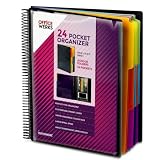
- FIND ANY PAPER IN SECONDS: Color-coded tabs and a blank label sheet let you sort up to 24 categories by class, client, or month, then flip straight to what you need. Write-and-erase tabs make relabeling instant when projects change.
- BUILT FOR A FULL SCHOOL YEAR: Tear-resistant covers, acid-free construction, and an oversized coil spine hold heavy paper loads without splitting or distorting. Two elastic straps lock everything shut so nothing slides out in a backpack or work bag.
- STANDARD PAGES SLIDE RIGHT IN: Each of the clear pockets fits 8.5 x 11 inch sheets without bending corners. Push papers all the way to the back edge and they stay flat every time you close the cover.
- REPLACES A BINDER AND NOTEBOOK: Works as a teacher binder, an IEP organizer for teachers, or a homeschool organization hub without hole-punching a single page. Slip syllabi, report cards, or lesson plans in and carry one item instead of three.
- EXTRAS ALREADY INCLUDED: A clear zippered utility pouch holds pens, note cards, and stencils. The customizable front cover has a non-glare overlay, and a clear back pocket lets you see loose items at a glance.
Product prices and availability are accurate as of the date/time indicated and are subject to change. Any price and availability information displayed on Amazon at the time of purchase will apply.




