Check the tight end’s official game status first, then judge whether he is likely to get his usual routes, targets and red-zone chances. Start him if his role looks intact and his expected opportunity beats your best healthy alternative. If he is active but may be limited, a steadier option is usually safer—especially when your lineup needs a reliable floor.
Does active mean he’ll play his usual snaps?
No. “Active” means the player is available to play; it does not guarantee a normal workload. The NFL injury report is the primary source for weekly practice participation and game status. Check the report for the relevant game week and recheck close to kickoff, since designations can change.


As an Amazon Associate I earn from qualifying purchases.
A limited practice designation or a questionable tag is not a precise snap-count forecast. Do not use either to infer medical clearance or the likelihood of re-injury. For the fantasy decision, look for credible team comments about workload and signs that the tight end will run routes and earn targets—not merely dress for the game. FantasyPros notes that a returning tight end may have a managed snap count and recommends weighing a reliable alternative while the workload is uncertain (FantasyPros injury analysis).
How to make the start-or-sit decision
- Confirm availability. Check the NFL injury report for the player’s game week. If he is ruled out, do not start him. If he is questionable or listed as limited, continue to assess his likely role and your alternatives.
- Estimate his opportunity if active. Ask whether he is expected to run his usual routes, play regularly in passing situations and remain involved near the goal line. A tight end used mainly as a blocker may not deliver the receiving opportunity his pre-injury fantasy role suggests.
- Check the offense around him. Consider his healthy teammates, quarterback situation and recent target distribution. The NFL Fantasy Week 17 analysis illustrates how targets, recent production, end-zone role and quarterback context can inform a tight-end decision.
- Compare him with your real alternatives. Use the best healthy tight end or eligible flex player on your roster, not a generic ranking. Apply your league’s scoring—standard, half-PPR or PPR—and weigh target volume and touchdown dependence against the floor and ceiling of the alternative.
- Use matchup as a tiebreaker. Opponent performance against tight ends, game environment and likely passing volume can help break a close call. They should not outweigh a substantial concern that the returning player’s workload will be restricted.
- Recheck before lineup lock. Review the final injury report, credible coach comments and any new indication of the player’s role. Keep a viable replacement available if his status or workload remains uncertain.
When should you start him—and when should you sit him?
| What you know | Lean | Why |
|---|---|---|
| He is active, his receiving role appears intact, and he has a stronger opportunity than the available alternatives. | Start | The injury label alone is not a reason to bench a player whose expected role and opportunity are strong. |
| He is active, but his workload may be managed or his routes and targets are uncertain; a healthy alternative offers a steadier floor. | Sit, if the alternative fits your lineup | Availability does not establish normal usage, and limited opportunity can undermine the expected fantasy value. |
| He is ruled out. | Sit | He will not play in that game. |
| The decision is close and workload looks plausible, but neither option has a clear advantage. | Use scoring and team needs | In PPR, target opportunity can matter more; when you need a safer floor, favor the alternative with the more dependable role. |
Why there is no universal first-game-back rule
A strong return is possible, but one player’s result is not a forecast for the next tight end coming back from injury. In its 2025 Week 14 analysis, NFL Fantasy reported that Brenton Strange scored more than 13 fantasy points in each of his first two games after returning from a hip injury and finished among the top seven tight ends in Weeks 12 and 13. That is a player-specific example, not a general recovery rate or expected outcome (NFL Fantasy Week 14 analysis).
#1 Best Overall
The relevant question is whether this player’s likely routes, targets and scoring opportunities—given his availability, team context and your league settings—outweigh the alternative. A matchup or past success cannot establish that he will receive his pre-injury workload.
Independent reader supportYour contribution helps us test, update, and keep practical guides available for everyone.Tools can help compare your lineup options
A roster-aware start/sit tool can account for league settings and the players actually available on your roster. FantasyPros describes its Start Sit Assistant as a lineup comparison resource. The Spread Sports also describes start/sit guidance using matchup, usage and recent form (The Spread Sports). Treat either kind of recommendation as an input, not certainty, and use the official injury report for the player’s status.
Quick Recap
Best Value

- 🏈 UPDATED FOR THE 2026-2027 SEASON Designed for 2026-2027 fantasy football draft events, featuring a clear and organized layout that keeps your league focused on every round and selection.
- 🇺🇸 250TH ANNIVERSARY 1776-2026 DESIGN Celebrate the historic 250th Anniversary with a bold red, white, and blue design featuring American-inspired graphics, fireworks, football imagery, and a festive draft-day atmosphere.
- 🏈 UPDATED FOR THE 2026-2027 SEASON Designed for 2026-2027 fantasy football draft events, featuring a clear and organized layout that keeps your league focused on every round and selection.
- 🇺🇸 250TH ANNIVERSARY 1776-2026 DESIGN Celebrate the historic 250th Anniversary with a bold red, white, and blue design featuring American-inspired graphics, fireworks, football imagery, and a festive draft-day atmosphere.
- 🏈 UPDATED FOR THE 2026-2027 SEASON Designed for 2026-2027 fantasy football draft events, featuring a clear and organized layout that keeps your league focused on every round and selection.
Rank #3

- CLASSIC DRAFT BOARD: The 2026-2027 Fantasy Football Draft Board Classic Version is perfect for your draft day event.
- GREAT FOR LEAGUES: Ideal for home draft parties, office leagues, and any group of fantasy football enthusiasts.
- CLASSIC DRAFT BOARD: The 2026-2027 Fantasy Football Draft Board Classic Version is perfect for your draft day event.
- GREAT FOR LEAGUES: Ideal for home draft parties, office leagues, and any group of fantasy football enthusiasts.
- CLASSIC DRAFT BOARD: The 2026-2027 Fantasy Football Draft Board Classic Version is perfect for your draft day event.
Rank #2
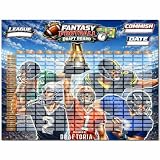
- EXTRA LARGE DRAFT BOARD: Oversized board provides ample space for all team picks, making draft night easy to follow.
- EXTRA LARGE DRAFT BOARD: Oversized board provides ample space for all team picks, making draft night easy to follow.
- EXTRA LARGE DRAFT BOARD: Oversized board provides ample space for all team picks, making draft night easy to follow.
- EXTRA LARGE DRAFT BOARD: Oversized board provides ample space for all team picks, making draft night easy to follow.
- EXTRA LARGE DRAFT BOARD: Oversized board provides ample space for all team picks, making draft night easy to follow.
Product prices and availability are accurate as of the date/time indicated and are subject to change. Any price and availability information displayed on Amazon at the time of purchase will apply.




