To convert a height in feet and inches to centimeters, first turn the feet into inches, add the remaining inches, then multiply by 2.54. To convert centimeters back, divide by 2.54 and express the result as feet plus leftover inches. For example, 5 ft 8 in is exactly 172.72 cm; 170 cm is about 5 ft 7 in when rounded to the nearest whole inch.
The conversion factors you need
One foot is 12 inches, and one inch is exactly 2.54 centimeters. Therefore, one international foot is exactly 30.48 centimeters. These are the appropriate factors for ordinary height conversion. The separate U.S. survey foot was a geodetic unit, deprecated for use after December 31, 2022. See the National Institute of Standards and Technology (NIST) references for the U.S. survey foot and conversion factors in the NIST Guide to the SI.
As an Amazon Associate I earn from qualifying purchases.
NIST’s quick-reference factors of 0.39 inches per centimeter and 3.28 feet per meter are rounded approximations, not exact factors. For precise height conversions, use 2.54 centimeters per inch or 30.48 centimeters per international foot. NIST’s unit-conversion overview notes that NIST SP 811, Appendix B is an essential source when exact conversion factors are needed.
The Tool Desk
Outbyte PC Repair FREEClear out junk files and repair common Windows errorsFree Scan →Outbyte Driver Updater FREEScan for outdated or missing drivers - takes under a minuteDriver Scan →Convert feet and inches to centimeters
- Multiply the number of feet by 12 to get inches.
- Add the inches already given.
- Multiply the total inches by 2.54.
Formula: centimeters = (feet × 12 + inches) × 2.54
#1 Best Overall

- Metric measurement: the height indicator tape ruler has 2 units of measurements, on the right side is a unit of measurement of 0 to 213 centimeter, on the left side is 0 to 83 inches, which can measure the height of most people; The width of each one is 1.8 inch
- Considerate design:the font is black and bright red to make the numbers more visible; 2 Kinds of measurement units can meet the measurement needs of different people; Compared with other height ruler, its width is large enough and can be cropped as needed
- Double sided: the design of double sided adhesive tape is suitable for most kinds of wall, which is convenient and fast to paste, sticky and firm, and can be maintained for a long time; For good results, do not apply to textured surfaces
- Cropped height: you may want to use one level to ensure that it is straight; In the case of obstruction, like floorboards or moldings, simply measure the obstacle's height and remove that length from the ruler with scissors
- Applicable Occasion: wall growth chart is well suitable for most occasions and convenient measurement such as hospital, station, office and home; It is a practical tool to record the height
Example: 5 ft 8 in = (5 × 12 + 8) × 2.54 = 68 × 2.54 = 172.72 cm.
Convert centimeters to feet and inches
- Divide the centimeters by 2.54 to find total inches.
- Divide total inches by 12. The whole-number quotient is feet; the remainder is inches.
- Keep the full result until the final step, then round only if you want to report a whole-inch height.
Example: 170 cm ÷ 2.54 ≈ 66.93 inches. That is 5 feet plus about 6.93 inches, or about 5 ft 7 in to the nearest whole inch. The rounded answer is not an exact equality: 170 cm is not exactly 5 ft 7 in.
Rank #2

- Very accurate -There are inches and centimetres measurement. It's very precise. The scale is very clear to read.
- Innovative design -The height ruler is a 3D sliding design that allows you to measure yourself with one hand just by standing up straight, with almost no data error.
- Save space -Demountable design, easy to take, 79inches, 7 section ruler can be joined. When you stick them on the wall, it never affect your wall design decoration.
- Safe material -Premium ABS materials, water proof, stain proof and scratch proof, durable and colorfast. Suitable for children, nursery, adults, etc
- Idea Choice for Birthday, Christmas and Thanksgiving Day. All of them are well tested before shipped to ensure qualified standard.
An equivalent route is to divide centimeters by 30.48 to get decimal feet. Keep the whole feet, then multiply the fractional part by 12 to convert it to inches. The exact factors are listed in NIST’s approximate conversions from U.S. customary measures to metric.
Do these 3 things before closing this tab:
1Scan for outdated or missing drivers - takes under a minute2Clear out junk files and repair common Windows errors3Fix the driver behind crashes, sound loss and screen glitchesChoose a useful level of precision
There is no universal NIST rule for how to round a casual height description. Match the format to the purpose:
Quick Recap
Best Value

- Stainless steel rule has etched black graduations for easy reading and long life
- Graduations on side 1 are in 32nds and 64ths
- On side 2 is a decimal equivalents chart
- Sliding pocket clip allows for use as depth or height gauge
- Specifications: Measurement: Upto 6 Inch
Rank #4
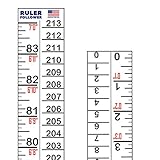
- 7 FOOT RULER: 1 3/4 inch wide Height Indicator on a Sticker Roll that measures 7 feet, but can be cut down to a smaller size to fit your needs
- US AND METRIC MEASUREMENT: The right side measures 0-213 centimeters with cm graduations. The left side measures 0-84 inches with 1/8 inch graduations
- DURABLE MATERIAL: High quality removable film material that is engineered to withstand outdoor weather conditions and sun damage
- STRONG ADHESIVE: High tack adhesive sticks to any smooth surface. Can be applied to walls, windows, glass, wood, metal, door frames, fiberglass, corners, curved surfaces and other challenging areas. For best results, do not apply to textured surfaces
- MADE IN THE USA: Suitable for use in a warehouse, medical office, gym, school, construction or for your kids growth chart
Rank #3

- Reads fractionally on left side from 0 to 80 Inch, in continuous inches and inches-and-feet
- Reads metric on right side from 0 to 203 Centimeter
- 1/4 Inch and 1/2 Centimeter graduations
- Dimensions are 1 1/2 Inch wide by 81 Inch long
- High-tack adhesive sticks to nearly any clean surface
- For a casual description: round the inch remainder to the nearest whole inch and say that the result is approximate.
- For a calculation or record that needs more detail: give decimal inches or centimeters and state the precision you are using.
- When converting between units: retain unrounded values through the calculation and round once at the end. If rounding the inch remainder gives 12 inches, carry that inch into the feet.
Avoid common conversion mistakes
- Convert all the feet. Multiply feet by 12 and add the remaining inches before multiplying by 2.54. Multiplying only the inch remainder leaves out most of the height.
- Do not confuse decimal feet with feet-and-inches notation. A decimal height of 5.5 feet is 5 feet plus half a foot, or 5 ft 6 in—not 5 ft 5 in.
- Do not treat a rounded answer as exact. For instance, 170 cm rounds to about 5 ft 7 in, but the unrounded inch value is about 66.93 inches.
- Avoid rounded shortcut factors when precision matters. Use 2.54 cm per inch rather than 0.39 inches per centimeter, or 30.48 cm per international foot rather than 3.28 feet per meter.
Product prices and availability are accurate as of the date/time indicated and are subject to change. Any price and availability information displayed on Amazon at the time of purchase will apply.




