What’s actually slowing this PC down?
Pick the symptom - the matching free tool is one click away.
Start by checking the camera’s lens mount and confirming that a lens covers its full-frame sensor. Then choose a focal-length range for the subjects you photograph and weigh reach against aperture, stabilization, and the size and weight you are willing to carry. A compact standard zoom can cover everyday scenes; a faster lens may suit low light, moving subjects, or stronger background blur.
How do I choose a lens for a compact full-frame camera?
- Match the mount. A lens must be made for the camera’s mount or used with an appropriate adapter. Compatibility can still have qualifications. For Sony E-mount, Sony says: “The cameras and lenses are interchangeable, but some caution is required depending on the camera/lens combination.” See Sony’s E-mount compatibility guidance.
- Confirm full-frame coverage. A lens that physically mounts is not automatically designed to cover a full-frame sensor. Check the manufacturer’s specifications and whether the camera will use a crop mode. Sony’s guidance says APS-C lenses can be used on full-frame E-mount cameras with crop-related qualifications and settings to check; that is a Sony-specific example, not a rule for all systems.
- Choose framing before shopping by size alone. Consider whether you need a wider view, more reach, or one lens to cover a mix of everyday scenes. A 28–60mm zoom reaches less far than a 28–70mm zoom at the long end, but either range may be suitable depending on what you photograph.
- Balance light, motion, and carry size. A larger maximum aperture admits more light and can allow higher shutter speeds for action. Stabilization can help reduce camera shake, but does not by itself freeze a moving subject. Compare the lens’s weight and dimensions with the compact body, as well as autofocus and control needs.
Is a 28–60mm enough for everyday photography?
It can be a useful compact standard-zoom range for everyday scenes if you value a small kit and do not often need longer reach. Compared with a 28–70mm zoom, it gives up some framing options at the telephoto end. Neither range is universally suitable: the right choice depends on your subjects and how often you need to crop or change lenses.
As an Amazon Associate I earn from qualifying purchases.
What lens should I buy for a small full-frame camera?
There is no one best choice without knowing the camera system and shooting priorities. The examples below are Sony E-mount lenses, not recommendations for other mounts. Sony product pages describe their specifications; they do not establish comparative optical quality, autofocus performance, or handling across brands.
Free tools Windows power users keep installed
One-click scans. No signup required.
| Lens | Coverage and aperture | Stabilization and size | Best fit to consider |
|---|---|---|---|
| Sony FE 28–60mm F4–5.6 (SEL2860) | 28–60mm; variable maximum aperture of F4–5.6. Sony describes it as a compact standard zoom with full-frame performance. Sony product page. | The cited product page supports its compact positioning; it does not establish that it is the smallest lens across camera systems. | Consider it if you use Sony E-mount and prioritize a compact standard zoom over longer reach. |
| Sony FE 28–70mm F3.5–5.6 OSS (SEL2870) | 28–70mm; variable maximum aperture of F3.5–5.6. Sony product page. | Optical SteadyShot lens stabilization; Sony lists the lens at 295g. Sony describes it as lightweight and compact. | Consider it if the extra reach over 60mm and lens stabilization matter to you. The 295g figure is this model’s published specification, not a general compact-lens benchmark. |
| Sony FE 28–70mm F3.5–5.6 OSS II (SEL28702) | 28–70mm. Sony describes it as a full-frame zoom; consult its product page for specifications. Sony product page. | Sony notes optical stabilization and describes it as small and light; a weight value is not stated in the cited material. | Check that a listing is for the OSS II version, then confirm compatibility with your specific body. |
When should I choose a faster lens?
Choose a lens with a larger maximum aperture when low-light exposure, faster shutter speeds for action, or subject separation matters more than keeping the lens as compact as possible. The compact zoom examples above have variable maximum apertures of F4–5.6 or F3.5–5.6, so their maximum aperture changes across the zoom range. Sony’s general explanation that a larger aperture admits more light and can permit higher shutter speeds comes from guidance framed around A-mount DSLR lenses; treat it as a general optical principle, not a body-specific performance guarantee.
Quick Recap
Rank #4

- Full-Frame Dual-Ring Pancake Lens: At just 23.8mm thick and 130g light, this lens packs both a dedicated aperture ring and a focus ring into an ultra-compact body. Slip it into your pocket and hit the street.
- Excellent Close-Up Performance: With a 0.2m minimum focusing distance and 0.2x magnification, capture fine textures and small subjects with stunning clarity and smooth background blur.
- Outstanding Optical Quality: 6 groups and 8 elements with 2 aspherical and 1 high-refractive index lenses deliver sharp, detailed images from center to edge.
- Versatile 26mm Focal Length: A natural, familiar perspective that works across street photography, travel scenes, and everyday life.
- Reliable STM Autofocus: The gear-type STM motor keeps the lens compact while delivering responsive, near-silent focusing performance suited for everyday shooting.
Rank #3

- Supreme lightweight portability that makes telephoto shooting fun
- Uncompromising image quality with 15 elements in 10 groups that lets you focus on creativity
- Up-close shooting performance (31.5" / 1:9.4 Wide & 59.1" / 1:5.1 Tele)
- Moisture-Resistant Construction
Rank #2
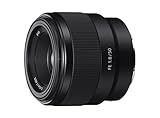
- Large F1. 8 maximum aperture enables beautiful defocusing effects
- 7-blade circular aperture creates beautiful defocused bokeh
- Compact, lightweight design Ideal for full-frame e-mount cameras
- Aspherical element controls spherical aberration and coma
- Double-gauss configuration suppresses field curvature & distortion
#1 Best Overall

- Fast, quiet VXD linear motor for high-speed and high-precision autofocus
- MOD (Minimum Object Distance) of 7.1” at wide end and maximum magnification ratio of 1:2.7 for creative close-ups
- New design provides enhanced texture and greater user-friendliness
- Compact at 4.6" long and weighing just 19 oz
- Moisture-Resistant Construction and Fluorine Coating
What should I check before buying?
- Exact camera mount and whether the lens is native or requires an adapter.
- Full-frame image-circle coverage, and any crop mode or settings required for an APS-C lens.
- Focal-length range against the actual subjects and working distances you encounter.
- Maximum aperture across the zoom range, plus whether your subjects move.
- Whether stabilization is in the lens or body, and the camera-specific behavior documented for your model.
- Weight and dimensions, including how the lens balances on the compact camera.
- Autofocus, video, and close-focus requirements, which vary by lens and body.
- Exact model/version and current regional availability; product names and availability can vary, and current prices or stock are not established here.
Product prices and availability are accurate as of the date/time indicated and are subject to change. Any price and availability information displayed on Amazon at the time of purchase will apply.




