Start with two checks: your Sony camera’s sensor format and whether you want autofocus. Sigma offers E-mount lenses for both APS-C and full-frame cameras, with autofocus options across a broad range of focal lengths. Voigtländer’s native E-mount lenses are manual focus. An E-mount lens can physically fit yet cover a different sensor area, so check the lens designation as well as the mount before choosing.
Check the mount and sensor format first
Sony E mount is used by both APS-C and full-frame cameras, but mount fit does not guarantee that a lens covers the camera’s entire sensor. Sony says the formats are interchangeable with caveats: an APS-C lens on a full-frame body records using APS-C/Super 35 framing. If you see vignetting, check the camera’s crop setting. The resulting framing and image dimensions may not suit every use. Sony’s E-mount compatibility guidance explains the format distinction.
As an Amazon Associate I earn from qualifying purchases.
- APS-C body: Sigma DC lenses are format-matched options. A full-frame lens also fits, but compare its size, weight, field of view and cost for your needs. The Voigtländer examples in this guide use full-frame image circles; on APS-C, they give a narrower field of view than on full-frame. The lens’s marked focal length does not change.
- Full-frame body: Sigma DG lenses are designed for full-frame coverage. A Sigma DC lens invokes APS-C crop framing, so consider whether the resulting framing and image dimensions work for you.
Sigma’s Sony E-mount lineup includes both DG full-frame and DC APS-C models. For specifications such as focal length, angle of view, filter diameter, dimensions and weight, consult the exact model entry in its March 2026 lens catalogue.
Decide whether you need autofocus
Choose an autofocus lens for moving subjects or AF-dependent work
If you photograph moving subjects or rely on your camera’s autofocus, shortlist a lens that explicitly supports AF for Sony E mount. Sigma says its E-mount lenses use an optimized AF drive algorithm, but actual feature compatibility depends on the lens and camera combination. Check Sigma’s camera compatibility table for your specific body. Sigma also describes in-body stabilization and in-camera aberration correction as available on compatible cameras, not as universal features.
#1 Best Overall

- Supreme lightweight portability that makes telephoto shooting fun
- Uncompromising image quality with 15 elements in 10 groups that lets you focus on creativity
- Up-close shooting performance (31.5" / 1:9.4 Wide & 59.1" / 1:5.1 Tele)
- Moisture-Resistant Construction
Choose Voigtländer when you want manual control
Voigtländer’s native E-mount lenses discussed here are manual focus: you set focus and aperture yourself. Their electronic contacts can transmit usage data such as EXIF information, and camera-dependent functions may include lens correction, stabilization or focusing aids. These features depend on the lens and camera specifications; electronic communication does not make the lens autofocus. See Cosina’s Voigtländer E-mount lineup and the E-mount manual for details.
Match focal range and lens type to what you photograph
Choose the framing and working distance you need before choosing by brand. A zoom covers multiple focal lengths without changing lenses; a prime gives you one focal length. Compare the actual range, maximum aperture, size and weight rather than assuming one category or brand is automatically better.
Rank #2
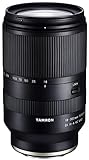
- World’s first 16.6x all-in-one zoom lens for APS-C mirrorless cameras
- Best-in-class, extremely fast and precise AF provided by VXD linear motor focus mechanism
- Maintains high resolving power from the center to the corners throughout the range
- Compact and portable design at 4.9 X 2.9 inches and a weight of just 21.9 ounces
- Moisture-Resistant Construction and Fluorine Coating
- For one flexible APS-C zoom: The Sigma 18–50mm F2.8 DC DN is an example to consider if its zoom range and constant maximum aperture suit your subjects and camera.
- For a full-frame standard zoom: The Sigma 24–70mm F2.8 DG DN II is a full-frame example. Check that the retail listing is the Sony E-mount variant.
- For a manual-focus prime: The Voigtländer 50mm F1.0 Nokton is a full-frame-image-circle E-mount option. It is manual focus, not an autofocus alternative. Its manufacturer page describes camera-dependent 5-axis stabilization support via its distance encoder; verify your camera’s support before relying on that function. Voigtländer’s product page lists the lens details.
These examples illustrate different formats and approaches, not a universal ranking. There is no established comparative laboratory or hands-on evidence here to support a blanket sharpness winner. Budget, subject, desired framing and willingness to focus manually all affect the right choice.
The Tool Desk
Outbyte PC Repair FREEClear out junk files and repair common Windows errorsFree Scan →Outbyte Driver Updater FREEScan for outdated or missing drivers - takes under a minuteDriver Scan →Compare exact model specifications and verify support
Before buying, compare the model-level details that affect how the lens will work in your kit:
Rank #3

- Wide zoom range (82 - 315mm 35mm equivalent) ideal for sports or nature;Aperture blades : 7
- Internal focusing for smooth, quiet operation - perfect for video capture.Direct manual focus with non-rotating focus ring during AF: ideal for precise, comfortable manual focus adjustments
- Optical Steady Shot image stabilization for stable video capture and low light performance
- Minimum Focus Distance - 3.28 ft, Maximum Magnification ratio - 0.23x
- Provides a wide focal range of up to 315mm (35mm equivalent) ideal for sports or nature shooting
- Mount variant and sensor-format label: DG or DC for Sigma, and the specified E-mount model for Voigtländer.
- Focal length or zoom range and angle of view for your camera’s sensor format.
- Maximum aperture, plus dimensions, weight and filter diameter if those matter to your setup.
- Autofocus, stabilization, correction and focusing-aid compatibility for your exact body.
Support can change as manufacturers issue firmware updates. Sigma’s firmware downloads page lists current support information; check it for the exact lens rather than treating a firmware state as permanent. For Voigtländer, consult the model page and manual for the particular lens and confirm camera-dependent functions with the relevant specifications.
Quick Recap
Rank #4
- Wide zoom range (82 - 315mm 35mm equivalent) ideal for sports or nature;Aperture blades : 7
- Internal focusing for smooth, quiet operation - perfect for video capture.Direct manual focus with non-rotating focus ring during AF: ideal for precise, comfortable manual focus adjustments
- Optical Steady Shot image stabilization for stable video capture and low light performance
- Minimum Focus Distance - 3.28 ft, Maximum Magnification ratio - 0.23x
- Angle of view (on APS-C) 28.2° - 7.8°
Product prices and availability are accurate as of the date/time indicated and are subject to change. Any price and availability information displayed on Amazon at the time of purchase will apply.




