Free tools Windows power users keep installed
One-click scans. No signup required.
Choose a cryogenic system by the temperature your sample must maintain under the experiment’s real heat load—not by the refrigerator’s advertised no-load base temperature. Then match its cooling power, run style, sample space, magnetic field, vibration performance, helium needs and lab utilities to the experiment. A system is suitable only if it can support the complete installed payload, including wiring, shields, magnet and measurement hardware.
Start with the sample’s operating temperature and heat load
Write down the temperature required at the sample while the experiment is running, and estimate the heat entering each relevant stage. Include wiring, radiation shields, the sample holder, magnet and other installed hardware. Ask vendors for cooling power at the intended operating temperature and in a configuration comparable to your planned setup; a base-temperature figure alone does not establish usable performance.


As an Amazon Associate I earn from qualifying purchases.
Specifications are configuration-specific. For example, Bluefors lists guaranteed cooling power for its Ultra-Compact LD350 and LD450 at both 20 mK and 100 mK, rather than relying on a single base-temperature figure. Those values apply to the named configurations, not to dilution refrigerators generally.
PC Slower Than It Used to Be?
A free scan shows the junk files, broken settings and background clutter dragging Windows down - then fixes them in one click.Free scan · Windows 10 & 11Outdated Drivers Are Slowing You Down
One free scan finds every outdated or missing driver and matches the right update for your exact hardware.Free scan · exact hardware matchWhich architecture fits the experiment?
| System type | Good initial fit | Key trade-offs to check |
|---|---|---|
| 4 K cryostat or cryocooler | Experiments needing approximately 4 K without continuous sub-kelvin operation. | Cooling power at the sample, vibration, sample exchange, magnet geometry and the cost and feasibility of any later upgrade. Bluefors describes a 4 K system with a dilution-refrigerator upgrade path. |
| 1 K system | Experiments operating around 0.5–1 K, or needing comparatively high cooling power in that range. | Cooling power and stable operating range, isotope and service requirements, and whether the added capability is needed. Bluefors lists helium-3- or helium-4-based systems with isotope-dependent base temperatures. |
| Continuous dilution refrigerator | Long or repeated measurements below 1 K, particularly in the millikelvin range. | Heat load at the mixing chamber, vibration, wiring, sample space, cooldown, service and facility utilities. Bluefors describes continuous helium-3/helium-4 circulation; ISIS identifies dilution refrigeration as its primary continuous ultra-low-temperature equipment. |
| 3He sorption refrigerator | Sub-kelvin measurements that can be performed in a single-shot cycle. | Available hold time and the interruption needed for regeneration. ISIS reports that its facility’s described sorption inserts reach 300 mK and require regeneration; check specifications for the particular system. |
| Liquid-helium bath or recondensing system | Setups that benefit from a helium bath or reservoir, including some superconducting-magnet arrangements. | Helium supply and recovery, boiloff or recondensing capacity, transfer and installation requirements, and vibration isolation. NIST describes recondensing helium boiloff using a cryocooler. |
This is a screening comparison, not a universal ranking. Compare proposed systems using the same sample payload, target temperature, magnetic-field conditions and utility assumptions.
Decide whether sub-kelvin cooling must be continuous
If measurements run for long periods below 1 K, or must repeat without a regeneration pause, a continuous dilution refrigerator is a natural candidate to evaluate. Bluefors describes systems based on continuous helium-3/helium-4 circulation. At ISIS, the facility guide describes dilution equipment reaching 50 mK and 3He sorption inserts reaching 300 mK; it characterizes the former as continuous and the latter as single-shot, with regeneration interrupting sub-1.5 K measurements. Those are facility-specific descriptions, not universal product guarantees.
A sorption system may suit a shorter measurement that can accommodate its cycle. Compare the required uninterrupted run time with the actual hold time and regeneration schedule for the proposed system; the ISIS figures do not establish those details for other equipment.
Rank #2
Check cooling power at the operating point
Request cooling-power data at the temperature where the experiment will operate and for the stages that carry meaningful heat loads. The load at a mixing chamber, for example, is not interchangeable with cooling power specified at a warmer stage. Make the proposed wiring, shields, sample assembly and other payload explicit when asking for a configuration-specific estimate.
| Configuration and source | Published cooling-power figures | Qualification |
|---|---|---|
| Bluefors Ultra-Compact LD350 | 12 μW at 20 mK; 350 μW at 100 mK | Guaranteed figures for the named configuration on the manufacturer page updated March 10, 2026. |
| Bluefors Ultra-Compact LD450 | 14 μW at 20 mK; 450 μW at 100 mK | Guaranteed figures for the named configuration on the manufacturer page updated March 10, 2026. |
| Compact refrigerator and helium recondensing system described in a 1980 conference paper | 3.5 W at 4.3 K | Historical example reported by Sumitomo Heavy Industries authors; not a current purchasing specification. |
These figures describe different systems, stages and contexts, so they are not a like-for-like ranking. Ask for the operating curve and conditions behind any specification that will determine whether the sample can stay at its target temperature.
Rank #3
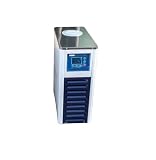
- LOW-TEMPERATURE COOLING: Achieves temperatures as low as -20°C, ideal for precise lab cooling applications.
- 5L CAPACITY: Features a 5-liter reservoir to provide consistent coolant circulation for extended lab sessions.
- COMPATIBLE WITH ROTARY EVAPORATORS: Designed to work seamlessly with lab rotary evaporators for efficient cooling.
- 110V OPERATION: Plug-and-play 110V power compatibility makes it ready to use in standard US lab environments.
- CRYOGENIC CIRCULATION PUMP: Delivers stable, continuous coolant flow to maintain consistent low temperatures during experiments.
Specify the magnetic field and sample geometry
Give the supplier the required field magnitude and orientation, homogeneity, bore and sample clearance. State whether the experiment needs a persistent switch or a field-compensated region. Ask for configuration-specific drawings and performance data: magnet options change the available sample space and must be assessed as part of the cryostat, not as a separate headline feature. Bluefors describes integrated solenoid and vector-magnet options, but the appropriate configuration depends on the experiment.
Assess vibration at the measurement
Vibration can be a measurement constraint, but there is no universal threshold established for all superconducting experiments. NIST identifies cryocooler type, separation, mounting, shielding, thermal damping and signal processing as factors to consider.
Rank #4

- COMBINES CRYOTHERAPY WITH STATIC COMPRESSION If you recently had knee replacement surgery or are suffering from a knee injury, then you need this ice therapy machine for knees. It will help immensely with pain, swelling, and inflammation.
- EASY-TO-OPERATE GRAVITY-FED COLD THERAPY SYSTEM There’s no motor or complicated setup with this unique compression ice pack for injuries. It delivers targeted chilled therapy utilizing gravity as its power source. No loud motors or cumbersome machines
- DESIGNED TO HOLD COLD TEMPERATURE MUCH LONGER The insulated, leakproof water canister and tubing provide a consistent, long-lasting cold temperature. Water will stay cold for approximately 12 or more hours.
- UNIVERSAL SIZE WILL COMFORTABLY FIT MOST KNEES Always the perfect fit. The cuff on this innovative knee ice pack is adjustable and designed to be one-size-fits-most. You’ll always be able to find the ideal level of compression and comfort for your knee.
- GREAT FOR HOME, HOSPITALS, AND REHAB FACILITIES This cold therapy knee wrap system is an affordable and effective way to deliver continuous cold and compression therapy. It’s an excellent tool to have on hand at home or in hospitals, PT facilities, rehabilitation centers, and gyms.
- Describe the measurement’s sensitivity and the parts of the apparatus most affected.
- Request vibration spectra or measurements at the sample for a configuration resembling the proposed installation.
- Ask what isolation or damping is included and what additional measures may be needed.
Choose between cryogen-free and helium-based arrangements
Compare cryogen-free operation with a liquid-helium bath or recondensing arrangement against the lab’s local supply, recovery capability, staffing, uptime and service arrangements. A helium reservoir can be useful for some setups, but it brings handling and supply considerations. A cryogen-free system still has site requirements: Bluefors lists three-phase electricity, cooling water and compressed air as basic requirements for its LD-4K system. Requirements differ by system, so obtain the installation specification for the exact configuration.
Quick wins for a faster PC:
Fix the driver behind crashes, sound loss and screen glitchesFind Drivers →Repair Windows errors before they cause bigger problemsFix Now →Include access, cooldown and lifetime operation
Ask how samples and wiring are installed or exchanged, how cooldown affects the measurement schedule, and whether experiments can be prepared while the system is running. Bluefors says its XLDHesl product allows wiring or a full experiment to be prepared while the system runs; treat this as a system-specific feature rather than a general property of cryostats.
Best Value

- Portable lab refrigerator: Measuring 78x51x41cm and weighing 46 pounds, this lab medical freezer can be easily transported by one person.
- Ultra-low temperature medical refrigerator: Capable of reaching temperatures as low as -86℃ (-122℉).
- Environmentally-friendly refrigeration system: Equipped with a copper tube fin-type air-cooled condenser and a low-temp mixed refrigerant that is free of fluorine, has a fast cooling speed, excellent heat dissipation, and a long service life.
- 304 stainless steel interior: With a capacity of 20L(0.8 Cubic Feet), this countertop refrigerator can hold approximately 25 cans of 300ml kola.
- Intelligent temperature control freezer: Equipped with a microcomputer temp controller and an LCD digital temperature display, accurately control the temperature, easy to use.
For lifecycle planning, compare purchase and installation costs with utilities, helium supply or recovery, service, consumables, staffing, uptime and expansion options. The cited sources do not provide comparable lifecycle costs across architectures or vendors, so they do not establish a cost winner. Obtain current quotations based on the same operating assumptions.
Build a configuration-specific request for quotation
- State the sample’s target temperature under load, expected heat load and required cooling power at each relevant stage.
- Specify the run duration, whether operation must be continuous, and any acceptable regeneration or sample-exchange pauses.
- Provide sample-space dimensions and the complete magnetic-field, orientation, homogeneity and bore requirements.
- Describe vibration sensitivity, wiring and payload, along with helium-handling preferences and available site utilities.
- Request configuration-specific cooling-power data, drawings, vibration information, installation needs, service assumptions and a lifecycle-cost breakdown.
Ray Radebaugh’s chapter “Refrigeration Methods for Superconductors” is identified in the NIST record as part of Handbook of Superconducting Materials, Volume 1 (2002), for readers seeking further technical background.
Quick Recap
Product prices and availability are accurate as of the date/time indicated and are subject to change. Any price and availability information displayed on Amazon at the time of purchase will apply.




