Quick wins for a faster PC:
Scan for outdated or missing drivers - takes under a minuteDriver Scan →Repair Windows errors before they cause bigger problemsFix Now →Fix the driver behind crashes, sound loss and screen glitchesFind Drivers →A shared home dashboard gives everyone one recognizable place to open household apps without memorizing IP addresses. For self-hosted services, an app-focused dashboard such as Homepage is a natural starting point; for device status and controls, Home Assistant dashboards are a better fit. Either can run on an existing compatible server, and neither replaces the services it links to.
What a shared dashboard does—and what it does not
Think of the dashboard as the front door to your services, not a replacement for them. A tile labeled “Photos” or “Media” can take a family member to the right app without exposing a raw address such as 192.168.1.20:8080. Optional widgets can show selected information from supported services.
As an Amazon Associate I earn from qualifying purchases.
The distinction matters: a link is a convenient route, while a widget may connect to an app’s API and display household information. The dashboard does not make an unavailable service available, nor does a friendly name alone secure access to it.
Choose the dashboard for the job
| Need | Good fit | What it is designed to do |
|---|---|---|
| Find self-hosted apps and see service-specific information | Homepage | Organize service links, integrations, and widgets. Its Docker integration can discover services from labels, reducing repeated manual entry as a container setup grows. See the Homepage project documentation. |
| See household or room state and control connected devices | Home Assistant dashboards | Present device and household information and controls, with visual customization and options for different household members. See Home Assistant dashboards and dashboards for multiple users. |
| Show an existing app page inside another interface | Home Assistant webpage dashboard | May embed a local page, but browser security headers or the app’s authentication can prevent it from working. It is not a universal substitute for a service link. |
Homepage and Home Assistant can overlap, but they solve different primary problems. You do not need to force every app link and every device control into one tool: pick the interface that best matches what household members need to do.
#1 Best Overall

- (1)This is an all-in-one Android multimedia tablet designed specifically for smart home consumers, integrating touch, computer, multimedia, audio, Internet, and LED ambient lighting
- (2)It is widely used in various work and life scenarios, including smart home control centers, smart building intelligent management, smart hotel management, and unattended vending machines, and is deeply loved by customers.
- (3)For home assistant enthusiasts, this device integrates LED ambient lighting and temperature and humidity sensors through MQTT. Eliminate the tedious steps of integration and conveniently use MQTT for remote control.
- (4)It has a stylish and novel design and exquisite appearance, making it a smart home tablet that is deeply loved by consumers.
- (5)Built in KIOSK mode switch, you can easily set KIOSK mode. Please note: when setting KIOSK mode, please set a password, otherwise, you will need to use the type-c interface mouse right-click to exit it. If you have set a password, you can easily exit KIOSK mode by entering it.
Build the page around how people look for things
Group services by the words people already use—such as “Photos,” “Files,” or “Media”—rather than by server names, container names, or port numbers. Give each service a clear label and link to the address that works on your home network. Keep the list focused on useful destinations; a dashboard becomes harder to use if every technical endpoint gets equal prominence.
With Homepage, service entries can be configured manually or discovered from Docker labels after its Docker integration is configured. Supported integrations can add service-specific widgets. That automation is helpful for a growing containerized setup, but it depends on the integration and labels being set up correctly; it is not automatic discovery of every application on a network. The available integrations and configuration are documented in the Homepage project.
Rank #2

- 【Android OS&RAM+ROM】Android 14 OS, RK3576S 8-core processor, 4GB RAM +64GB ROM,with Proximity Sensor,No Camera
- 【Screen Model】10.1 inch capacitive touch screen, 1280*800P resolution
- 【Network】Support WIFI 6 ,100/1000M, Ethernet /BLE 5.3;
- 【RJ45&POE Supported】Support RJ45 POE power supply
- 【Interfaces】Support I/O, IR, RS232, RS485 serial protocol supported
Choose widgets selectively. They can make a page more informative, but API-backed widgets may expose personal information to anyone who can view the dashboard. A simple link page may be preferable when a status panel adds little value or the information should remain private.
Decide whether to reuse a server or add hardware
A dedicated computer is optional. Homepage publishes AMD64 and ARM64 images, so it can run on compatible hardware already hosting services. Home Assistant also documents a Raspberry Pi Container installation route; its guidance recommends Home Assistant OS for most users, while Container is a standalone option with different capabilities. Compare an existing server with a separate low-power host based on what is already running, storage needs, maintenance comfort, and whether device integrations need access to hardware.
Rank #3

- Powerful Processor: RK3576 8-core processor featuring Quad-core Cortex-A72 and Quad-core Cortex-A53 with a maximum frequency of 2.2 GHz for smooth and responsive performance
- Operating System and Storage: Android 14 OS with 4GB RAM and 64GB ROM providing ample space for smart home applications and multitasking capabilities
- Advanced Network Connectivity: Support for WIFI 6, 100/1000M Ethernet, and BLE 5.3 ensuring fast and reliable wireless and wired connections
- Power over Ethernet Support: RJ45 POE power supply capability simplifies installation by eliminating the need for separate power cables
- Comprehensive Interface Options: Support for I/O, IR, RS232, and RS485 serial protocols enabling integration with various smart home devices and systems
If a Home Assistant Container integration needs a device, the installation may require mapping the relevant device files into the container. Follow the official Raspberry Pi installation guidance for the applicable setup rather than assuming a container can access host hardware automatically.
Keep local convenience separate from remote access
A dashboard on a trusted home network is one access case; making it reachable from an untrusted network is another. Homepage’s project security notice says it “must sit behind a reverse proxy (and/or VPN) that enforces authentication, TLS, and strictly validates Host headers.” Treat that as a security boundary, not an optional polish step, especially if widgets show personal information. See the project security guidance.
Rank #4

- 15.6 inch capacitive touch screen, 1920*1080P resolution
- Android 14 OS, RK3576S processor, 4GB RAM +64GB ROM,
- Support WIFI 6E / 1000MB Ethernet /BLE 5.3
- Support RJ45 POE power supply
- Support I/O, IR, RS-232, RS485 serial protocol supported
Home Assistant likewise recommends VPN-based approaches such as Tailscale or ZeroTier One for secure remote access and documents reverse-proxy considerations. Choose and configure a remote-access method deliberately; a dashboard link does not itself provide secure remote connectivity. See Home Assistant remote access guidance and its HTTP and reverse-proxy documentation.
Embedding pages has extra limits
Embedding an app inside a Home Assistant webpage dashboard may be convenient, but it depends on the target app and browser allowing the page to be framed. Security headers can block embedding, and the app may still require a separate login. Home Assistant also notes that files served from its /local/ path are not protected by Home Assistant authentication. Do not put sensitive files there on the assumption that dashboard login will secure them; consult the Home Assistant HTTP documentation.
Quick Recap
Best Value
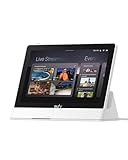
- 𝐈𝐧𝐬𝐭𝐚𝐧𝐭 𝐇𝐚𝐧𝐝𝐬-𝐅𝐫𝐞𝐞 𝐃𝐨𝐨𝐫 𝐀𝐥𝐞𝐫𝐭𝐬: When someone rings the doorbell, unlocks the door, or is detected by the camera, the display automatically lights up with a live feed and a voice alert. Know who's there instantly, hands-free.
- 𝐒𝐞𝐞 𝐄𝐯𝐞𝐫𝐲𝐭𝐡𝐢𝐧𝐠 𝐰𝐢𝐭𝐡 𝐅𝐨𝐮𝐫 𝐕𝐢𝐞𝐰𝐬 𝐨𝐧 𝐎𝐧𝐞 𝐒𝐜𝐫𝐞𝐞𝐧: View your entire property at a glance through four simultaneous live feeds while maintaining full control and near-instant access to live video streams. The moment something happens, you're instantly in the know.
- 𝐈𝐧𝐬𝐭𝐚𝐧𝐭 𝐏𝐥𝐚𝐲𝐛𝐚𝐜𝐤, 𝐍𝐨 𝐖𝐚𝐢𝐭𝐢𝐧𝐠, 𝐍𝐨 𝐁𝐮𝐟𝐟𝐞𝐫𝐢𝐧𝐠: Historical events are automatically downloaded to local storage so you can replay past moments instantly—no delays, no buffering.
- 𝐒𝐦𝐚𝐫𝐭 𝐃𝐚𝐢𝐥𝐲 𝐑𝐞𝐩𝐨𝐫𝐭𝐬 𝐰𝐢𝐭𝐡 𝐊𝐞𝐲 𝐒𝐞𝐜𝐮𝐫𝐢𝐭𝐲 𝐄𝐯𝐞𝐧𝐭𝐬: Using advanced facial and package recognition (powered by HomeBase 3), the display intelligently compiles daily summaries, including stats and video recordings for quick insights.
- 𝐌𝐨𝐧𝐢𝐭𝐨𝐫 𝐄𝐯𝐞𝐫𝐲𝐭𝐡𝐢𝐧𝐠, 𝐀𝐧𝐲𝐭𝐢𝐦𝐞, 𝐀𝐧𝐲𝐰𝐡𝐞𝐫𝐞: The user-friendly 8-inch touchscreen is simple enough for kids and seniors, ensuring ease of use for everyone. Designed for flexible monitoring wherever you need it.
Product prices and availability are accurate as of the date/time indicated and are subject to change. Any price and availability information displayed on Amazon at the time of purchase will apply.




