A cross-platform terminal setup works best when you carry over the same mental model—not the same configuration files. The terminal is the host that displays a session, the shell interprets commands, and a profile connects the host to a command-line program. Choose the shell and host for each machine, then share only the settings and habits that make sense across them.
What is the difference between a shell and a terminal?
A terminal is the application that presents a command-line session: it renders text and handles the window or tab in which a command-line program runs. A shell is one kind of command-line program; it reads and interprets commands. Microsoft describes Windows Terminal as a host for running multiple command-line apps or shells side by side in tabs or panes. Microsoft’s Windows Terminal FAQ also distinguishes the graphical terminal from the command-line clients it hosts.
As an Amazon Associate I earn from qualifying purchases.
This distinction matters when you move between operating systems. Changing the terminal host does not necessarily change your shell, and choosing the same shell does not require using the same terminal application. The host displays the session; the shell determines the command language and behavior.
The Tool Desk
Outbyte Driver Updater FREEFix the driver behind crashes, sound loss and screen glitchesFind Drivers →Outbyte PC Repair FREERepair Windows errors before they cause bigger problemsFix Now →Choose the command environment before the terminal
Start with the commands and tools you need to run. On Windows, you might use native PowerShell or Command Prompt, or run a Linux environment through WSL. Git Bash is another command-line client that Windows Terminal can host when it is installed. Azure Cloud Shell is also supported. Windows Terminal is one Windows host option, not the only terminal available.
#1 Best Overall

- Keychron K3, a compact 75% layout ultra-slim wireless mechanical keyboard built for peak productivity and a great tactile typing experience.
- Be ready to multitask without missing a beat by connecting the K3 with up to 3 devices via the stable Broadcom Bluetooth 5.1 chipset and switch between your laptop, PC, tablet and phone seamlessly. *Keep the distance between the keyboard and the device within reasonable limits to minimize signal interference.
- With a unique Mac layout, the K3 has all the necessary Mac multimedia keys while still being compatible with Windows. Extra keycaps for both Windows and Mac operating systems are included. *If it doesn't match your device exactly, you can try updating the keyboard's firmware.
- With open-source QMK firmware, it offers endless possibilities for key remapping, macros, and shortcuts. Customize every key easily using the Keychron Launcher web app for a more personalized typing experience. With its built-in AI assistant (live in beta now), keyboard customization is no longer complicated — just ask in plain language, and AI handles the rest.
- Together with the reinforced aluminum body (plastic bottom frame) make the K3 one of the thinnest and lightweight wireless mechanical keyboards on the market. The K3 also comes with a floating keycap design with a charming white backlight with modern keycap legends to sync with your mood.
Windows Terminal profiles define how the host launches a command-line program. A profile can start an executable, a command or batch file, or an SSH connection. It can also set options such as the starting directory. The Windows Terminal FAQ documents profile creation and supported clients.
Separate portable habits from platform-specific configuration
Think of portability as a set of layers rather than a single configuration file. Keep shell initialization with the shell that uses it, and configure each terminal host to launch that shell appropriately. PowerShell profiles and bash or zsh startup files are different systems; they are not interchangeable just because they can produce similar prompts or aliases.
Rank #2

- Mini portable 60% compact layout: MK-BOX is a 68 keys mechanical keyboard have cute small size, but with separate arrow keys and F1-F12, Fn function keys you need, can use it for gaming or work while saving space.
- Mechanical red switch: characterized for being linear and smoother, slight key sound has no paragraph sense with minimal resistance, but fast action without a tactile bump feel which makes it easier to tap the keyboard.
- Classic charming blue LED backlit: Customize multiple illuminated LED light effects, supports about 16 backlight modes, press Fn + Ins can control it, FN + ←/→ control backlight speed, FN + ↑/↓ control backlight brightness.
- Full anti-ghosting keyboard: all 68 keys are no conflict, black grey red mash up design, ergonomic suspension double-color injection keycap, double kickstand feet adjustable typing angle and detachable usb cable, both practical and beautiful.
- Extensive compatibility: MageGee MK-Box mechanical keyboards use USB 2.0 connector making it compatible with Windows (2000, XP, ME, Vista, 7, 8), Linux and Mac, plug and play, no drivers or software required.
- Carry across machines: your preferred command-line workflow, useful aliases or functions where the shell supports them, and visual choices you can reproduce.
- Adapt per operating system: executable paths, shell startup-file locations and behavior, working directories, and commands that depend on installed tools.
- Configure per terminal host: profile launch settings, tabs or panes, keyboard shortcuts, and appearance settings supported by that host.
On Windows Terminal, settings intended for every profile can go in shared defaults; settings that differ by shell or launch target belong in the individual profile. Microsoft’s Windows Terminal tips and tricks shows this shared-defaults approach. For broader customization and launch options, see Microsoft’s Windows Terminal overview.
Set up Windows Terminal profiles and defaults
- Install the stable host. Microsoft recommends installing the stable Windows Terminal app through the Microsoft Store. Preview is a separate version that receives features before they typically reach the stable release; choose it only if you specifically want preview features. Check the FAQ’s current installation guidance.
- Pick a client for each profile. Add or select a profile for the environment you intend to use, such as PowerShell, Command Prompt, an installed WSL distribution, or Git Bash. A profile is a launch configuration, not a shell in itself.
- Set the launch details that vary. Choose the correct command-line program and, where needed, its startup arguments and starting directory. For SSH, configure a profile to launch the connection you use.
- Move genuinely shared preferences into defaults. Apply common font, color, or other host-level choices once where they should affect every profile. Leave shell-specific behavior in the relevant profile or shell startup file.
- Test each profile separately. Open it and confirm it launches the intended environment, starts in the expected directory, and displays its prompt and symbols correctly.
Keep shell startup files and integrations shell-specific
Shell integrations depend on the shell being launched. Microsoft’s Windows Terminal shell integration tutorial covers Command Prompt, PowerShell, and zsh, and documents bash integration. Follow the instructions for the shell in a given profile rather than pasting one shell’s initialization into another shell’s configuration.
Rank #3
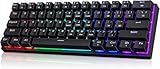
- 🌟【60% Keyboard: 61 Keys Compact Design】Ultra-compact layout with 61 keys that free up your desktop, leaving more space for mouse movements. Especially,there is a long detachable Type-C cable on the right side of the keyboard, ensuring safe transport in your travel bag. For FPS gamers who are focused on speed & secure connection,this 60% keyboard is proper to pick.( 💙Simply Press Fn+Space key to switch to direction keys for efficient operates)
- 🌟【Mechanical keyboard: Responsive Blue Switches】CACKBIRD gaming keyboard features blue mechanical keys that give a satisfyingly "click" sound and tactile resistance with each keystroke, so you can be confident with every move you make.This keyboard is more comfortable to type on since it features deeper key travel,greater feedback,and more space between keys.Great for gamers, office workers, copywriters, programmers and editors.( 💙 Include a keycaps puller for cleaning or other needs.)
- 🌟【Rainbow LED Backlit Accompanies Your Night】18 LED Rainbow Backlight Effects,5 brightness levels & speeds,1 customization mode.Exchange lighting mode for every mood and environment--making your gaming experience one-of-a-kind.Moreover,this gaming keyboard features double injection ABS engineered keycaps that bring crystal clear uniform backlight to greatly improve your typing accuracy at night.
- 🌟【Ergonomic Design & Full keys Anti-ghosting】All keys can work simultaneously,thus you can fully enjoy your game without program errors.Our Keyboard with the scientific stair-up keycaps design and stable foldable kickstands brings maximum comfort,keeping your hand in the most natural state to minimize hand fatigue after longtime use and help you minimize typos.
- 🌟【Strong Compatibility】Plug and play,no drivers or software required.Work perfectly for Windows 10/8/7/XP, Mac OS, and Windows VISTA.
Test integration in a clean shell before adding it to a heavily customized startup configuration. Microsoft cautions that existing assignments to PROMPT_COMMAND, PS0, PS1, or PS2 can produce unpredictable results. If the clean-shell test works but your usual shell does not, inspect those existing prompt settings and add changes incrementally.
Treat fonts and prompts as optional presentation choices
A terminal remains usable without a special font or customized prompt. Fonts matter when you want particular glyphs or symbols to display correctly; prompts affect how much context appears beside the command line. Windows Terminal supports font customization, and Microsoft’s shared-settings example uses Cascadia Code. A Windows-plus-WSL example also installs Cascadia Code Nerd Fonts, but that is an optional design choice rather than a requirement for using a terminal.
Rank #4
- Keychron K3, a compact 75% layout ultra-slim wireless mechanical keyboard built for peak productivity and a great tactile typing experience.
- Be ready to multitask without missing a beat by connecting the K3 with up to 3 devices via the stable Broadcom Bluetooth 5.1 chipset and switch between your laptop, PC, tablet and phone seamlessly. *Keep the distance between the keyboard and the device within reasonable limits to minimize signal interference.
- With a unique Mac layout, the K3 has all the necessary Mac multimedia keys while still being compatible with Windows. Extra keycaps for both Windows and Mac operating systems are included. *If it doesn't match your device exactly, you can try updating the keyboard's firmware.
- With open-source QMK firmware, it offers endless possibilities for key remapping, macros, and shortcuts. Customize every key easily using the Keychron Launcher web app for a more personalized typing experience. With its built-in AI assistant (live in beta now), keyboard customization is no longer complicated — just ask in plain language, and AI handles the rest.
- Together with the reinforced aluminum body (plastic bottom frame) make the K3 one of the thinnest and lightweight wireless mechanical keyboards on the market. The K3 also comes with a floating keycap design with a charming white backlight with modern keycap legends to sync with your mood.
Use a Windows-plus-WSL setup as a pattern, not a universal recipe
Microsoft’s WSL Comfort Shell project illustrates how a setup can combine Windows and Linux layers: a Windows installer works with an Ubuntu bootstrap and offers zsh or bash, optional Starship, command-line utilities, dotfile setup, and Cascadia Code Nerd Fonts. Its documented prerequisites are Windows 11, WSL, and Ubuntu. That makes it a concrete example for that environment, not a ready-made recipe for macOS, other Linux distributions, or every Windows shell. Review the project’s README and setup instructions before adopting its approach.
Do these 3 things before closing this tab:
1Scan for outdated or missing drivers - takes under a minute2Repair Windows errors before they cause bigger problems3Fix the driver behind crashes, sound loss and screen glitchesCheck the setup on every machine
- Does the chosen terminal host run on this operating system?
- Is the intended shell or command-line client installed?
- Does the profile launch the correct program and set a useful working directory?
- Are common host preferences in shared settings and shell-specific initialization in the right startup file?
- Does the shell behave as expected in its login and non-login contexts?
- Do the prompt, font, and any special symbols render correctly?
A setup is portable when its purpose and behavior are easy to recreate—not when every machine has identical files. Preserve the useful ideas, then adjust launch paths, startup conventions, and host settings to fit each environment.
Quick Recap
Best Value

- True Full-Size Typing: 105 keys, 0.65in keycaps, a number pad, function row, and navigation keys deliver a desktop-style typing experience for travel, office, and remote work
- Tri-Fold Travel Design: The keyboard folds to 8.46 x 4.68 x 0.78 in, with internal aluminum hinges tested for 10,000+ folds and a no-clip design for quick setup
- 3-Device Bluetooth Switching: Bluetooth 5.1 connects up to three devices and switches with one button, helping you move between laptop, tablet, and phone without breaking workflow
- USB-C Rechargeable Standby: Recharge with the included USB-C cable and rely on auto-sleep standby up to 150 days, so the travel keyboard is ready when your work moves
- Quiet Scissor-Switch Keys: Low-profile scissor switches reduce typing noise in coffee shops, open offices, and shared rooms while keeping each keystroke comfortable and controlled
Product prices and availability are accurate as of the date/time indicated and are subject to change. Any price and availability information displayed on Amazon at the time of purchase will apply.




