Add a lower third by placing a graphic layer over your live video, then cueing it on and off during the broadcast. In OBS Studio, add a transparent PNG as an Image source—or use a Browser source for a dynamic graphic—position it over the camera or screen layer, and rehearse the visibility control before going live. StreamYard, Vimeo’s browser production tool, and vMix provide other workflows for different production setups.
What a lower third does
A lower third is an on-screen overlay, usually near the bottom of the frame, that identifies a speaker or labels a segment. It can include a name, role, show title, or short announcement. The video remains visible through transparent parts of the graphic.
As an Amazon Associate I earn from qualifying purchases.
The simplest choice is a static transparent image if the wording will not change. If names need to change during a broadcast, use a browser-based graphic or a studio feature with editable fields so you do not have to export a new image for every speaker.
Recommended Free Tools
Add a lower third in OBS Studio
- Create or select the scene. Choose the scene that contains the camera, screen capture, or other video you want to label.
- Add the graphic. In Sources, select +, then choose Image for a prepared static graphic or Browser for a web-based graphic. For a Browser source, enter the URL supplied by the graphic provider and follow its documented dimensions and setup requirements.
- Choose the asset. For an Image source, select your transparent PNG file. Confirm that transparency was preserved when you exported it; an opaque background will cover the video rather than overlay it.
- Set its size and position. Adjust the graphic in the OBS preview so it sits near the bottom without obscuring a face, captions, or important screen content.
- Set the layer order. In the Sources list, move the lower-third source above the camera or video source. OBS renders higher sources over lower ones.
- Preview at the actual output size. Check that the text remains legible at the resolution you will stream, and make sure the graphic is not cropped or covering essential content.
- Rehearse the cue. Practice showing and hiding the source before the event. For a static image, use its visibility control in the scene; for a Browser source, check whether the provider supplies a separate control page or on-air controls.
StreamYard’s OBS guide documents this Image-or-Browser-source approach, including positioning the source and changing its order in the scene: How to add overlays in OBS.
#1 Best Overall
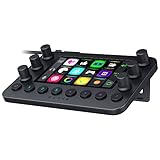
- All-in-one Stream Controller: Effortlessly manage your stream with shortcuts for multiple programs—organized through custom layouts and icons for intuitive use
- 12 Haptic Switchblade Keys: Bind an infinite variety of commands and macros. Customize their icons for easy visual navigation and adjust their haptic feedback for the ideal level of tactile response
- 6 Tactile Analog Dials: Conveniently tweak the levels of your audio, media, and other channels, as you manage it all at a glance using the controller’s dynamic LCD touchscreen
- 8 Programmable Buttons: Program them to instantly toggle between up to 8 different haptic key layouts, or simply used as a faster way to perform commonly used actions
- Designed for Efficient Multi-Tasking: Group commands into dedicated layouts and Dynamic Mode to automatically switch profiles based on the detected app
Prepare a clear graphic
Match the production canvas
Build the graphic at the same resolution as your production output. Keep the canvas transparent except for the nameplate or title treatment, and export as a PNG with transparency enabled. StreamYard’s guide uses 1280×720 as a baseline for a 720p workflow; that is not a universal requirement. Use the dimensions appropriate to your own output. StreamSlayers, for example, documents a 1920×1080 Browser source for its own setup, not as a general OBS rule.
StreamYard’s lower-third guidance covers transparent overlay assets and platform-specific dimensions and limits: How to use lower thirds. Check the current documentation for the specific service or graphic you use because file limits and supported formats can change.
Keep the text readable
- Use a short name, role, or segment label rather than a sentence.
- Choose strong contrast between the lettering and the nameplate background.
- Keep the graphic clear of faces and details viewers need to see on a shared screen.
- Use animation sparingly, and preview the result in motion as well as when it is still.
These are practical design recommendations, not a formal safe-area specification. Check your own program preview before the broadcast.
Choose another workflow when it fits better
| Workflow | Where it runs | Changing text during the show | What to plan for |
|---|---|---|---|
| Static image source | Desktop scene software such as OBS | Replace or edit the asset, or pair it with another text workflow | Prepare the image and layer it correctly in the scene |
| Browser-source graphic | OBS or another tool that accepts browser sources | Often controlled through an external page; features depend on the provider | Provider URL, source dimensions, and any separate control workflow |
| Built-in browser-studio graphics | The service’s browser production studio | May offer editable banners or speaker fields | Studio mode, plan, and feature access can apply |
| vMix GT title | vMix desktop production environment | Title input can be edited; confirm the workflow for the chosen template | Create a title template and cue it through an overlay channel |
StreamYard
StreamYard’s studio workflow uses its overlays panel to upload and toggle assets while live. Its lower-third guidance also describes using live banners for text that changes from speaker to speaker, rather than exporting a separate static image for each name. Consult the current official instructions for applicable dimensions, file formats, and limits: OBS overlay guide and lower-thirds guide.
Vimeo browser production tool
Vimeo’s Help Center says lower thirds are available when producing through its in-browser studio using “Stream through your browser.” Its documented workflow is to create graphics, add them to scenes, edit speaker name and title fields, then choose Show or Hide on the stage. The article states that access requires an Advanced or Premium plan, or an Enterprise plan with the Events feature added; confirm current availability before relying on those entitlements. See Vimeo’s lower-thirds instructions.
Rank #3

- This bundle includes a Fire TV Stick 4K Max and a Luna Controller – the essentials to get started with Luna, Amazon's game streaming service. Prime or Luna subscription required (subscriptions sold separately).
- Download the Luna app on your Fire TV, and play your favourite games straight from the cloud. No game console required.
- Prime members play Fortnite and a rotating selection of games at no additional cost.
- Subscribe to Luna Premium to access a growing selection of games across all genres. (subscriptions sold separately)
- Connect via Wi-Fi - Luna Controller connects directly to Luna servers using Cloud Direct technology for low-latency gameplay.
vMix
The vMix User Guide describes creating title and lower-third templates with GT Designer, adding a template through Add Input → Title, and using overlay-channel buttons to transition it in and out. The guide says animation support is available in the 4K and Pro editions, except included built-in GT templates, which work in all editions. Check the current edition details and template workflow in the vMix User Guide.
Browser-source services and optional controls
StreamSlayers documents adding its graphic as a Browser source at 1920×1080 and controlling it through its interface. It describes a Stream Deck plugin as optional: a physical control surface can cue graphics, but it is not needed to create a lower third or use the basic OBS Image-source method. See StreamSlayers’ OBS browser-source guide.
Free tools Windows power users keep installed
One-click scans. No signup required.
Rank #4
![AJAZZ Macro Keypad Stream Controller Deck Gaming Streaming Shortcut Keyboard, 6 Programmable Keys Customizable Visual AI Pad USB Soundboard for YouTube, Desk Office Setup, Laptop, PC, Mac [Macintosh]](https://m.media-amazon.com/images/I/31yKKDN8EAL._SL160_.jpg)
- Six Programmable Macro Keys: At the heart of the live streaming console lies its six customizable macro keys (six keys with LCD displays, three physical knobs, and three toggle switches). These keys offer unparalleled flexibility, allowing assignment of single or continuous actions to optimize workflows. Whether executing game combos, launching applications, or controlling media, their applications are limitless.
- One-Click Operation: Achieve instant execution with a single press through a customizable USB macro keyboard, putting efficiency at your fingertips. Instantly launch macro commands, input text, open files and websites, and control media with a single click. This intuitive design perfectly caters to the needs of gamers, streamers, and professionals, enabling you to execute tasks with speed and precision.
- Driver Software Settings: Simple drag-and-drop functionality allows you to assign desired actions to six customizable keys via drag-and-drop operations and configure their properties. This enables triggering single or multiple actions with a single key press. Intuitive and easy to understand, it offers a quick learning curve.
- Wide Compatibility: This live streaming controller offers a wealth of software, applications, and plugins—whether purchased from the store or downloaded directly to your computer. It seamlessly integrates with platforms like Streamlabs, Twitch, and YouTube on your streaming computer. You can also drag-and-drop, configure, and download directly from the console store, with a vast selection of plugins and icons to choose from, comprehensively enhancing your streaming setup experience.
- Exceptional Quality, Exceptional Value: The AJAZZ Computer Media Controller Board Macro Keyboard is crafted from premium materials and undergoes rigorous quality control to ensure lasting performance. Equipped with a variety of practical plugins—including schedule reminders, clock, stopwatch, weather, and calendar functions—it serves not only as a high-tech productivity tool but also as the perfect companion for your computer desktop. We provide 24/7 customer support and free software updates to help you achieve excellence.
Test and troubleshoot before going live
- The graphic is hidden behind the video: Move its source above the camera or video source in the OBS Sources list.
- The graphic has a solid box instead of a transparent background: Check that you selected a PNG exported with transparency enabled and that the file itself has transparent areas.
- The lower third is cropped or misplaced: Reposition and resize it in the preview, then check against the actual output resolution. Do not assume dimensions documented for one service apply to another.
- The text is hard to read: Shorten it, increase contrast, and preview it at the final stream size.
- The name does not update when the speaker changes: A static image will not update by itself. Replace or edit the asset, use a separate text workflow, or choose a graphic feature with live-editable fields.
- You cannot find the graphic’s on-air control: Determine whether the workflow uses OBS source visibility, a provider’s control page, a studio overlay panel, or a vMix overlay channel, then rehearse that exact action.
Or let it run in the cloud
If your production is a prerecorded video loop rather than a live camera show, StreamNeo keeps a YouTube channel live from uploaded videos. Upload a recording or build a playlist, add your YouTube stream key once, and go live; the cloud continues the stream without a computer or home connection staying on. It does not create lower-third graphics, and it is for uploaded video on YouTube, not a camera feed.
Each slot streams your video as uploaded, up to 4K 60fps, at one flat price per slot; there are no quality tiers. If YouTube drops the stream, StreamNeo automatically recovers. The first day is free with no card required. Monthly: $9.99 per month.
Quick Recap
Best Value

- SIMPLIFIED POWER MANAGEMENT: The Wireless Streaming Graphic Equalizer (EQ-595BT) includes a convenient integrated power on/off switch for the amplifier, eliminating the need for an additional external switch. This feature simplifies the setup process, offering a cleaner setup and direct power control from the equalizer itself, ensuring a more efficient and cohesive audio system design
- 4-BAND WIRELESS STREAMING WITH 15V LINE DRIVER: The Wireless Streaming Graphic Equalizer (EQ-595BT) offers advanced control over your audio, featuring 4 distinct frequency bands for precise audio shaping. Including a 15V audio signal line driver, provides a higher voltage signal to connected devices, ensuring clean, undistorted audio transmission, especially beneficial for high-power systems that demand superior signal integrity
- ADJUSTABLE SUBWOOFER FREQUENCY CONTROL: The EQ-595BT allows you to customize the subwoofer frequency cutoff between 50Hz, 80Hz, and 120Hz.This feature is essential for aligning the subwoofer with the main speakers in your system, ensuring balanced low-end response, and preventing undesirable frequency overlap or underperformance in different environments (home theater, car audio, live sound)
- CUSTOMIZABLE BACKLIGHT AND AESTHETIC CONTROL: The EQ-595BT features selectable backlight illumination, allowing users to choose between a cool blue or hot red hue to suit their visual preferences or match the overall aesthetic of the audio setup. This dynamic lighting feature enhances the look of the device while providing clear visibility of controls in various lighting conditions
- ENHANCED LOW-END PERFORMANCE: The Wireless Streaming Graphic Equalizer (EQ-595BT) includes specialized subwoofer output and adjustable level controls, offering users precise control over the bass frequencies. This ensures optimal low-end enhancement, delivering deeper, more dynamic bass that enriches the listening experience
See StreamNeo or start your free first day.
Product prices and availability are accurate as of the date/time indicated and are subject to change. Any price and availability information displayed on Amazon at the time of purchase will apply.




