Windows Errors? Fix Them Before They Spread
Repair common Windows errors and clear accumulated junk for a smoother, more stable PC - no reinstall needed.Free scan · no reinstallOutdated Drivers Are Slowing You Down
One free scan finds every outdated or missing driver and matches the right update for your exact hardware.Free scan · exact hardware matchMicrocooling could help agentic AI scale by removing heat close to the chips that generate it, while responsive controls adjust cooling as computing demand changes. But “microcooling” is not a standard category in the studies cited here, and there is no evidence that agentic AI inherently requires it. The case is a forward-looking one: more capable cooling and control may help data centers manage demanding AI workloads efficiently.
What does microcooling mean in this context?
Here, microcooling means cooling applied close to heat-generating chips or packages, rather than relying only on air movement across a server room. It is a useful working description, not a standardized system type established by the cited studies. A close-to-chip approach can be part of a larger cooling chain: heat still has to move through server, rack, and facility systems before it can be rejected outside.
As an Amazon Associate I earn from qualifying purchases.
This distinction matters because “liquid cooling” can describe systems at different scales. A liquid loop may collect heat near computing hardware, while pumps, valves, heat exchangers, and other facility equipment manage its movement and removal. The label alone does not establish where heat is captured, what equipment is controlled, or how much energy the whole facility uses.
Why might agentic AI increase the value of responsive cooling?
AI workloads make thermal management an infrastructure concern
High-performance computing and AI workloads place significant demands on data-center thermal management. An ASME-published study, “Understanding the Impact of Data Center Liquid Cooling on Energy and Performance of Machine Learning and Artificial Intelligence Workloads” (June 2025), found direct liquid cooling beneficial in the context it evaluated. That is evidence for the approach under those study conditions, not a universal finding that every AI facility should use the same cooling system.
#1 Best Overall

- An intelligent fan system designed for cooling audio video, DJ, server, network, and IT equipment racks.
- Protects rack-mount equipment from overheating, performance issues, and shortened lifespans.
- Programmable thermostat controller with automated speed control, alarm warnings, and backup memory.
- Premium anodized aluminum construction with CNC-machined detailing for a professional appearance.
- Size: 2U Rack Space | Design: Exhaust | Airflow: 50 to 220 CFM | Noise: 10 to 36 dBA | Bearings: Dual Ball
Agentic AI and cooling control are separate things
Agentic AI refers here to AI systems that can carry out multi-step tasks; it does not mean that the cooling equipment is itself controlled by an AI agent. As data centers serve changing workloads, operators may have reason to coordinate workload placement and cooling settings. A controller that responds to measured conditions could potentially help manage that coordination, but studies of such controllers do not establish that they are widely deployed or that they will improve every facility.
The possible link is therefore indirect: if AI workloads increase the need for efficient thermal management, cooling that captures heat near its source and controls that adapt to operating conditions may help support further deployment. Cooling is an infrastructure enabler in this argument, not a capability that makes an AI system agentic.
Rank #2
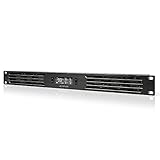
- An intelligent fan system designed for cooling audio video, DJ, server, network, and IT equipment racks.
- Protects rack-mount equipment from overheating, performance issues, and shortened lifespans.
- Programmable thermostat controller with automated speed control, alarm warnings, and backup memory.
- Premium anodized aluminum construction with CNC-machined detailing for a professional appearance.
- Size: 1U Rack Space | Design: Intake | Airflow: 20 to 60 CFM | Noise: 8 to 28 dBA | Bearings: Dual Ball
What do the studies actually show?
The published results below concern different methods and comparisons. They should not be read as a head-to-head ranking or as savings guaranteed at another data center.
The Tool Desk
Outbyte PC Repair FREEClear out junk files and repair common Windows errorsFree Scan →Outbyte Driver Updater FREEFix the driver behind crashes, sound loss and screen glitchesFind Drivers →| Study | What it examined | Reported result | How to interpret it |
|---|---|---|---|
| “Energy-efficient thermal management of air-liquid-cooled data centers via deep reinforcement learning,” Elsevier, March 2026 | Deep reinforcement learning for thermal management; the authors’ abstract reports comparative experiments conducted on the CINECA data center. | The authors report 11.68% lower cooling energy consumption. | A study-specific result for the reported experiments and comparison, not a general forecast for other facilities. |
| “Co-optimization of thermal-aware workload scheduling with deep reinforcement learning-based cooling control in data centers,” Elsevier, February 2026 | A method combining thermal-aware workload scheduling and cooling control, compared with a conventional control method. | The authors report up to 8.6% lower cooling-system energy consumption. | The “up to” figure belongs to that study’s method and baseline; it is not directly comparable with the CINECA result. |
| “Understanding the Impact of Data Center Liquid Cooling on Energy and Performance of Machine Learning and Artificial Intelligence Workloads,” ASME, June 2025 | Direct liquid cooling in the study’s evaluated AI and machine-learning workload context. | No percentage is stated here. | The authors conclude the approach is beneficial in the evaluated context; the conclusion does not settle what is best for every facility. |
The percentages measure cooling energy or cooling-system energy in particular studies, not a single standardized measure of total data-center energy. Different workloads, equipment, system boundaries, baselines, and evaluation methods can produce different results. Without a common test covering the same architectures and operating conditions, the figures do not show which cooling design is most efficient overall.
Rank #3

- An intelligent fan system designed for cooling audio video, DJ, server, network, and IT equipment racks.
- Protects rack-mount equipment from overheating, performance issues, and shortened lifespans.
- Programmable thermostat controller with automated speed control, alarm warnings, and backup memory.
- Premium anodized aluminum construction with CNC-machined detailing for a professional appearance.
- Size: 2U Rack Space | Design: Intake | Airflow: 50 to 220 CFM | Noise: 10 to 36 dBA | Bearings: Dual Ball
How could autonomous cooling control work?
A cooling controller can make decisions about system settings based on operating conditions. The LC-Opt benchmark, described in NeurIPS 2025 proceedings and on the Oak Ridge National Laboratory research portal, is built on a digital twin of the cooling system at ORNL’s Frontier supercomputer. Its modeled control scope includes coolant supply temperature, flow rate, cabinet-level valve actuation, and cooling-tower setpoints.
That scope illustrates why cooling control can involve more than one local setting: choices at the coolant, cabinet, and facility levels interact. LC-Opt provides a research benchmark for testing control approaches in a modeled environment. It is not evidence that a commercial system is available, that its results transfer unchanged to another data center, or that agentic cooling control is broadly in production.
Rank #4

- Adjustable temperature control helps ensure optimal performance for rackmount such as network, server, music, and AV cabinets
- Noise controlled fans makes the cooling system useful for a quiet office or business space
- Compact design mounts to any 19" inch cabinet and takes up only 1 unit of space
- Simple and easy to use LCD display allows user to control temperature
- Air pumped through to the top exhaust system of the fan
What would a data-center operator need to assess?
A decision about close-to-chip or liquid cooling cannot be made from a headline efficiency percentage alone. Operators need to evaluate how a system fits their workload and facility, and whether measured gains persist under the conditions that matter to them.
- Heat capture point: Establish whether the design collects heat at the chip or package, server, rack or cabinet, or farther downstream. “Microcooling” by itself does not specify this boundary.
- Control scope: Identify which variables are adjustable, such as coolant temperature, flow, valves, air-side equipment, or workload placement. A controller that changes one setpoint is not equivalent to one coordinating several layers.
- Performance and safety: Assess thermal limits alongside workload performance. Lower cooling energy is not enough if the evaluated operating conditions do not meet the facility’s requirements.
- Energy boundary: Check whether a reported figure covers cooling equipment alone or a wider facility boundary. Do not treat cooling-system savings as the same thing as total data-center energy savings.
- Evidence type: Distinguish hardware or facility evaluation from simulation and benchmark results. A digital twin can support controlled testing, but it is not a substitute for confirming performance in a target environment.
- Integration and variability: Consider how the design and control method interact with existing infrastructure and changing workloads. Results from one control method or facility need not carry over unchanged.
Is microcooling a critical enabler of agentic AI?
It could become an important enabler if AI infrastructure needs more capable ways to manage heat and if close-to-chip cooling and responsive control prove effective in real operating environments. The studies cited here support interest in liquid cooling and in reinforcement-learning-based thermal management; they do not establish a standardized “microcooling” category, widespread agentic cooling deployment, or a requirement that agentic AI use a particular cooling architecture.
Best Value

- An intelligent fan system designed for cooling audio video, DJ, server, network, and IT equipment racks.
- Protects rack-mount equipment from overheating, performance issues, and shortened lifespans.
- Programmable thermostat controller with automated speed control, alarm warnings, and backup memory.
- Premium anodized aluminum construction with CNC-machined detailing for a professional appearance.
- Size: 3U Rack Space | Design: Intake | Airflow: 60 to 300 CFM | Noise: 12 to 38 dBA | Bearings: Dual Ball
The defensible conclusion is conditional: cooling can help make AI infrastructure more practical to operate, but the evidence does not show that microcooling alone enables agentic AI. The value of any approach depends on the facility, workload, system boundaries, and measured outcomes.
Quick Recap
Product prices and availability are accurate as of the date/time indicated and are subject to change. Any price and availability information displayed on Amazon at the time of purchase will apply.




