Quick wins for a faster PC:
Scan for outdated or missing drivers - takes under a minuteDriver Scan →Repair Windows errors before they cause bigger problemsFix Now →Fix the driver behind crashes, sound loss and screen glitchesFind Drivers →Machines process images as numerical data, then learn patterns from examples to predict what a new image contains. In image classification, for instance, a model trains on photos labeled with categories such as “cat” and “dog.” Other computer vision tasks locate objects or outline their regions, producing more detailed outputs than a single label.
How an image becomes information a model can use
A digital image may look like a picture to us, but a model receives numbers. Image data is commonly represented as a tensor: a structured array of numerical values that encodes the image’s pixels. Microsoft’s Introduction to Computer Vision with TensorFlow introduces this representation alongside neural networks used for image tasks.
As an Amazon Associate I earn from qualifying purchases.
Those numbers are not a ready-made description of what is pictured. They encode visual measurements. A model must learn which patterns in those measurements are useful for the task it has been given.
How supervised image classification learns
1. Choose the categories
First define the output categories the model should recognize, such as cats and dogs. The categories need to match the question the model is expected to answer.
#1 Best Overall

- Ultra High Definition 8000x6000 Lightburn Camera for Laser Engraver, USB2.0 Machine Vision Industrial Camera for Computer,Raspberry Pi
- Super Image reality, real color reproduction, ultra crystal shooting image. The camera works like human eye, get sharp image and accurate color reproduction in every detail
- 5-50mm Zoom Lens, Pro industrial grade 12mp ultra hd optical zoom lens, manual focus, iris and zoom. Pefect for close-ups and quality inspection
- USB Plug & Play, UVC compliant usb camera, just connect the camera to PC, laptop, Android device or Raspberry Pi with the included USB cable without extra drivers to be installed.
- Wide Applications: Well used for industrial camera, Medical device, Quality Inspection, Scientific research and development, image processing, computer and machine vision.
2. Prepare labeled examples
Provide example images with their correct labels. In supervised learning, those labels show the model the target answer for each training example. Google’s ML Practicum: Image Classification uses cat-versus-dog photos to illustrate this setup.
3. Train the model to connect patterns with labels
During training, the model adjusts its internal parameters so its predictions better match the supplied labels. A convolutional neural network (CNN) is a common architecture taught for image classification. Rather than relying on a person to write a separate visual rule for every variation, the network learns useful patterns from the examples.
Microsoft’s introductory module covers CNNs as well as dense neural networks. The exact model design depends on the task; the central idea is that the examples shape the model’s parameters and the resulting predictions.
Rank #2

- 2MP Global Shutter & 90fps High Frame Rate: This camera features a 2MP global shutter sensor and up to 90fps high-speed frame rate, effectively eliminating motion blur and distortion. It delivers stable and clear images for fast-moving objects, ideal for high-speed capture, motion detection and industrial applications.
- 2.8-12mm 4X Manual Varifocal Zoom Lens: Equipped with a 2.8‑12mm varifocal CS mount lens supporting 4X manual zoom. You can freely adjust focal length, focus and field of view to meet various needs from wide viewing to close‑up detail capture.
- Strong System & Device Compatibility: UVC compliant plug‑and‑play design with no driver required. Fully compatible with Windows, Linux, Jetson Nano and embedded systems, supporting stable long‑time working for industrial and daily use.
- Wide Software Support: Perfectly works with Lightburn, OpenCV, machine vision software, live streaming tools and video monitoring programs. Great for laser engraving monitoring, machine vision, production detection and live broadcast.
- Versatile Wide Applications: Widely used in industrial inspection, machine vision, Lightburn monitoring, USB video microscope, live streaming, high-speed recording, security monitoring and embedded projects.
4. Apply the trained model to a new image
Once trained, the model can produce predictions for images it was not given as labeled training examples. A prediction is an output of the trained system, not proof that the system understands the picture as a person would.
Why the same object can look different to a model
Pixel values change when an object moves within the frame, the background changes, lighting shifts, the camera angle differs, or the image is out of focus. Google’s practicum explains why simply averaging pixels across example images is not a reliable way to recognize an object: those variations can make the averages uninformative.
Earlier image-recognition workflows often relied on manually engineered features such as color, texture, or shape. Those features could require substantial tuning. Neural networks instead learn representations from training examples, though their usefulness still depends on the examples and task.
Rank #3

- Day/Night Vision: IR-CUT Filter switched in and out automatically based on light condition (only visible light during the daylight and infrared sensitivity during the night with 850 IR LEDs on)
- HD Resolution: This camera adopts 2MP OV2710 sensor for sharp image, Max. resolution: 1920*1080
- High Frame Rates: 30fps@320*240, 352*288, 640*480, 800*600, 1024*768, 1280*720, 1280*960, 1280*1024, 1920*1080; YUY2 30fps@320*240 15fps@640*480 20fps@800*600 10fps@1024*768, 1280*720; 5fps@1280*960,1280*1024,1920*1080; High speed USB 2.0 interface.
- Plug&Play: UVC-compliant, just connect the camera to PC, laptop, Android device or Raspberry Pi with the USB cable without extra drivers to be installed.
- Applications: this mini 38mmx38mm camera board can be installed in most hidden and narrow position for a home surveillance system, wildlife photography, dashcam, baby camera, etc.
Classification, detection, and segmentation are different outputs
“Understanding an image” can refer to several distinct computer vision tasks. They differ in what the system returns and how precisely it identifies visual content.
| Task | What the output says | What training data must identify |
|---|---|---|
| Image classification | One or more categories for the image as a whole. | The image’s category label or labels. |
| Object detection | Which objects appear and where they are located. | Object labels and locations. |
| Instance segmentation | Which separate object instances appear and which image regions belong to them. | Object identities and their regions. |
Microsoft’s AutoML computer vision documentation lists classification, object detection, and image instance segmentation as separate task types. Its computer vision data schema documentation describes data formats for image tasks.
These names describe the task and its outputs. They should not be read as evidence that a model comprehends an image in the human sense.
Rank #4

- 1) Camera transfer speed is fast.
- 2) Provide SDK, easy to use and convenient.
- 3) Support external trigger and flash.
- 4) SDK supports Windows and Linux systems.
- 5) SDK supports VC/C++, VB6, VB.NET, Delphi, C#, JAVA, Python, OpenCV.
Why transfer learning can make a new task easier
Training every part of a model from scratch can require considerable data and computing resources. Transfer learning starts with a model already trained on another task and adapts it to a related one. The idea is to reuse visual representations learned earlier instead of learning every useful pattern anew.
In Microsoft’s ML.NET image-classification workflow, frozen layers of a pretrained TensorFlow model process images into features; a later task-specific stage learns the new categories. This approach can help when the pretrained model’s learned representations are relevant to the new task. It does not guarantee good results if the tasks or images differ too much.
Microsoft’s ML.NET classification tutorial describes the pretrained-feature workflow. Its automated visual inspection tutorial applies transfer learning to classify concrete surfaces as cracked or uncracked. That example explains a workflow; it does not establish that a particular model is safe or suitable for real infrastructure inspections without validation.
Best Value
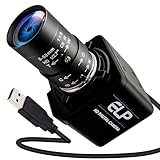
- Global Shutter 90fps High Speed Camera: Equipped with global shutter technology and up to 90fps high frame rate, effectively eliminates motion blur and distortion, perfect for capturing fast-moving objects in golf swing analysis, 3D printing monitoring and high-speed motion recording.
- 5-50mm Varifocal Lens with 10X Zoom: Features a 5-50mm adjustable varifocal lens, providing 10X manual zoom for flexible viewing distance and frame adjustment, allowing you to get clear and detailed images without changing lenses.
- UVC Compliant & Plug and Play : Adopts standard UVC video protocol, no extra driver required. Simply plug into the USB port to use instantly, saving time and effort for quick setup on various devices and applications.
- Wide Compatibility for Multi Devices: Works seamlessly with laptops, Android devices, Raspberry Pi and more industrial or DIY platforms, ideal for machine vision, industrial monitoring, computer vision projects and home experimental applications.
- Stable Performance for Professional Scenarios: Built for long time continuous operation, delivering stable video output and clear imaging for golf swing analysis, 3D printer monitoring, industrial inspection and other high speed capture tasks.
What the examples show—and what they do not
A cat-versus-dog classifier illustrates the basic supervised-learning loop: select categories, label example photos, train a model, and use it to predict a category for another image. A cracked-versus-uncracked concrete classifier illustrates how transfer learning can adapt a pretrained image model to a more specialized classification task.
In either case, the output answers only the question the task defines. A classification label does not give object locations; detection does not necessarily outline every object pixel; and a tutorial example alone does not establish performance in a different setting.
Quick Recap
How to think about a computer vision result
- Ask what output the task is designed to produce: a whole-image category, object locations, or separate object regions.
- Remember that the model learned from examples and their labels, not from human-like experience of the scene.
- Consider whether the images and task resemble those used to train or adapt the model; transfer learning is most useful when the learned visual patterns carry over.
Product prices and availability are accurate as of the date/time indicated and are subject to change. Any price and availability information displayed on Amazon at the time of purchase will apply.
Free tools Windows power users keep installed
One-click scans. No signup required.




