Not yet: no complete system has been shown producing drinkable water on the Moon. NASA and its partners are developing technologies to find icy lunar soil, extract and collect water-bearing material, remove dust and other volatiles, and condition the result for a specific use. Drinking water, astronaut-use water and ultrapure water for an electrolyzer are distinct requirements.
What “making Moon water drinkable” means today
Lunar water extraction is a technology-development goal, not a demonstrated lunar water service. NASA’s in-situ resource utilization overview, last updated July 26, 2023, describes demonstrations of excavation, processing and commodity-production technologies using simulated extraterrestrial materials and terrain. It also says those analog tests were short-duration and conducted under Earth conditions.
As an Amazon Associate I earn from qualifying purchases.
The resource itself is not fully mapped. Its location, physical form, concentration, distribution and accessibility remain open questions, especially in permanently shadowed regions where water-bearing regolith is a target for exploration. A machine that detects possible water is therefore not the same as one that extracts it, and extraction is not the same as purification.
How a lunar water system could work
1. Locate and measure water-bearing soil
Before designing a production system, missions need to learn where volatiles occur and in what form. NASA’s explanation of lunar water extraction describes prospecting as a necessary step. The PRIME-1 instrument suite illustrates the distinction: its TRIDENT drill is designed to bring subsurface samples to the surface, while the MSolo mass spectrometer evaluates water and other volatile emissions. These instruments investigate the resource; they are not a water plant or a supply of drinking water.
#1 Best Overall

- Removes Bacteria & Parasites: The Microfiltration Membrane Removes 99.999999% of Waterborne Bacteria (Including E. Coli and Salmonella), and 99.999% of Waterborne Parasites (Including Giardia and Cryptosporidium) - Essential for Your Survival Kit
- Removes Microplastics: Removes the Smallest Microplastics Found in the Environment (Down to 1 Micron), and Reduces Turbidity Down to 0.2 Microns - Ideal for Hiking and Camping Essentials
- Rigorous Testing: All Claims Are Verified with Laboratories Using Standard Testing Protocols Set by the US EPA, NSF, ASTM for Water Purifiers
- Long Lifetime: The Microbiological Purification System Will Provide 4,000 Liters (1,000 Gallons) of Clean and Safe Drinking Water - a Must-Have for Your Bug Out Bag
- Make an Impact: For Every LifeStraw Product Purchased, a School Child in Need Receives Safe Drinking Water for an Entire School Year. Essential Camping Accessory Made With BPA Free Materials
2. Excavate or drill icy regolith
Once a useful deposit is characterized, equipment would have to reach and collect it. NASA’s ISRU overview describes drilling or excavating regolith deposits as part of the broader resource-use process. The engineering challenge is not simply digging: the system must work with abrasive, dusty material in a difficult environment, and its scale and operating duration must match a mission’s needs.
3. Release or capture the water-bearing material
One family of approaches heats icy soil so that ice sublimates into vapor, which can then be captured. NASA’s Aqua Factorem concept proposes a different route: sort frozen ice grains from surrounding mineral grains without first changing the ice’s phase. The article presents reduced power use as a concept estimate, not as a measured result from an operating lunar system. These approaches are not established head-to-head winners; they differ in energy demands, material handling and how collection would be arranged.
Rank #2

- CLEAN WATER ANYWHERE: Our water filter straws solve the real challenge of being on the move, finding water is rarely the problem, finding water that's safe to drink is. Each filter removes over 99.99% of waterborne bacteria and parasites so you stay properly hydrated and in the best shape possible
- LIGHTWEIGHT & PORTABLE: Our filters weigh only 2 oz and measure 8 inches long, so you can take them with you anywhere. Be prepared when camping, hiking, enjoying the outdoors, or when facing unexpected situations such as natural disasters, accidents, or just about anything
- HIGH LEVEL FILTRATION: Each of the 5 filters removes over 99.99% of waterborne bacteria (such as E. coli and Legionella) and over 99.99% of waterborne parasites (such as Giardia and Cryptosporidium), including the smallest microplastics found in the environment, down to 0.1 micron
- LASTS UP TO 10 YEARS: Each filter reaches up to 1800 gallons, providing up to 10 years of drinking water for the average person. Built BPA-free, FDA-compliant, manufactured under rigorous quality control standards and tested regularly for performance, individually sealed with its own backflushing plunger
- EMERGENCY PREPAREDNESS: Keep this lightweight filter when backpacking, fishing, hiking, camping, hunting, or exploring the wilderness. Perfect for power outages, hurricanes, earthquakes, floods, and storms. Keep a set in your car or bugout bag, so you're always prepared wherever life takes you
4. Separate water from dust and other volatiles
Collected material may include mineral dust and volatile compounds besides water. A NASA technical assessment, Technology Assessment for Producing Propellant From Lunar Water, discusses freeze distillation to separate water from other volatiles and sub-micronic filtration to reduce dust. NASA’s ICICLE cold-trap project describes a component intended to collect water from sublimation-mining or filtration architectures while rejecting other volatile gases. A completed project record is not evidence that the hardware has been deployed or operated on the Moon.
5. Purify to the standard required by the next step
“Pure enough” depends on the intended use. The NASA technical assessment says proton-exchange-membrane (PEM) electrolysis requires ultrapure, deionized feed water, with a cited resistivity threshold greater than 10 megaohm-centimeters. In the described process, deionization follows freeze distillation and filtration. That specification concerns electrolyzer feed water; it does not report human consumption testing of water extracted from the Moon.
Rank #3
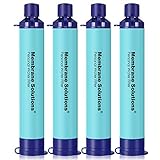
- Drink Anywhere, Certified by Science - This survival-grade straw filter meets strict NSF/ANSI 42, 372, 401 standards (Test Report: NBF21-004693-01). It instantly removes 99.9999% of total coliforms (including E. coli and other representative organisms). It’s designed for extreme reliability during hiking, camping, international travel, or emergency preparedness—proven by science, trusted by adventurers.
- Triple NSF Certified for Complete Reliability & Superior Taste - Breathe easy with every sip. Our straw is independently certified to NSF/42 (for chlorine & taste improvement), NSF/372 (lead-free materials), and NSF/401 (reducing microplastics and particulate). This triple verification guarantees you get the best-tasting water while keeping metals, microplastics and particulate at bay.
- Portable & Long Life-Span - This straw filtration at only 7.1'' long and 1" in diameter fits any 28mm threaded bottle, cup, or glass. It weighs just 2 ounces and fits in the palm of your hand, pocket, gym bag, backpack, survival pack or purse. Both ends of the Upgrade water filter straw are removable for extend Longer Lifespan ensuring it provides up to 1,320 gallons (5,000 liters) of drinking water. Don't miss this opportunity to drink water conveniently wherever you go.
- 5-Stage Filtration - Our Upgrade 5-Stage Filtration System includes a coarse filter screen, double layer pp cotton fiber, coconut shell activated carbon and hollow fiber ultrafiltration membranes. Flexible use of threaded water inlet cap to easy backflush. (IT DOES NOT LOWER TDS VALUE, ensuring water's essential mineral balance remains untouched.)
- 0.1 Micron Pore Size & Balanced Flow Rate - This water filter straw features a 0.1 micron pore size, designed to help improve filtration precision. It delivers a flow rate of up to 16.9 fl oz/min (500 ml/min) for a balance between filtration performance and drinking speed, making it suitable for outdoor, travel, and emergency use.
6. Use the water—or split it into gases
Water could support life-support needs, while electrolysis can split it into hydrogen and oxygen. Those are different outputs: producing propellant ingredients does not itself establish that water is safe to drink. NASA’s IHOP project update describes an effort to integrate water purification with hydrogen-and-oxygen production components, but reports that its planned long-duration integrated test was not achieved during the project option period.
What NASA’s project status does—and does not—show
The IHOP update, dated February 13, 2026, reports an Ionomer-membrane Water Processor at Technology Readiness Level 5 and a water electrolyzer at Level 4; the planned Level 5 for the electrolyzer was not reached. The update lists target production metrics of 1.34 kg/hour of water, 0.14 kg/hour of hydrogen and 1.16 kg/hour of oxygen. These are project targets, not achieved lunar production rates.
Rank #4

- Ideal for outdoor recreation, hiking, camping, scouting, domestic or international travel, and emergency preparedness
- High-performance 0.1 micron absolute inline filter fits in the palm of your hand and weighs just 2 ounces; 100% of MINI units individually tested three times to performance standards by Sawyer
- Attaches to included drinking pouch, standard 28 mm disposable water bottles, hydration packs, or use the straw to drink directly from your water source
- Removes 99.99999% of all bacteria (Salmonella, Cholera, and E. coli); removes 99.9999% of all protozoa (such as Giardia and Cryptosporidium); also removes 100% of microplastics
- Filter rated up to 100,000 gallons; Includes one Sawyer MINI filter, 16-ounce reusable squeeze pouch, 7-inch drinking straw, and cleaning plunger.
Together, these details describe developing components and integration work, not a complete operational system making potable water on the lunar surface. The distinction matters because prospecting, extraction, volatile separation, purification, and verification for human consumption each answer a different engineering question.
Independent reader supportYour contribution helps us test, update, and keep practical guides available for everyone.Why the proposed technology is difficult to validate
- Unknown resource conditions: the location, distribution, concentration and accessibility of polar volatiles are not fully characterized.
- Different environments: NASA says prior ISRU analog demonstrations validated hardware and concepts only for short durations under Earth conditions. Higher production rates, simulated space conditions and longer mission durations remain development needs.
- Multiple outputs and purity standards: water intended for people is not interchangeable with water prepared for a particular industrial process, and electrolyzer specifications should not be mistaken for drinking-water certification.
- System integration: a drill, filter, cold trap or electrolyzer can be useful as an individual component without proving that a full chain can operate reliably at lunar scale.
NASA’s lunar surface technology overview, accessed October 7, 2026, places resource use within a broader technology-development effort. The evidence described here supports a future capability under development, not a claim that lunar water is already being made drinkable.
Quick Recap
Best Value

- LifeStraw Go Series is the ULTIMATE SIDEKICK. The BPA-Free bottle filters out nasties so you can fill up from airport bathrooms, a tap in Mexico, or a gas station while road-tripping
- IMPROVES TASTE: the Carbon filter reduces chlorine, odors + organic chemical matter
- FILTERS OUT CONTAMINANTS: the Membrane microfilter protects against 99.999999% Bacteria (including E.coli + Salmonella), 99.999% Parasites (including Giardia and Cryptosporidium), 99.999% Microplastics, sand, dirt, and cloudiness
- LONG LASTING: The membrane microfilter lasts up to 1,000 gal (4,000 L) - about five years of daily use. Carbon filter lasts up to 26 gallons (100 L) - about two months
- SAVES WASTE: The membrane microfilter lasts up to 4,000 liters. That’s 8,000 single use plastic water bottles out of our parks, our oceans, and our communities
Product prices and availability are accurate as of the date/time indicated and are subject to change. Any price and availability information displayed on Amazon at the time of purchase will apply.




