Recommended Free Tools
Free space optics (FSO) is wireless communication that transmits information using light through open space between a sending terminal and a receiving terminal. It does not need a continuous fibre cable between those terminals, but the beam must reach the receiver and the equipment must operate as designed.
How free space optics works
A transmitter encodes information onto an optical signal and directs it toward a receiver. The receiver detects the light and decodes the information. In spacecraft communications, NASA describes optical communications as using laser-transmitted light rather than radio frequencies; common wavelengths include near-infrared examples such as 1064 nm and 1550 nm. NASA SmallSat Institute

As an Amazon Associate I earn from qualifying purchases.
FSO names the wireless optical link, not a particular networking protocol. It is also distinct from fibre: fibre carries light inside a physical cable, while FSO sends light across an open path. Terrestrial interface standards may address both FSO and fibre interfaces. ITU-T G.641 work item
Where FSO is used
Space communications
Optical links can support spacecraft communication functions such as uplinks for commands, downlinks for data, and crosslinks between spacecraft. NASA also uses the terms “laser communications” and “lasercom” in this context. NASA SmallSat Institute
Terrestrial communications
On Earth, FSO can be considered for short-reach links such as mobile backhaul, or where laying cable is impractical, including temporary or emergency connections and paths across geographic obstacles. These are possible applications, not guarantees that a link will be available or dependable at a given site. ITU-T G.641 work item
What affects an FSO link
Because the beam is narrow, terminals need accurate pointing and alignment. The same narrow beam can support high-capacity communications, but it makes the path and mounting important. NASA: Laser Communications
Rank #2
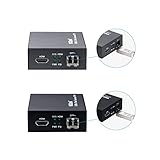
- Supports HDMI 1.4a signal, 4Kx2K@30Hz, 3D video.
- 2pcs free SFP+ LR Lite Transceiver with link length up to 2km included.
- SFP+ port is designed to meet transceivers with different link lengths.
- The DVD side should be linked to signal source and TV side should be linked to display device; reverse usage is forbidden.
- RAW signal transmission, uncompressed audio and non-delay.
For terrestrial links, the atmosphere can attenuate or disturb the signal. Clouds and weather, turbulence-related scintillation, ambient light, path characteristics, and terminal mounting all matter. ITU-R’s terrestrial FSO design recommendation covers these factors, along with geometrical and atmospheric attenuation and link-margin calculation. ITU-R P.1814-1, September 2025
Crashes, No Sound, or Screen Glitches?
Random freezes, missing sound and display glitches usually trace back to one bad driver. Find and replace yours safely.Free scan · under a minutePC Slower Than It Used to Be?
A free scan shows the junk files, broken settings and background clutter dragging Windows down - then fixes them in one click.Free scan · Windows 10 & 11Consequently, there is no universal FSO speed, range, or uptime figure that applies to every installation. Capacity depends on the equipment and link conditions, while practical availability depends on the path and its exposure to propagation effects. A specific deployment needs a link analysis rather than a general promise.
Rank #3

- UPGRADE NETWORKS WITH COPPER-TO-FIBER CONVERSION: Convert 100M to 10GBASE-T copper (RJ-45) to 10G fiber using an open SFP+ slot; supports multimode or single-mode transceivers (e.g., 10GBASE-SR/LR) for flexible deployment and extended reach
- FLEXIBLE MOUNTING: Use as a compact standalone unit or mount to a wall, rack, DIN rail (ADJDINKIT) or chassis (MCM7-MEDIA-CHASSIS, MCM15-MEDIA-CHASSIS) for clean, professional integration into structured wiring closets, data centers, or server rooms
- STANDARDIZE NETWORK CONVERSIONS:: Plug-and-play installation supports auto-negotiation of 100Mbps, 1/2.5/5/10Gbps copper speeds, 16K Jumbo Frames, and full-duplex flow control, helping IT deploy one media converter across networks with different speeds
- DEPLOY EFFICIENTLY IN COMPACT, POWER-SENSITIVE SPACES: Consumes only 3.75W (typical) via 5V DC input from included power adapter or chassis power supply and rated for 0°C to 50°C operating environments; Does not support PoE
- THE IT PRO'S CHOICE: Designed for reliability in edge and on-prem deployments, our media converters are lab-tested and field-proven for seamless integration and maximum uptime; Backed by free lifetime 24/5 multi-lingual technical assistance
FSO compared with radio and fibre
| Connection type | What carries the signal | Key practical consideration |
|---|---|---|
| FSO | Optical light across open space | Requires a clear, accurately aligned optical path; terrestrial performance is affected by atmospheric conditions. |
| Radio frequency (RF) | Radio waves | Uses radio-frequency bands rather than an optical carrier; the right comparison depends on the system and deployment. |
| Fibre | Optical light inside a physical cable | Needs a cable route; it is not a wireless link. |
Optical systems have much narrower beams than RF systems and can offer substantial bandwidth potential, but that does not establish a specific throughput advantage for every real-world installation. NASA identifies higher data rates as a potential advantage of optical communications while also noting pointing accuracy and atmospheric interference as challenges. NASA: Laser Communications NASA SmallSat Institute
FSO is therefore not automatically a replacement for RF or fibre. The choice depends on the route, weather exposure, required availability, link budget, and whether terminals can be mounted and aligned reliably. No general cost or availability figure follows from the technology definition alone.
Quick Recap
Best Value

- LC Uniboot Connectors - Space-saving: LC duplex connector with uniboot is two LC connectors encased in a common housing with one boot, terminated on a single twin-fiber round cable. By using cable assemblies with LC Uniboot connectors, half of the space can be saved over traditional duplex cable. Uniboot single jacket patch cables make patch panel cable management becames considerably easier. Ideal for high-density cabling application.
- Reversible Polarity of Uniboot Connectors - easy polarity changing: Unlike common LC patch cords, this switchable uniboot cable supports the polarity to be switched without connector re-termination. Polarity changes can be made in the field quickly (By switching the A and B positions in the connector for each fiber), without the use of tools, to the correct fiber mapping polarity. No damage to fiber.
- Bangun LC to LC Multimode Duplex fiber patch cords terminated with Foxconn precision ceramic ferrule LC/PC fiber patch cable connectors, insuring low insertion loss(less than 0.15 dB) for faster speed network performance.
- WIDE APPLICATION: LC LC Fiber Patch Cable (OM3) LOMMF connects to 10GBase-SR, 10GBase-LRM, SFP+ and QSFP+ transceivers for 10Gb networks. This LC LC OM3 Patch Cable works with all brands of multimode SFP transceivers and fiber optic networks.
- Product details: LC/PC-LC/PC, Duplex, Multimode, OM3, 50/125. Jacket Material: Low-Smoke, Zero Halogen (LSZH) jacket. Jacket Color: Aqua. OD: 3.0mm.
Rank #4

- LC Uniboot Connectors - Space-saving: LC duplex connector with uniboot is two LC connectors encased in a common housing with one boot, terminated on a single twin-fiber round cable. By using cable assemblies with LC Uniboot connectors, half of the space can be saved over traditional duplex cable. Uniboot single jacket patch cables make patch panel cable management becames considerably easier. Ideal for high-density cabling application.
- Reversible Polarity of Uniboot Connectors - easy polarity changing: Unlike common LC patch cords, this switchable uniboot cable supports the polarity to be switched without connector re-termination. Polarity changes can be made in the field quickly (By switching the A and B positions in the connector for each fiber), without the use of tools, to the correct fiber mapping polarity. No damage to fiber.
- Armored Fiber Optic Cable: This LC fiber jumper cable built-in a stainless steel tube inside to protect the inner core(fiber glass) from damage like pet chew. it remains all the features of a standard patch cord, but is much stronger. Pressure resist, Wear resist and Heat Resist.
- IMPORTED CORE: Bangun uniboot fiber patch cables manufactured with industry-leading Corning G.657.A2 optical fibres(which are fully compatible with G652D fibres but is less bend-sensitive - as low as 7.5mm radius), The G657A2 is a powerful solution for access networks where frequent bending and joining of cables and hardware miniaturization is observed.
- Bangun LC to LC Single mode Duplex uniboot fiber patch cords terminated with Foxconn precision ceramic ferrule LC/PC fiber patch cable connectors, insuring low insertion loss(less than 0.15 dB) for faster speed network performance.
Standards that address FSO design and compatibility
- ITU-R P.1814-1: A September 2025 recommendation covering prediction methods for terrestrial FSO link design, including weather, attenuation, scintillation, ambient light, mounting, and link margin. Recommendation details
- ITU-T G.641: A work-programme item for terrestrial FSO mobile backhaul with short-reach interfaces, covering FSO and fibre interfaces; the page lists approval on November 29, 2025. Work item details
- ITU-T G.640: An in-force recommendation, dated March 2006, describing a procedure to assess interference between co-located FSO transmission systems. Recommendation details
Product prices and availability are accurate as of the date/time indicated and are subject to change. Any price and availability information displayed on Amazon at the time of purchase will apply.
Do these 3 things before closing this tab:
1Fix the driver behind crashes, sound loss and screen glitches2Clear out junk files and repair common Windows errors3Scan for outdated or missing drivers - takes under a minute



