Drone traffic management systems reduce collision risk by helping operators share planned flights, identify overlapping routes and times, and coordinate changes before flights conflict. They are not a universal collision-avoidance autopilot: operators still have safety responsibilities, and avoiding crewed aircraft is a separate problem from deconflicting planned drone flights.
What a drone traffic management system does
In the United States, the FAA calls this ecosystem UAS Traffic Management, or UTM. It is designed to support drone operations at low altitude through a distributed network connecting operators, UAS Service Suppliers (USSs), supplemental data services, and FAA information. Its functions can include flight planning, authorization, surveillance, and conflict management.
As an Amazon Associate I earn from qualifying purchases.
UTM is separate from conventional air traffic services, but the two can complement one another. A USS helps its users exchange and act on relevant operational information; it does not mean that an air traffic controller is monitoring and separating every drone. The FAA’s UTM overview, last updated May 2, 2025, describes the framework and its ongoing development.
Do these 3 things before closing this tab:
1Scan for outdated or missing drivers - takes under a minute2Repair Windows errors before they cause bigger problems3Fix the driver behind crashes, sound loss and screen glitchesThe key idea is coordination: operators share flight intent and use information about other planned operations and airspace constraints to make safer plans. The FAA Aeronautical Information Manual puts it this way: “Operators share their flight intent with each other and coordinate to de-conflict and safely separate trajectories.” That is a planning-and-coordination model, not a promise that every aircraft is continuously detected and automatically steered away from an imminent collision.
#1 Best Overall

- There is a difference between black and yellow coloured wires for this sensor part, there is no difference in function. Colours are shipped randomly
- Front Vision Forward Facing Vision Positioning Sensors Avoidance Sensor Repair Parts
- Ensure optimal performance and safety for your Front Vision Forward Facing Vision Positioning Sensors.
- These essential repair parts are specifically designed to replace damaged or faulty sensors, ensuring that your drone's obstacle avoidance system operates flawlessly. Featuring seamless compatibility with
- these sensors provide accurate and reliable obstacle detection and avoidance capabilities. By replacing damaged sensors with these high-quality parts, you can trust in the safety and reliability of your drone during flight.
How the collision-prevention loop works
The FAA’s UTM Concept of Operations describes a process that begins with proposed operations and can continue as plans or constraints change. An operation’s route is considered in both space and time, so two flights are not judged only by whether their maps overlap: their expected use of the overlapping area matters too.
- Submit initial operation details. An operator provides its USS with information such as the intended operating area and time. The USS gathers relevant intent from its own users and, through network discovery and exchange, from other USSs. Planning may also take airspace constraints and other data into account.
- Develop a route and operation volumes. The operator plans a nominal four-dimensional route: location plus time. The USS applies performance buffers to define segments of an operation volume, including expected entry and exit times. These volumes represent the space and time an operation is expected to use, rather than just a line drawn on a map.
- Check for conflicts. The USS compares those volumes and times with other planned operations. A possible conflict can arise when planned operations overlap in space and time. This check is intended to identify a problem early enough for operators to coordinate a change.
- Resolve planned conflicts. Operators can change when an operation enters or exits a volume, change its lateral or vertical boundaries, or combine timing and spatial changes. If an operator cannot resolve the conflict alone, operators can coordinate through their respective USSs.
- Continue to account for constraints. Operators receive applicable real-time airspace constraints and remain responsible for operating safely. The coordination is primarily digital and distributed; it is not equivalent to routine voice separation instructions between each remote pilot and a controller.
This sequence is described in the FAA’s UTM Concept of Operations, Version 2.0, dated August 16, 2022. The particular details available to an operator depend on the service and operation; the concept document should not be read as a guarantee that every deployed service provides every possible function.
Ways operators can deconflict planned drone flights
When plans conflict, the FAA concept identifies temporal separation, spatial separation, or a combination. These are coordination choices, not universally ranked solutions. Which one is practical depends on the route and the constraints of the operation.
Rank #2

- [Original]: This front view component is genuine DJI original.
- [Repair]:Purchase with confidence, will have the perfect mavic repair.
- [Applicable models]:For DJI Mavic Pro Drone/Mavic Pro Platinum.
- [The Parts]:mavic pro avoidance sensor parts, yellow/black lineup randomly sent (the function is the same)
- [Protection]:If you have any query, please contact us, we will provide satisfactory service.
| Approach | What changes | When it may help |
|---|---|---|
| Temporal separation | Change an operation’s entry or exit time so it does not use the relevant volume at the same time as another planned operation. | When a delay or different time window can avoid simultaneous use without requiring a route-boundary change. |
| Lateral separation | Change the horizontal boundary of an operation volume. | When the operation can use a different horizontal area while remaining feasible. |
| Vertical separation | Change the vertical boundary of an operation volume. | When a different vertical band is available and appropriate to the operation. |
| Combined separation | Adjust timing and one or more spatial boundaries. | When a single timing or boundary change does not adequately resolve the planned conflict. |
The aim is to coordinate before two planned operations occupy a conflicting volume at the same time. A conflict check is therefore not the same as an automatic instruction to one drone to maneuver, nor does it establish that every unplanned hazard has been detected.
What UTM does not guarantee
UTM’s central collision-prevention contribution is strategic: it helps make intent and relevant constraints available so that operations can be planned and adjusted. It should not be described as a system that senses every aircraft in real time or automatically prevents every imminent collision. A plan-based conflict check depends on the operations and information available to the network; it cannot, by itself, stand in for all parts of safe flight operations.
Another important boundary is air traffic control separation. UTM is complementary to conventional air traffic services, not a blanket replacement for them. The FAA’s Aeronautical Information Manual discusses UTM as a means for operators to coordinate. It does not say every UTM user receives positive FAA air traffic control separation. When operators are not receiving FAA separation services, they remain responsible for safe operations and for responding to applicable constraints.
Rank #3

- This backward vision radar module detects obstacles behind the drone, improving safety during reverse maneuvers or when operating near structures
- The sensor uses high frequency signals to measure distance, providing real time data to the flight controller for collision avoidance
- Direct replacement for a damaged or non functional existing radar, matching the mounting holes and electrical connector of the drone frame
- Made from dust resistant material, the module withstands vibration and weather exposure common in agricultural environments
- Each module is tested for signal accuracy and response time before shipping, ensuring reliable obstacle detection for plant protection tasks
These distinctions matter when interpreting claims about “collision avoidance.” Sharing intent and deconflicting scheduled flights can lower the risk of planned drone-to-drone conflicts. It does not prove that an operation is protected from every unexpected drone, crewed aircraft, obstacle, or change in conditions. The FAA identifies crewed-aircraft avoidance as a separate responsibility: “All drone operators need a way to avoid crewed aircraft, whether they are using a USS or not.”
Recommended Free Tools
Avoiding crewed aircraft is a separate safety problem
Strategic coordination among drone operations and avoidance of crewed aircraft are related to overall safety, but they are not the same function. A crewed aircraft may not be part of the same planned-operation exchange, and a drone-to-drone conflict check is not evidence that the drone can detect and avoid a crewed aircraft.
The FAA identifies visual observers and detect-and-avoid systems as possible means for beyond-visual-line-of-sight (BVLOS) operations. A detect-and-avoid system is evaluated as part of a waiver or exemption application; it is not a universal capability automatically supplied by UTM. The appropriate safety case depends on the particular operation and the evidence considered by the FAA.
Rank #4
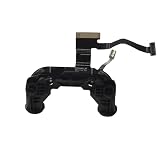
- Precision Obstacle Detection: This forward vision sensor is engineered to accurately identify and locate obstacles in the drone's flight path, contributing to enhanced flight safety and collision prevention during operation.
- Restored Avoidance Capability: Replaces the essential sensing component that enables the aircraft to perceive and react to potential hazards in its environment, helping maintain intelligent flight functions.
- Integrated Cable Design: The included 7-in-1 flat cable simplifies installation and ensures reliable connectivity between the sensor and the mainboard, reducing the need for multiple separate connections.
- Durable Sensor Construction: Manufactured from resilient materials to withstand operational vibrations and environmental factors encountered during typical unmanned aircraft flights.
- Targeted Repair Solution: Provides a specific replacement part for addressing issues with the forward-facing vision system, facilitating the restoration of critical flight safety features.
| Approach | What it involves | What the FAA material establishes |
|---|---|---|
| Visual observers | People observe the operation to support awareness of surrounding aircraft. | The FAA identifies visual observers as a possible means for BVLOS crewed-aircraft avoidance. The cited material gives no universal cost or performance comparison. |
| Detect-and-avoid system | A system intended to detect relevant traffic and support avoidance. | The FAA says such a system may be evaluated as part of a waiver or exemption application. The cited material gives no universal cost or performance comparison. |
Neither option can be declared generally superior from the FAA material cited here. The relevant questions are whether the operation is VLOS or BVLOS, what its environment and surveillance needs are, and what evidence supports its specific waiver or exemption safety case.
Independent reader supportYour contribution helps us test, update, and keep practical guides available for everyone.What FAA demonstrations and service acceptance mean
FAA-reported UTM Pilot Program Phase Two demonstrations included in-flight separation from other drones or manned aircraft in high-density airspace, volume reservations to notify operators of emergencies, Remote ID-related technologies, and secure information exchange. The FAA described these activities as proof of concept intended to inform policy, standards, and implementation in its November 17, 2020 announcement.
A demonstration shows that a capability was exercised in that program; it does not establish that every current UTM deployment includes it. Likewise, the FAA’s current UTM work includes development of an operating concept, a service-recognition framework, data exchange with air traffic services, and industry standards. Its Near-Term Approval Process evaluates the safety-mitigation value of proposed services, and the FAA explicitly says that this is not a certification process.
Best Value

- Drone Part, Obstacle Avoidance
- for L600 / L600 Pro / L600 Pro MAX Quadcopter Accessories
- Easy to install and made of sturdy material
The FAA also reports that it has begun issuing Letters of Acceptance to some providers in the Operational Evaluation for strategic deconfliction services. That is a program-specific step, not blanket certification of all UTM products or proof that every operator has access to the same capabilities. Readers should distinguish a tested demonstration, a provider’s status in a particular FAA program, and the functions actually available for a given operation.
How to evaluate a UTM safety claim
When assessing whether a system meaningfully supports collision prevention, identify the exact problem it addresses. A service that exchanges planned drone intent and flags overlapping operation volumes supports strategic deconfliction. It should not be assumed to provide crewed-aircraft detect-and-avoid, universal real-time surveillance, or FAA air traffic control separation unless the operation’s applicable arrangements establish those functions.
Quick Recap
- Ask what information is exchanged. Determine whether the service uses the user’s planned operations and obtains relevant intent from other USSs, as opposed to making a broader claim about all traffic.
- Ask what a conflict check compares. Look for both spatial operation volumes and expected times, rather than treating a route as a map line with no temporal dimension.
- Ask how conflicts are resolved. The FAA concept describes operator coordination through changes to timing, lateral or vertical boundaries, or a combination.
- Separate planned-flight coordination from aircraft avoidance. Confirm what the operation relies on for crewed-aircraft avoidance, especially for BVLOS flights, and whether that means is included in the relevant FAA waiver or exemption evaluation.
- Check the status claim precisely. A proof-of-concept demonstration, a safety-mitigation evaluation, and a Letter of Acceptance in a defined operational evaluation do not amount to blanket certification of an entire market.
Product prices and availability are accurate as of the date/time indicated and are subject to change. Any price and availability information displayed on Amazon at the time of purchase will apply.
The Tool Desk
Outbyte Driver Updater FREEScan for outdated or missing drivers - takes under a minuteDriver Scan →Outbyte PC Repair FREERepair Windows errors before they cause bigger problemsFix Now →



