A serial monitor can show what firmware reports; it cannot fix a module whose pad never made electrical contact. For IoT prototypes, micro-soldering is a practical extension of debugging: learn to make and inspect the specific connections your build requires, then verify them before applying power. Start with accessible joints and practice boards. Fine-pitch components demand more control, magnification, and experience—and some packages are better left to a specialist.
Start with the connection, not the tool
“Micro-soldering” covers different jobs that need different approaches. A wire, a castellated radio module, an exposed test pad, and a fine-pitch IC are not interchangeable targets. Identify the package, pad geometry, board guidance, and whether the joint is visible before choosing a technique.
As an Amazon Associate I earn from qualifying purchases.
- Accessible through-hole joints and wires: useful first practice because the work is visible and the parts are easier to position.
- Castellated modules: module edge pads sit against matching carrier-board pads; alignment and consistent contact along the row matter.
- Fine-pitch leaded parts: closely spaced leads make solder bridges more likely and demand careful flux use and inspection.
- Hidden-joint packages: connections beneath the component cannot be confirmed by looking at the top. These may require specialized assembly or inspection equipment.
For a concrete IoT example, Iscatek documents an nRF9151 Micro Breakout with 1 mm-pitch castellated pads. Its guide recommends practicing on a disposable board before attaching the module. The pitch is a specification for that breakout, not a general threshold for what can be hand-soldered. Iscatek Docs
Set up safely and practice first
Use a stable, uncluttered work surface with good lighting, magnification, and ventilation. Secure the board so it cannot shift while you work. Keep the hot iron in its stand when it is not touching a joint, and keep flammable materials away from the work area. Silicon Labs advises: “Work should be done in a well-ventilated area.” Its application note also warns against sparks or flames when solvents are in use. Follow the safety instructions for your solder, flux, and cleaning solvent, and do not treat ventilation as a substitute for applicable workplace safety requirements. Silicon Labs AN114
#1 Best Overall

- High-power Performance: This soldering iron kit's 110W heating element allows the soldering iron to heat up fast. You can set your desired temperature from 90°C~480°C(194°F~896F°). Precise double numerical display presents the set temperature and actual temperature at the same time for you to monitor real-time temperature changes.
- User-friendly functions: 3 preset channels save you the hassle of repeated temperature configurations. You can save your usual temperature settings and press one button to toggle between channels. Sleep mode allows the soldering station to rest in low temperature when not in use for an extended period, thus reducing wear on the soldering iron and prolonging the lifespan of the soldering station. You can set the timer from 0 to 99 minutes.
- Compact and space-saving design: This soldering iron kit integrates soldering iron, iron holder, tip cleaner, solder wire dispenser, helping hands, magnifying glass with LED lights and tip storage slots into one station, thus greatly reducing the space needed. This design can be especially useful for those who have smaller working space and require more space optimization.
- Complete set of accessories: WEP 927-IV comes with a full-fledged set of accessories to suit your varied needs. No more holding the components in your hands. Helping hands can assist you in fixating components from different directions. Magnifying glass with LED lights helps you with more micro soldering work by enlarging components and providing sufficient light. Use solder wire dispenser and tip storage slots to store your solder wire and soldering tips, making your workbench well-organized.
- Please note that WEP 927-IV model uses WEP #1400 Soldering Iron Tips, which are available in our store. This soldering iron kit is covered by our exclusive 1-year USA technical support, with 24-hour assistance from our dedicated team. Note: This product is rated for 110-127V USA specifications. Do not connect this iron to a 220V power socket.
Practice on a low-cost, disposable board before working on a valuable module or prototype. Begin with larger joints and learn how your iron, solder, and flux behave together. Use temperatures and procedures appropriate to the component, board, and solder alloy; the sources do not establish one universal temperature setting.
Build a task-matched toolkit
For typical prototype work, a temperature-controlled soldering station with a clean fine tip is a useful starting point. Small-diameter solder, electronics flux, tweezers, solder braid, and a way to hold the board steady help with small joints and cleanup. Good lighting and magnification make it easier to place the tip and inspect visible work. Choose tools for the pad geometry and thermal demands rather than assuming that the smallest tip or highest power is automatically best.
Rank #2

- Fast Heating & Adjustable Temperature - This digital soldering station heats up fast and has a wider temperature range (194℉~896) to choose from. The soldering iron can stay at the set temperature consistently with its PID temperature stabilization. This product conforms to the UL Standard (U.S.), [an Important Evaluation for Electric Appliances Safety].
- Space Saving – This compact soldering station helps save precious work space with an integrated soldering iron holder to provider greater space saving. The metallic protective mesh at the rear of the station prevents accidental contact with the soldering iron, and the mesh comes with soldering tip storage slots.
- Functions & Features – includes easy °C to °F conversion, Sleep Mode (5/10/30 mins adjustable), and Digital Temperature Calibration. All functions and temperature read-outs are displayed via a digital display, and accessed via a master control knob. The station enters sleep mode when non-use is detected for longer than the set duration to reduce unnecessary wear for the soldering tip and heating element.
- 12-IN-1 – This soldering iron kit includes the YIHUA 926 III Soldering Station, 2 Helping Hands, 6 Soldering Tips(YIHUA #1200/900M Series), Roll of Lead-free Solder Wire (35g), Solder Sucker, ESD Safe Tweezers, Solder Wire Dispenser, Cleaning Sponge.
- Choose YIHUA with Confidence – Enjoy our 12-month US- exclusive manufacturer technical coverage and 24/7 professional assistance on Amazon. Note: This model is designed to operate on 110-127V with a US-standard power plug.
| Tool or feature | Why it matters | What to check |
|---|---|---|
| Temperature-controlled station | Lets you work at a controlled setting suited to the task and solder alloy. | Stability, tip compatibility, and how quickly the tip recovers heat at the joint. |
| Fine, replaceable tips | Help reach small pads and leads without contacting neighboring features. | Tip shape, availability of replacements, and whether the geometry suits the pads. |
| Flux and small-diameter solder | Support wetting and controlled solder placement on compact joints. | Use electronics-appropriate products; reapply flux if it has been consumed during prolonged work. |
| Tweezers and board holder | Help position components and keep the board stable. | Choose tools that allow a clear view and do not obstruct the joint. |
| Lighting and magnification | Make visible bridges, alignment problems, and poor wetting easier to spot. | Working distance, stability, and a view of the joint from useful angles. |
| Solder braid | Can remove excess solder and help clear bridges. | Use it carefully; excessive heat or pressure can damage pads. |
Manufacturers publish product specifications for specialized tools, but those figures are not independent performance tests. Weller lists its WMRP as a 40 W micro-soldering iron and describes an approximate three-second heating time across 50–350 °C; HAKKO lists 0.2D and 0.4D tip options for the FX-9703/FX-9704. These examples illustrate different tool specifications, not a universal ranking or guarantee of suitability. Regional availability and replacement-tip supply can vary. Weller WMRP · HAKKO FX-9703/FX-9704
Progress from larger joints to a castellated module
1. Make an accessible joint
Secure the board or wire, clean the tip, and apply flux where appropriate. Heat the pad and the part together, then feed a small amount of solder into the heated joint rather than melting a blob onto the iron and depositing it. Remove the solder and iron smoothly, and allow the connection to cool without movement. A good-looking surface is useful evidence, but it does not replace an electrical check.
Rank #3

- 【FAST HEATING & LED TEMPERATURE DIAPLAY】 : This digital soldering station heats quickly and can adjust the temperature between 180°C and 480°C (356°F and 896°F). The temperature can also be easily switched between °C and °F. The temperature calibration function ensures accurate temperature control.
- 【AUTO HIBERNATE】 : The sleep mode allows the soldering iron station to rest at a low temperature when not used for a long time, effectively improving the service life. The timer can be set to 0 ~ 600 seconds. Equipped with an on/off switch, users can turn off the soldering iron when not in use. This safety and energy saving feature can also prevent children from accidentally touching the iron.
- 【ADVANCED TECHNOLOGY】 : The solder kit meets a variety of test requirements. Upgraded steel pipe design with four vents to speed up cooling in case of welding interruption. Ergonomically designed handles and silicone sheathing ensure long-term comfort and safety for welding projects.
- 【WIDELY APPLICATION】The compact soldering station helps save valuable work space and is suitable for beginners and welders using different shaped soldering tips to weld circuit boards, home DIY, crafts, and repair mobile phones, appliances and electronics.
- 【ESSENTIAL WELDING STATION】 Including soldering station, helping hands, solder wire dispenser, cleaning sponge, iron tip cleaner, 5pc tips, elbow tweezers, solder sucker, solder wire, screw driver, mini wrench.
2. Add strain relief to wires
Solder can provide a sound electrical connection while remaining mechanically weak. The University of Pennsylvania Embedded Systems Handbook emphasizes that “Soldering is electrically excellent but mechanically weak.” Secure wires so pulling, bending, or vibration is not carried by the solder joint alone; use an appropriate mechanical anchor or strain-relief method for the design. University of Pennsylvania Embedded Systems Handbook
3. Align and solder a castellated module
For an edge-pad module such as the nRF9151 Micro Breakout, practice first, then align its castellated pads to the carrier-board pads and keep the assembly steady. Use a clean fine tip, variable temperature, small-diameter solder, and flux as Iscatek recommends. Work methodically along the pads rather than rushing through the row. If solder bridges adjacent pads, solder braid can help remove excess; inspect the result under magnification before checking the circuit electrically.
Rank #4

- Full Soldering Kit: This soldering kit comes with a spool of solder wire, 5 extra soldering tips, tweezers, desoldering pump. The accessories included covers a wide range of soldering tasks, and you can get started with this hobby as soon as you get the WEP 926LED V3
- Compact: The WEP 926LED V3 soldering iron kit integrates the soldering iron holder directly onto the station's body. This is great for users who have limited desk space, but is still considering soldering as a hobby. Not only does our soldering station save space, the holder is also built with highly temperature-resistant material to ensure safe storage
- Advanced Temperature Control: The temperature can be adjusted from 392 to 896°F via the control knob on the soldering station, and the digital display reads-out the real-time temperature. Our built-in PID microcontroller calculates for temperature compensations rapidly, and keeps the soldering iron tip at the set temperature steady. This way, you can solder much more smoothly as compared to non-temperature stabilized soldering iron
- Useful Functions: Comes with sleep mode function for when you're not using the soldering iron for longer than 10 minutes, keeping the iron at low idling temperature to reduce wear and extend service lifespan. The soldering tips and heating element lasts longer thanks to this function. You can also toggle the temperature display unit from Fahrenheit to Celsius at will, a helpful function if you're learning from soldering tutorials in different regions
- This Soldering Iron Station Kit is covered by our exclusive 1-year USA technical support, with 24-hour assistance from our dedicated team. Note: This product is rated for 110-127V USA specifications. Do not connect this iron to a 220V power socket
Approach fine-pitch leaded parts with added caution
Fine-pitch QFP work is possible in prototype settings, but it is a step up in difficulty. Silicon Labs AN114 describes removing, cleaning up, and replacing a 48-lead TQFP/LQFP with 0.5 mm lead pitch for designers building initial prototypes without surface-mount assembly equipment. That is a documented example, not proof that every fine-pitch repair is appropriate for a hand tool or a first attempt. The note calls for ventilation and warns that prolonged exposure to solder fumes and solvents can be hazardous. Silicon Labs AN114
Quick wins for a faster PC:
Fix the driver behind crashes, sound loss and screen glitchesFind Drivers →Clear out junk files and repair common Windows errorsFree Scan →Use flux to help solder wet and spread across the intended surfaces. Flux removes oxides and helps prevent rapid re-oxidation; heat consumes it, so it may need reapplication during prolonged soldering or rework. After working a row of leads, inspect for solder bridges and poorly wetted connections. A microscope improves the view of visible leads, but it cannot reveal every hidden connection beneath a package. If the package, board value, your experience, or available equipment makes the result uncertain, pausing for professional assembly or rework is a reasonable engineering decision.
Best Value
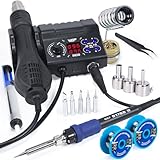
- 2-IN-1: This 2-IN-1 rework station combines a soldering station with a hot air rework station in a super compact body. Comes with individual LED displays, power switches, temperature control buttons, and air volume adjustment.
- Precision Temperature Control: This rework station comes with built-in PID program, providing temperature control for both the soldering iron and hot air gun. The soldering station temperature is 392-896°F adjustable, and hot air rework station temperature is 212-896°F adjustable with variable air volume.
- Useful Functions: This unit comes with sleep mode for soldering iron, standby mode for hot air gun, °C-°F Conversion, automatic shutdown, and calibration function. You can use these functions to reduce wear, extend soldering tips and heating element's lifespan, and achieve greater temperature precision.
- Complete Soldering Kit: This soldering kit for electronics rework includes 2 spools of solder wire, 5 soldering tips (I/B/K/3.2D/3C), brass wool tip cleaner, desoldering pump, 1 pairs of tweezers, 3 hot air nozzles. You can get started with soldering with everything in this kit.
- This soldering iron kit is covered by our exclusive 1-year USA technical support, with 24-hour assistance from our dedicated team. Note: This product is rated for 110-127V USA specifications. Do not connect this iron to a 220V power socket.
Inspect joints, then verify electrically
Visual inspection and electrical checks answer different questions. Magnification can reveal visible bridges, poor alignment, or joints that do not appear to wet the pad and lead. It cannot establish continuity inside every joint or inspect beneath a hidden-joint package. Use the board schematic or design documentation to identify the expected connections, then check continuity and verify that power is not shorted to ground before applying power.
- Look for solder connecting adjacent pads or pins.
- Check that the solder appears to have wetted both the pad and the component lead or terminal.
- Confirm expected continuity on the connections you worked on.
- Check for an unintended short between supply and ground before powering the board.
Troubleshoot common soldering symptoms
| Symptom | Plausible soldering cause | How to verify |
|---|---|---|
| Board does not power or a signal is missing | An open or poorly wetted joint, misalignment, or a damaged pad may interrupt the connection. | Inspect the joint under magnification, then check continuity against the schematic or expected connection. |
| Adjacent pins or pads appear joined | Excess solder may have formed a bridge. | Inspect the area from more than one angle under magnification; check whether the neighboring nets are unexpectedly connected before power-up. |
| Supply appears connected to ground | A solder bridge or other assembly fault may have created a short. | Measure between power and ground before applying power, and inspect the worked area. |
| Wire or component moves at the joint | The joint may be mechanically weak or the wire may lack strain relief. | Check whether the connection shifts under gentle handling; add a separate mechanical anchor where the design requires it. |
| Connection beneath a package is uncertain | The joint may be hidden from direct visual inspection. | Use the appropriate electrical checks; a top-side microscope view alone cannot establish the condition of every hidden connection. |
Know when to stop
Hand soldering is a useful prototyping skill when the connection is accessible, the package suits your tools, and you can verify the result. It is not a reason to attempt every board repair. Consider the complexity of the package, the cost and importance of the board, your practice, and the inspection or rework equipment available. For a valuable board or hidden-joint package, professional assembly or rework can be safer than relying on visual confidence alone.
Quick Recap
Product prices and availability are accurate as of the date/time indicated and are subject to change. Any price and availability information displayed on Amazon at the time of purchase will apply.




