Cells can perform a narrowly defined logic operation when molecular events are arranged so that the cell’s response depends on their order. In a 2013 report, researchers used the ordered binding of three enterotoxin components at a mammalian cell membrane as the input and cell death as the output. It was a proof of concept for a memory-like cellular logic operator—not a ready-made computer, diagnostic, or treatment.
What “biocomputer” means in this example
A biocomputer uses biological material to carry out an information-processing operation. Here, the operation was a cellular logic gate: the cell’s response depended on whether protein-binding events happened in a particular sequence. The demonstration did not replace a conventional computer or show that a cell could perform general-purpose computing.

As an Amazon Associate I earn from qualifying purchases.
The work was described in a Royal Society of Chemistry (RSC) Chemical Communications blog item on 3 December 2013. The underlying paper is by Kui Zhu, Jianzhong Shen, Richard Dietrich, Andrea Didier, Xingyu Jiang and Erwin Märtlbauer: “Ordered self-assembly of proteins for computation in mammalian cells,” Chemical Communications (2014).
Crashes, No Sound, or Screen Glitches?
Random freezes, missing sound and display glitches usually trace back to one bad driver. Find and replace yours safely.Free scan · under a minuteWindows Errors? Fix Them Before They Spread
Repair common Windows errors and clear accumulated junk for a smoother, more stable PC - no reinstall needed.Free scan · no reinstallHow the protein-binding logic operator worked
Input: a particular order of binding
The team used the ordered interactions of three enterotoxin components with a mammalian cell membrane. The key was not simply that the components were present: their sequential binding supplied the input to the logic operator. The cell’s response therefore depended on the order of molecular events.
#1 Best Overall

- Contains 88 atoms to provide students a visual, hands-on experience for learning chemistry functional groups and molecular structures
- The durable, high quality plastic atoms are color coded to universal standards
- Instructions are included on the inside cover to easily identify all of the atoms and connectors included in the set
- Molecular tool included to quickly disassemble molecules and atom connectors
- Great gift for young aspiring scientists
Output: cell death
Cell death served as the output, making the result of the specified sequence observable. The RSC account describes the sequence-dependent behavior as memory-like: like a keypad lock, the operator responds only when the inputs arrive in the right order. That analogy refers to the role of sequence in the logic, not to an electronic memory device or a computer stored inside the cell.
How this differs from other cellular computing approaches
“Cellular biocomputing” now covers several distinct strategies. They differ in what carries out the computation, how inputs and outputs are represented, and what tasks researchers hope to address. The newer approaches below provide context; they are not extensions or demonstrated applications of the 2013 toxin system.
Rank #2

- Easy to learn and handle: The molecular model kit is simple to assemble, store, and carry. Atoms connect securely yet can be easily detached using the included disconnect tool, making it perfect for repeated classroom use.
- Practical for teaching: This model helps students visualize the structural features of protein molecules covered in textbooks. It boosts learning interest and allows teachers to explain complex concepts more clearly and intuitively.
- Versatile building options: The protein molecular model can be used to build both common and slightly complex protein structures, making it suitable for teaching demonstrations and laboratory experiments.
- 3D visualization aid: With this 3D modeling kit, students can explore molecular structures and angles from every angle, gaining a deeper understanding of molecular geometry and spatial relationships.
- Bright and color-coded: The model includes colorful atoms and connectors that follow standard color conventions, making identification easier. The vibrant colors and quality construction keep students engaged and simplify learning.
| Approach | Substrate and mechanism | Typical inputs and outputs described in the sources | Research focus and evidence |
|---|---|---|---|
| 2013 membrane-protein operator | Ordered assembly of three enterotoxin components at a mammalian cell membrane | Input: sequential protein binding. Output: cell death. | A specific logic operation with sequence-dependent, memory-like behavior, as summarized by the RSC account. |
| Genetic or DNA-based circuits | Genetic or DNA circuit components carry out logic or alter cellular gene-network behavior | Chemical or molecular signals can act as inputs; circuit responses can support sensing or other conditional behavior. | A 2025 review discusses areas including cellular imaging, biosensing, diagnostics, conditional therapeutics and rewiring endogenous gene networks. Clinical translation remains challenging. |
| Cell-bioelectronics | Cell-based synthetic biology combined with electronic interfaces | Electrical stimulation or readout can interface with cells; reviewed work includes remotely triggered cells and sensing or biomolecule production. | A 2025 review examines these research directions alongside challenges in assembling and deploying such systems. |
| Organoid intelligence | Research interfaces involving organoids and information processing | Learning and memory are subjects of investigation; the reviewed work discusses biohybrid information processing. | A 2024 review presents this as an emerging direction, not as evidence of general-purpose computers made from organoids. |
The table describes different mechanisms and research aims, not a performance ranking. The cited reviews do not provide quantitative head-to-head data establishing which approach is faster, more energy-efficient, more reliable or less expensive.
What the 2013 result does—and does not—show
The RSC account supports a high-level description of the mechanism and the paper’s bibliographic details. It presents the membrane-based protein approach as comparatively simple in the context of that 2013 article, particularly in contrast with strategies that modify cellular DNA. That comparison should not be read as proof that the system is easy to engineer, scalable, safe, or suitable for use in a living organism.
Rank #3
- Bright Colors: The molecular model consists of colorful balls and connecting , which are brightly colored, well made, and very The common standard for atomic color makes it easier to use and learn.
- 3D Modeling: Molecular modeling shows the basic molecular structure through 3D modeling studies. It can display molecular structure, molecular and angles in all directions.
- Building : Protein molecular can be used to build of common and slightly complex protein molecular structures for teaching and laboratory use.
- Easy to Learn: Molecular model is easy to learn, store and carry. The atoms and are tightly held together and can be easily disassembled with a disconnect tool.
- Application Scenario: This model kit is used for the structural feature of QH3212‑2 protein molecules in textbooks, which can improve students' learning interest and teachers can explain it more intuitively.
- It shows: a cellular response can implement a specific logic operation when the operation depends on an ordered series of protein-binding events.
- It does not establish: a practical computer, a diagnostic or therapy, clinical readiness, or superiority to electronic logic.
- It does not provide: quantitative performance measures or a basis for comparing speed, energy use, reliability or cost.
The RSC item is a short news summary rather than the paper’s full methods and results. Its description should therefore be understood as a report of a proof of concept, not as a complete account of experimental performance or reproducibility.
Independent reader supportYour contribution helps us test, update, and keep practical guides available for everyone.Where the broader field is heading
Later cellular biocomputing research explores other ways to connect biological systems with information processing. A 2025 review covers cell-based synthetic biology combined with bioelectronics, including remotely triggered cells and sensing or biomolecule production, while discussing assembly and deployment challenges. A separate 2025 review of DNA-based circuits surveys research areas such as imaging, biosensing, diagnostics and conditional therapeutics, and identifies clinical translation as a challenge. These are broader research directions; none should be attributed to the 2013 toxin-based operator.
Rank #4
Organoid intelligence is another emerging direction. A 2024 review considers whether organoid-based systems could help investigate learning and memory and support biohybrid information processing. This is an exploratory research area, not evidence that organoids are general-purpose computers or outperform electronic systems.
Do these 3 things before closing this tab:
1Scan for outdated or missing drivers - takes under a minute2Clear out junk files and repair common Windows errors3Fix the driver behind crashes, sound loss and screen glitchesQuick Recap
Best Value
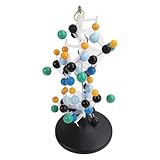
- Build common and slightly complex protein structures with this molecular model kit, perfect for teaching and lab use.
- Brightly colored balls and connectors follow standard color coding, making it easy to identify and use.
- Ideal for demonstrating protein molecular features from textbooks, boosting student interest and helping teachers explain clearly.
- 3D modeling shows basic molecular structure from all angles, helping visualize molecular and angles.
- Easy to learn, store, and carry; atoms and connectors fit tightly yet can be easily disassembled with a disconnect tool.
Product prices and availability are accurate as of the date/time indicated and are subject to change. Any price and availability information displayed on Amazon at the time of purchase will apply.




