Catalyst kinetics reveals how fast a reaction proceeds under particular conditions—and helps scientists test explanations for why. Researchers measure rates as conditions change, fit kinetic models to concentration data, and, for heterogeneous catalysts, can use transient experiments to probe surface processes that steady-state measurements alone may not resolve. The results support mechanistic explanations; they do not make one rate-limiting step universal to all catalysts.
What catalyst kinetics measures
Kinetics is the study of reaction rates and how they depend on conditions. In a catalyst study, researchers measure how a reaction proceeds and compare the data with models of possible mechanisms. A catalyst can enable a different pathway that increases the rate, but it does not change the reaction’s equilibrium position: it can help the system reach equilibrium faster, not move that equilibrium.
As an Amazon Associate I earn from qualifying purchases.
Rate measurements therefore answer a narrower question than “what does the catalyst do?” on their own. They show the reaction’s behavior under defined conditions. Connecting that behavior to a particular sequence of chemical steps requires interpreting the measurements with suitable models and, where available, additional evidence.
How concentration data becomes a kinetic model
One approach is to measure concentration as a reaction proceeds, then fit the time-dependent data to estimate rate constants. Those constants describe the fitted model under the studied conditions; fitting is not, by itself, proof that the model’s mechanism is correct.
#1 Best Overall

- ✔ 66 ACTION-PACKED SCIENCE EXPERIMENTS – Includes 26 step-by-step guided activities and 40 bonus DIY ideas using household items. Explore fizzy explosions, color changes, bubbling potions, and more.
- ✔ REAL SCIENCE, SERIOUS FUN – Learn chemistry concepts like acid-base reactions, states of matter, pH indicators, and gas expansion—all through hands-on, kid-friendly experiments.
- ✔ VOLCANOES, GLOW LAVA & SLIME – Make your own volcano with plaster and paint, create glowing potions and blue lava, blow up gas balloons, and mix gooey self-siphoning slime.
- ✔ INCLUDES TOOLS & INGREDIENTS – Comes with test tubes, food coloring, volcano mold, citric acid, slime mix, popping crystals and more to start a home science lab performing exciting experiments.
- ✔ STEM LEARNING FOR AGES 8+ – Perfect for future scientists and curious kids. Encourages critical thinking, creativity, and scientific exploration with clear instructions and adult supervision.
A 2026 Journal of Chemical Education activity uses experimental concentration data to teach kinetic-parameter estimation. It compares bisection and Newton–Raphson root-finding with Levenberg–Marquardt nonlinear regression, emphasizing that the estimated parameters need to be interpreted alongside each method’s convergence and limitations.
Why researchers use transient experiments
Steady-state rate tests measure reaction behavior after conditions have stabilized. For heterogeneous catalysts—where reactions occur at or near a solid surface—transient methods deliberately examine time-dependent responses. Those responses can provide information about intermediates, surface processes and kinetic parameters that steady-state rates may not reveal as clearly.
Rank #2

- A SCIENCE KIT THAT INSPIRES - Your kids will have hours of fun as they explore the fizzy and bubbly reactions they create, just like a real scientist in a lab!
- A TOTAL OF 45 EXPERIMENTS - Build and erupt a volcano, create a geyser, launch a rocket, and cause some awesome chemical reactions! Each experiment is easy to conduct and a whole lot of fun!
- EASY-TO-FOLLOW INSTRUCTIONS - The experiment guide in this kit has kid-friendly instructions with illustrations for each step, and fascinating insight into the chemical reactions.
- HANDS-ON STEM - Kids will learn the scientific process, important fundamentals of chemistry, and how to safely conduct experiments. This science kit serves as an important stepping-stone in STEM success!
- AMAZON EXCLUSIVE - Blue Marble has developed this product exclusively for Amazon.
Temporal analysis of products
Temporal analysis of products (TAP) is one transient approach covered in a 2024 ChemCatChem review. The review surveys TAP and SSITKA work published from 2017 through 2023 and discusses how these methods contribute to mechanism and microkinetic analysis across heterogeneous-catalysis research.
Quick wins for a faster PC:
Fix the driver behind crashes, sound loss and screen glitchesFind Drivers →Repair Windows errors before they cause bigger problemsFix Now →Steady-state isotopic transient kinetic analysis
Steady-state isotopic transient kinetic analysis (SSITKA) uses an isotopic change during a steady-state reaction to examine the system’s transient response. One repository-described example combines spatially resolved SSITKA with DRIFTS for reverse water-gas shift over 3 wt% Pt/CeO2. Further modeling in that example identifies water production as rate-limiting in the proposed mechanism; this is a result for that catalyst and reaction, not a general rule.
Rank #3

- OVER 100 EXCITING EXPERIMENTS - The science experiments in this kit let kids explore the wonders of hands-on science experiments. They'll make bubbling, color-changing solutions, glowing test tubes, a colorful bouncy ball, glowing worms, and more!
- EVERYTHING KIDS NEED - This kit includes all materials needed to conduct 15 stunning chemistry experiments, including growing a crystal tree, changing the color of liquid with their breath, and more.
- 85 BONUS EXPERIMENTS - Because we know your kids will want to conduct even more science experiments once they get going, we include a bonus experiment guide with 85 additional experiments that can all be done with common household items.
- HANDS-ON STEM - Our science toys are known for being hands-on, and this kids activity kit is no different. Your kids will use real scientific tools, like test tubes, beakers and pipettes, as they explore the fascinating world of chemistry.
- AWARD-WINNING PRODUCTS - Blue Marble, winner of the Toy Association's prestigious Toy of the Year Award, proudly develops products that foster education, imagination, and creativity, with a U.S. support team to ensure a stellar experience!
How to interpret a rate-limiting-step claim
A rate-limiting-step assignment belongs to a specified reaction, catalyst and set of conditions. It is a conclusion drawn from a proposed mechanism and the evidence used to support it—not a label that can automatically be carried over to other catalysts or reaction systems. Observed reaction orders, isotope effects, spectroscopy and modeling can contribute evidence, but a single rate observation should not be treated as proof of an elementary mechanism without adequate support.
The distinction matters even within water-gas-shift research. In the Pt/CeO2 reverse water-gas-shift example, modeling assigns water production as rate-limiting. A separate Purdue dissertation by Yanran Cui reports a kinetic isotope effect of about 2.0±0.3 for the two water-gas-shift catalysts it studied. It also reports a calculated decrease of about 0.7 eV in the water-dissociation energy barrier at the Au/MgO interface compared with pure MgO and pure Au. These figures describe that dissertation’s catalysts and calculations; its year is not established by the available repository result, and neither finding makes a universal claim about water-gas-shift catalysis.
Quick Recap
Best Value

- Play the role of chemist with this huge, colorful, functional lab station!
- Create glowing slime, fizzing reactions, Oozing Bubbles, colorful chromatography, and more!
- With 57 pieces, This kit has everything you need to conduct experiments like a real scientist, including beakers, test tubes, flasks, pipettes, and more.
- Printed experiment cards clip onto the lab station for easy reference and additional experiments and scientific explanations are included in a separate 16-page, full-color manual.
- Includes non-hazardous chemicals; does not contain borax.
Rank #4
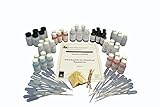
- This kit will introduce two common types of chemical reactions; single replacement and double replacement.
- Students will perform a series of experiments highlighting the differences in these reactions and use what they learn to write balanced chemical reaction equations.
- Kit contains enough materials for 15 groups.
- Teacher’s manual and Student Study Guide copymasters are included.
What the methods can—and cannot—establish
- Steady-state rate measurements characterize reaction rates under stable conditions and help establish how observed behavior changes with conditions.
- Transient methods such as TAP and SSITKA add time-resolved responses that can help investigate intermediates, surface processes and kinetic parameters.
- Data fitting and numerical solving estimate parameters within a chosen model; convergence and model limitations matter when interpreting those estimates.
- Mechanistic attribution draws on multiple kinds of evidence and remains specific to the studied system. A fitted rate constant or measured rate alone does not settle the mechanism.
Product prices and availability are accurate as of the date/time indicated and are subject to change. Any price and availability information displayed on Amazon at the time of purchase will apply.




