Within pairs a browser-based journal with reflection prompts and mood-based writing ideas, while routing AI requests to Ollama running on the same computer. Creator Sara Aniceto says journal entries stay in browser storage and the AI request goes to local Ollama rather than a cloud AI service. That describes the intended architecture; it is not an independent audit of every network request or device process.
What Within does
Within is a small progressive web app made for Aniceto’s friend group. It provides a distraction-light writing page, a history of saved entries, reflection questions based on an entry, and short prompts for anxious, grateful, reflective, or bored moods. The creator says writing and saving still work when AI is unavailable.




As an Amazon Associate I earn from qualifying purchases.
Two small interaction choices shape the writing flow: after a successful save, the text field clears; choosing “Write about this” replaces its current contents with the selected prompt. The app is a writing aid, not a mental-health service. Aniceto puts it plainly: “This is a writing aid, not therapy or professional support.”
Do these 3 things before closing this tab:
1Clear out junk files and repair common Windows errors2Scan for outdated or missing drivers - takes under a minute3Repair Windows errors before they cause bigger problemsWhere the AI runs—and what “private” means here
In the described current setup, the browser sends generation requests to Ollama at http://localhost:11434/api/generate. The app can discover installed models through /api/tags, remember a selected model, filter recognized cloud-model entries, and report connection errors. The static interface is hosted on Render; Aniceto says the journal text is not sent to Render through the AI request.
#1 Best Overall
According to the creator, entries remain in browser storage and the model request goes to local Ollama rather than a cloud AI service. The app does not upload entries for model training or train a model on them, she says. These are claims about the described design, not an independent verification of all browser traffic, extensions, operating-system activity, or hosting behavior.
Journal history is stored in localStorage and belongs to that browser and site origin. It is not a backup, and the project description does not establish synchronization, recovery, encryption, or protection from someone who can access the browser.
Rank #2
How the architecture changed
The project began with MediaPipe and WebGPU for inference in the browser. Aniceto says that approach involved large model downloads and reliance on browser GPU support, so the project moved to Ollama running on the same computer. The current version is described as plain HTML, CSS, and JavaScript without a framework or build step; a service worker caches the application shell.
| Architecture | Where inference runs | Model setup | Main dependency | Phone access to the same inference |
|---|---|---|---|---|
| Earlier MediaPipe/WebGPU approach | In the browser | Large model downloads through the browser, according to the creator | Browser GPU support | The current source does not establish that a phone could use the computer’s inference through this approach. |
| Described current Ollama approach | Ollama on the same computer as the browser | Install Ollama and download a model on that computer | Ollama running locally and resources on that computer | No: a phone’s localhost points to the phone itself, not the laptop. |
This is an architectural comparison, not a performance comparison: the creator’s account provides no benchmark, hardware compatibility list, memory requirement, or model-quality evaluation.
Set up the described local Gemma configuration
Aniceto’s setup instructions use gemma3:1b as the Ollama model identifier. Treat these as the creator’s steps rather than universal current Ollama guidance; setup labels and requirements can change.
- Install Ollama on the computer that will run the journal’s AI.
- Download the model with
ollama pull gemma3:1b. - Allow
https://within-offline-journal.onrender.comin Ollama’sOLLAMA_ORIGINSconfiguration. - Restart Ollama so it uses the updated origin setting.
- If the browser requests local network access, allow it for the app.
- Reconnect to the app and select one of the installed models.
The creator also gives this macOS/Linux command for running Ollama with cloud features disabled, after stopping any existing Ollama server:
Rank #4
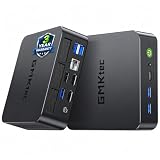
- AI MINI PC WORKSTATION - Powered by the Intel Core Ultra 5 226V (3.50GHz base, 4.50GHz boost) with a dedicated 97 total TOPS (47 NPU + 64 GPU), this mini PC outperforms the Core i5 14450HX, Ryzen 7 6800H in real-world AI tasks; the K17 AI local workstation enables real-time generative AI tasks without the cloud on Gemma-4-E4B & E2B—supporting text generation, code completion, summarization, intelligent chat, and data analysis directly on your edge device for enhanced privacy, zero latency, and offline capability.
- GAMING PC WITH INTEL ARC 130V GPU - Experience a quantum leap in integrated graphics with the Intel Arc 130V GPU (boosting up to 1.85GHz), which leaves the competition in the dust by delivering comparable or superior gaming and content creation performance while consuming up to 50% less power than leading rivals like the Radeon 890M—this groundbreaking efficiency means you get desktop-class discrete performance (rivaling the GTX 1650) in a silent, cool-running mini PC, with cutting-edge features like hardware ray tracing, XeSS AI upscaling, and full AV1 encoding support that competitors' integrated solutions simply can't match
- UPDATE DRIVERS - Intel Graphics Driver 32.0.101.8509 (WHQL Certified – Released 02/13/26) for Intel Arc 130V GPU delivers XeSS 3 Multi-Frame Generation (MFG) supporting up to 4× AI-based frame output; enhances gaming performance by 10% average FPS uplift and up to 25% improvement in 1% low (99th percentile) FPS for reduced stuttering across 9-game suite including Black Myth: Wukong (+13.8%), Fortnite S34 (+17.9%), DOTA 2 (+16.0%), PayDay 3 (+12.6%), *Counter-Strike 2* (+8.0%), and Cyberpunk 2077 (+6.1%); XeSS 3 MFG officially extended to Lunar Lake platform GPUs (Arc 130V and 140V) alongside Arc B/A Series discrete GPUs.
- WHY LPDDR5X IS BETTER THAN DDR5 - Equipped with 16GB of premium SK Hynix LPDDR5x memory running at an incredible 8533 MT/s, this mini PC delivers nearly 2x the bandwidth of standard SO-DIMM DDR5 (4800–5600 MT/s). The soldered, ultra-low-latency design reduces power draw and unlocks smoother multitasking, faster app loading, and significantly better iGPU gaming performance—especially on Intel Core Ultra integrated graphics—so you can game at higher settings and zip through creative workloads without stutter or slowdown.
- TRANSFORM YOUR WORKSPACE WITH TRIPLE 4K DISPLAY SUPPORT: Unleash unparalleled productivity by connecting three crystal-clear 4K monitors at 60Hz via DUAL HDMI 2.1 TMDS and USB4 port—effortlessly run stock tickers on one screen, complex spreadsheets on another, and video conferencing on the third, or dominate trading and financial modeling with real-time data sprawled across your entire field of view without any lag or stuttering.
OLLAMA_NO_CLOUD=1 ollama serveThe article does not establish that this command is the current recommended method for every Ollama installation. Check Ollama’s current documentation and the app’s setup instructions before relying on it.
What’s actually slowing this PC down?
Pick the symptom - the matching free tool is one click away.
What works offline, and what does not
The site needs an initial connection to load and cache its application shell, and the model must first be downloaded. After that, Aniceto says the design supports offline writing and saved-entry access while Ollama remains running locally. Inference still depends on the computer’s resources; the creator’s account does not specify hardware requirements.
Opening the PWA on a phone can still provide writing and history, but it does not connect that phone to Ollama on a laptop. As Aniceto explains: “The site also opens on mobile for writing and history. The current AI integration is for the same computer: localhost on a phone refers to that phone, not a laptop.”
Fix common connection and update problems
“Cannot reach Ollama at localhost:11434”
The app’s displayed message asks users to start Ollama on the same computer, allow the site in OLLAMA_ORIGINS, and allow local network access in the browser. Aniceto reports that a 403 error occurred when Ollama had not been restarted after the allowed origin was configured; restarting it with the explicit origin resolved that case.
An old interface still appears after an update
The creator reports that a deployed update once continued to show an obsolete “Downloading model” message. The described remedy was versioning asset URLs and creating a new service-worker cache so the updated files would be loaded.
Quick wins for a faster PC:
Clear out junk files and repair common Windows errorsFree Scan →Scan for outdated or missing drivers - takes under a minuteDriver Scan →Repair Windows errors before they cause bigger problemsFix Now →What the creator reports testing
Aniceto reports four automated tests: local model discovery and selection, non-streaming requests, failure handling, and service-worker cache cleanup. She also reports manually verifying the local connection. These reports describe project testing; they do not amount to an independent security or privacy audit.
Licensing
The creator says the application code is MIT-licensed and that Gemma models have separate usage terms. The project article does not spell out those model terms, so check the applicable license texts before reusing code or choosing a model.
Quick Recap
Product prices and availability are accurate as of the date/time indicated and are subject to change. Any price and availability information displayed on Amazon at the time of purchase will apply.




