Crashes, No Sound, or Screen Glitches?
Random freezes, missing sound and display glitches usually trace back to one bad driver. Find and replace yours safely.Free scan · under a minuteWindows Errors? Fix Them Before They Spread
Repair common Windows errors and clear accumulated junk for a smoother, more stable PC - no reinstall needed.Free scan · no reinstallDongoconodon platycauda, a small mammal that lived in what is now China about 120 million years ago, preserved an unusual mix of traits: evidence of multiple tooth generations at some positions, a partly jaw-connected middle-ear structure, and anatomy interpreted as semiaquatic adaptations. The fossil does not show that this animal was a human ancestor. It shows that tooth replacement, jaw-ear separation and ecology did not necessarily change together in one simple sequence.
What is Dongoconodon?
The newly named species Dongoconodon platycauda was a eutriconodontan mammal from the Jiufotang Formation at Changzigou, Liaoning, China. The study assigns the fossil locality an age of approximately 120 million years. Its holotype, specimen IMMNH-PV01700, is housed at the Inner Mongolia Museum of Natural History.

As an Amazon Associate I earn from qualifying purchases.
The fossil is a nearly complete skeleton, unusually informative for a Mesozoic mammal. The authors estimate its mass at 115–190 grams, roughly comparable to a water vole. That estimate and its anatomy help place the discovery in context, but the evolutionary significance lies in the combination of traits rather than size alone.
How did this ancient mammal replace its teeth?
The authors report that Dongoconodon appears to have had multiple generations of teeth at some loci across all four tooth types. In other words, the fossil preserves evidence consistent with replacement occurring more than once at certain positions. This qualified interpretation is the basis for describing its pattern as polyphyodonty.
#1 Best Overall

- Realistic Fossil Replica: Museum-quality cast of an Early Eocene bat skeleton from the Lower Green River Formation, Lincoln County, Wyoming
- Historic Specimen: Represents one of the earliest known mammals, offering a glimpse into life approximately 50 million years ago
- Great Gift for Fossil Lovers: Appropriate for fossil collectors, educators, and anyone fascinated by prehistoric life and natural history
That does not mean every tooth was continuously replaced throughout the animal’s life. The paper describes teeth at different eruption stages and replacement teeth at different stages of formation; it does not provide a complete, lifelong growth sequence. Fossil tooth categories can also be difficult to establish because specimens rarely preserve a growth series, so researchers infer identity from position and shape.
The study calls Dongoconodon the only mammal known to its authors with apparent multiple generations at some loci in all four tooth types. This describes the published evidence available to the authors, not a guarantee that future fossils will not reveal other examples. They also stress that dental replacement in Mesozoic mammals remains incompletely understood.
What makes the teeth “reptile-like”?
“Reptile-like” refers to the reported pattern of multiple tooth generations at some positions, broadly reminiscent of polyphyodonty in reptiles. It is not a classification: the study identifies Dongoconodon as a mammal, not a reptile. Nor does the phrase mean its whole dentition was identical to that of living reptiles.
Free tools Windows power users keep installed
One-click scans. No signup required.
The point is that tooth replacement patterns could vary among early mammals. The fossil adds evidence against treating the familiar mammalian pattern as a single, uniform condition across every lineage and tooth position.
Rank #3
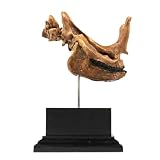
- Size: 2.7" L(70mm) x 2.6" W(65mm) x 4.3" H(110mm)
- Package Include: 1 x Model, 1 x Base
- Material: Made of Resin, Safe and Eco-friendly
- Feature: Animal collection, Decoration Scientific Art Model
- Note: Please refer to the measurement. The tiny measuring error is allowable in the normal range. There might be a little color difference due to the monitor, camera or other factors, please refer to the physical item.
What does its middle ear reveal?
The skeleton preserves an ossified Meckel’s cartilage with slight contact with the mandible, alongside differentiated auditory ossicles. Meckel’s cartilage is relevant because of its developmental and evolutionary relationship to the jaw and the middle-ear bones. In this specimen, slight contact indicates that the jaw-ear relationship cannot be reduced to a simple all-or-nothing story.
By comparing this anatomy with other fossil mammals, the authors argue that changes in jaw-ear attachment could have occurred along more than one pathway or on different timelines. The finding supports a less linear account of middle-ear evolution; it does not establish one universal sequence or show that Dongoconodon had a modern human ear.
Rank #4

- 7 inches long
- Made from resin/fiberglass
- Museum quality replica
- Hand painted to look realistic
Was Dongoconodon a swimmer?
The authors interpret its broad, elongated hands and feet, limb features and tail anatomy as evidence of semiaquatic adaptations. This is a comparative anatomical inference, not direct evidence of observed swimming behavior.
The study’s classification analysis compared locomotor categories across 124 living species. The authors report 61.3% overall classification accuracy, with 77.8% success for semiaquatic cases and 33.3% for semifossorial cases. Within that analysis, Dongoconodon had a 100% posterior probability of falling within semiaquatic morphospace. These figures describe the model’s classification results, not certainty about how an individual animal behaved.
Best Value

- Replica Chirostenotes dinosaur claw – approx. 4.5 inches (11.43cm)
- Species: Chirostenotes pergracilis, Late Cretaceous (~76.5 million years ago), Alberta, Canada
- Realistic texture and anatomical accuracy – great for collectors, educators, and fossil enthusiasts
- Useful in paleontology education, museum displays, or as a unique prehistoric gift
- Display-ready fossil replica (stand not included)
How does this change the picture of mammalian evolution?
The study’s central implication is that dental replacement, jaw-ear anatomy and ecological adaptations need not have evolved as a tightly linked package. Traits often presented as steps in one transition may have varied independently among mammalian lineages. Dongoconodon therefore complicates a simple textbook sequence without overturning the broader account of mammalian evolution.
For its evolutionary analysis, the paper used a matrix of 105 taxa and 594 characters. The authors also note that the placement of eutriconodontans has varied across previous analyses. The fossil is evidence for diversity in early mammalian anatomy, not a direct ancestor of humans or proof that its specific combination of traits was widespread.
What the fossil can—and cannot—establish
- It supports: apparent multiple tooth generations at some loci in four tooth types, a slight mandibular contact involving ossified Meckel’s cartilage, differentiated auditory ossicles, and anatomical features consistent with a semiaquatic lifestyle.
- It does not establish: continuous replacement of every tooth, direct observation of swimming, a single route for mammalian jaw-ear evolution, or a direct ancestry relationship to humans.
- Its limits matter: the key evidence comes from one specimen, and the authors say tooth replacement in Mesozoic mammals remains incompletely understood.
The primary study, “A polyphyodont, semiaquatic eutriconodontan mammal from the Early Cretaceous of China,” was published in Nature Communications on September 28, 2026: read the study.
Quick Recap
Product prices and availability are accurate as of the date/time indicated and are subject to change. Any price and availability information displayed on Amazon at the time of purchase will apply.




